Quick Take
- Read by: Bradford Hastings brings the same committed, unhurried delivery to the Lost Town finale that has carried the series across six volumes, holding the emotional weight of a conclusion that is expected but still has to earn its resolution.
- At its heart: Belonging in an impossible place, community as survival strategy, the cost of permanent displacement
- Vibe: Bittersweet and quietly epic, the energy of a story that knows it is ending
- Short version: Nathan Hystad closes the Lost Town series with the discipline and character consistency that has defined the run, delivering a finale that satisfies precisely because it does not overreach.
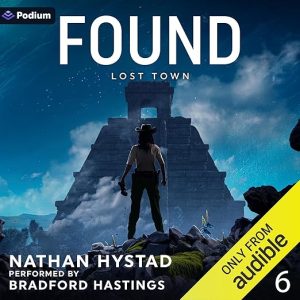
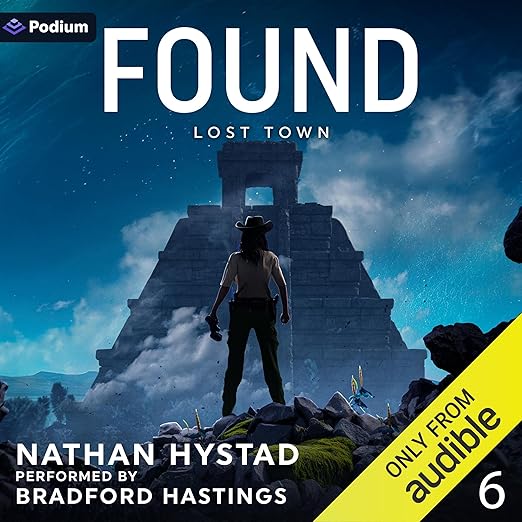
Nathan Hystad's Found, narrated by Bradford Hastings, is the sixth and final volume in the Lost Town series, a position that shapes everything about how the audiobook should be approached and what it can reasonably deliver. The settlers of Lost Town are stranded on Arcadia with the Shift between their world and Earth now permanently closed, and the series has spent five volumes building the specific texture of lives being rebuilt under conditions of irrevocable displacement. This concluding installment arrives knowing that the reader has been here for the whole journey, and Hystad writes accordingly. This is not an audiobook designed to welcome newcomers.
The setup of Found is characteristically grounded for this series. Amelia travels with Milton's journal to discover an ancient civilization. John faces tragedy at the heart of Lost Town itself. The community attempts to restart from scratch under new pressures. These are not the escalating plot mechanics of a series that has run out of genuine story and is filling runtime; they are extensions of the thematic work the series has been doing since the first volume about what it costs to make a permanent home out of a forced one. Reviewer Jules G. noted that each book in this series functions as its own story with the same basic characters finding new challenges, and that observation is accurate for Found as well, with the added weight of knowing this is the last one.
Bradford Hastings has narrated the Lost Town series throughout, and the final volume benefits from that accumulated familiarity in ways that a fresh narrator could not replicate. The characters in Lost Town have developed specific vocal identities across 50-plus hours of previous listening, and Hastings arrives at Found with those identities already established. Amelia's particular quality of anxious curiosity, the way her discoveries in the ancient civilization carry both intellectual excitement and the specific grief of someone who knows there is nothing to go home to and report, lands with emotional depth that a first-time narrator would have to rebuild from scratch.
Reviewer William Cleveland, noting at 75 years of age that it takes a really good story to hold his attention and thanking Hystad for the ride, captures something essential about how this series works as audio. The characterization is patient, the personality build cumulative, and the pace reflects a writer who trusts that the reader is invested enough to follow the community through ordinary difficulty rather than requiring constant escalation. Found continues that approach for the finale: the tragedy that strikes John is not a genre twist but a natural consequence of the world Hystad has built, and Hastings delivers it with the restraint that the series has consistently earned.
The Strengths
The case for the audio format across the Lost Town series is straightforward: Hastings's narration has created a community on Arcadia that exists as much in the listener's ear as on the page, and the finale's emotional payoff depends on that accumulated sonic familiarity. Lost Town works as a series because Hystad has built characters whose ordinary days matter, and audio is the format that makes ordinary days most vivid. The 9-hour-and-16-minute runtime of Found is comfortable within the series' established rhythms, shorter than some middle volumes, which reflects a deliberate decision to close cleanly rather than extend.
The ancient civilization Amelia discovers with Milton's journal provides the volume with its sense of wonder and expands the world of Arcadia beyond the community dynamics that have defined the series' interior focus. Reviewer Jules G. specifically praised the impeccable timing of events, and that timing is visible in how Hystad spaces the discoveries against the tragedy and the community rebuilding, keeping the balance between outward exploration and inward consolidation that has been the series' structural signature.
Before You Commit to Found
This audiobook is not the right entry point into the Lost Town series, and Hystad does not attempt to make it one. The emotional stakes of John's tragedy depend entirely on what the previous five volumes have built, and the significance of the Shift being permanently closed reads very differently for listeners who have followed Amelia from Lost Town's first days on Arcadia versus listeners encountering her for the first time. Reviewer Doug's mild caveat about some far-fetched science fiction elements, particularly the alien and animal encounters reading as uniformly dangerous, is a series-level observation rather than a specific critique of Found, and it has not prevented the series from maintaining its 4.6 average rating across 390 reviews.
The ancient civilization Amelia uncovers through Milton's journal also serves a function beyond plot novelty. It places Lost Town's community within a larger arc of habitation and abandonment on Arcadia, suggesting that the settlers are not the first beings to have to make this planet home against their original intentions. That historical depth gives the series finale a resonance that a purely character-focused conclusion would not have achieved, and Hastings delivers the discovery sequences with the controlled sense of wonder they require.
The finale structure is emotionally honest rather than dramatically maximalist. Hystad does not resolve Lost Town's displacement with a rescue or a discovery that changes everything. The title is not ironic, but it refers to something quieter than a conventional genre payoff: the community finding what it means to truly belong to a place they did not choose. Listeners who want their series finales to deliver spectacle will find this one understated. Listeners who have invested in the community's ordinary life will find the resolution exactly proportionate to the story that preceded it.
Recommended For
This audiobook is for listeners who have completed at least the first five Lost Town volumes and want the series closed well. Within that audience, Hystad delivers a finale that is consistent, emotionally honest, and textured enough to justify the series' length. For listeners who have not started the Lost Town series and are considering it, Found represents the conclusion of a run worth beginning from the first volume rather than an entry point. The series as a whole rewards commitment; the finale earns its title.
Common Questions
Can Found be listened to as a standalone audiobook without the prior Lost Town series?
No, not in any meaningful way. The emotional stakes, character relationships, and significance of the Shift being permanently closed all depend entirely on the previous five volumes. Hystad does not provide backstory scaffolding because he is writing for readers who have already made the journey. Start with the first Lost Town volume if you are new to the series.
Does Bradford Hastings narrate the entire Lost Town series, and does that continuity matter?
Yes to both. Hastings has narrated throughout the series and arrives at Found with the character voices and community rhythms already established across 50-plus hours of prior listening. The finale's emotional payoff depends significantly on this vocal familiarity. A first-time narrator on this final volume would have had to rebuild the character identities that Hastings has been developing across the entire run.
How does the audiobook handle the balance between action and character in the series finale?
Hystad maintains the series' consistent balance, with Amelia's discovery of an ancient civilization providing the outward exploration and John's tragedy providing the inward emotional weight. The finale is not maximalist in its action; it resolves the displacement arc that has run through the series through character consequence rather than plot spectacle, which is appropriate to the series' established tone and which Hastings delivers with the restraint the material requires.