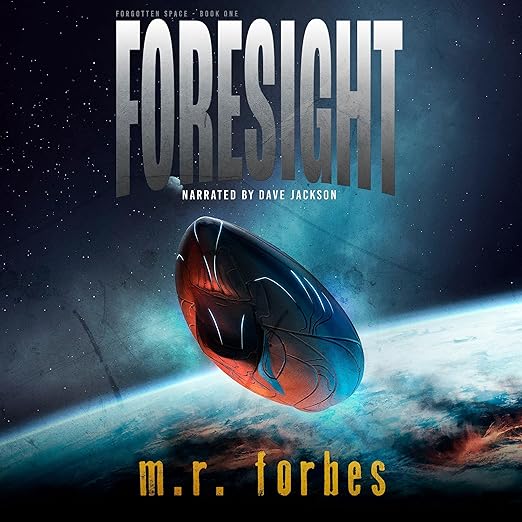
Captain Nicholas Shepherd gets almost nothing right in this audiobook, and that is precisely why Foresight works. M.R. Forbes opens his Forgotten Space series, narrated by Dave Jackson, with a scenario that strips away every assumption: Earth has already lost. The war with the alien invaders began in 2050, ended two years later, and the conclusion was not ambiguous. Humanity was defeated. What remains is not a story about winning but a story about what it costs to survive, and what it means when survival requires leaving everything familiar behind.
The setup moves fast. The experimental starship Foresight exists as a development platform, a vessel designed to generate advanced technology that might give humanity something resembling leverage against the alien occupation. For Shepherd, the program is more personal than strategic: complete the mission, and he can move his wife and son off-world, away from the war and whatever comes after it. The plan falls apart during what should have been a routine final test flight. What begins as a mechanical malfunction spirals into something far larger, and by the time Shepherd understands what the ship actually is, the scope of the story has expanded well beyond what the first act suggested.
The Verdict, Briefly
Forbes writes military SF with a clean economy of movement. The action sequences are visceral but not gratuitous; the character work is efficient without being thin. Shepherd is a protagonist who earns sympathy through competence and loss in roughly equal measure. His attachment to his family is established early and maintained consistently, giving the escalating stakes a personal anchor that prevents the larger alien-war backdrop from becoming purely abstract. One reviewer described the book as sitting at the edge of the seat from the first act, and that captures the texture accurately: the pacing doesn't relent, but it also doesn't feel like a sequence of set pieces disconnected from emotional stakes.
The central discovery at the book's midpoint, that Foresight is much more than a prototype, is handled with the restraint that distinguishes good SF world-building from the expository kind. Forbes does not stop the action to deliver a technical briefing. He lets Shepherd discover the ship's true nature in real time, under pressure, and allows the implications to unfold across the remaining chapters rather than resolving into a clean revelation. This is a series opener, and it earns that function: by the final chapter, you have a full picture of what Shepherd survived and only the beginning of an understanding of what he's headed toward.
Why Foresight Works as an Audiobook
Dave Jackson's narration is well-matched to the material. He handles the military register of the early chapters with authority and shifts register smoothly as the story expands beyond its initial parameters. The alien-contact scenes, which require a narrator to render the genuinely strange without tipping into parody, are navigated with the right degree of controlled unease. Jackson keeps the ensemble of survivors Shepherd accumulates during the frantic evacuation sequence differentiated enough to follow in audio, which is a significant technical challenge in a cast-heavy action narrative.
What separates Foresight from the crowded field of military SF series openers is the genuine sense that the universe Forbes has built is larger and stranger than the first book shows. The phrase that ends the synopsis, that humanity won't just be lost but completely erased, signals an existential scale that the story delivers on in terms of emotional weight if not full narrative resolution. Series readers will find a first volume that builds genuine forward momentum without the frustrating cliffhanger mechanics that plague lesser entries in the form. The story reaches a satisfying resting point while clearly establishing that the larger journey has only begun.
Points to Consider
Pay attention to how Forbes handles the supporting survivors Shepherd acquires during the evacuation sequence. They arrive quickly and under chaotic circumstances, but Forbes has the discipline to give each one a distinct function and a legible personality. In a story where the world-building stakes are enormous and the action is constant, the human-scale relationships are what sustain the emotional investment. The reviewer who noted that the characters are interesting alongside the high-tech action and alien encounters was pointing at this balance, which Forbes maintains more consistently than many writers operating at this pace.
The book also rewards attention to its structural logic. Forbes front-loads the personal stakes, establishing Shepherd's family and his investment in the mission's completion before the catastrophic malfunction, so that when the story expands into territory far beyond the original mission parameters, the reader's emotional compass is already set. The larger alien war becomes meaningful partly through what Shepherd stands to lose, and Forbes never lets the plot outrun the personal stakes that make the larger conflict matter.
Who Should Listen to Foresight
Fans of military SF with a strong thriller backbone and genuine world-building ambition will find this a reliable and satisfying series opener. Listeners who enjoy the work of authors like John Scalzi or Michael Mammay at their most kinetic will recognize the register. The book is fully accessible as a standalone entry point; no prior knowledge of M.R. Forbes's other work is required, though his reputation for productive series output means the Forgotten Space arc that begins here has meaningful continuation.
Listeners who are drawn to SF that takes the personal stakes of its protagonist as seriously as its galactic stakes will find that Foresight earns this balance. Shepherd's investment in getting his family off-world gives every escalation a human weight that prevents the larger alien-war premise from feeling abstract. Those who prefer SF that prioritizes contemplation over action may find the pacing relentless, but readers looking for a first volume that keeps its promises across the full arc of the story will find Dave Jackson's narration and Forbes's plotting a dependable combination throughout the eight-plus hour runtime.
Does this audiobook work as a standalone listen, or does it end on a cliffhanger?
The audiobook reaches a genuine narrative resting point by the end. The larger Forgotten Space series clearly extends beyond this volume, but Foresight does not end on a frustrating cliffhanger. The immediate mission has a resolution, though the larger journey is clearly just beginning.
How does Dave Jackson handle the ensemble of survivors that forms around Captain Shepherd?
Jackson differentiates the supporting characters effectively through vocal choices that remain consistent across the action-heavy sequences. In a fast-moving audiobook with a growing cast, this is a meaningful technical achievement and keeps the story followable through the chaotic evacuation scenes.
Is the alien-contact element of the audiobook developed in detail, or is it primarily background to the human story?
The alien occupation is the foundational premise rather than the focus of the plot. Forbes reveals the nature and stakes of the alien threat gradually, keeping the emphasis on Shepherd's personal mission and the discovery of what the Foresight ship actually is. Listeners wanting deep alien-culture world-building should expect that to develop further in subsequent volumes.