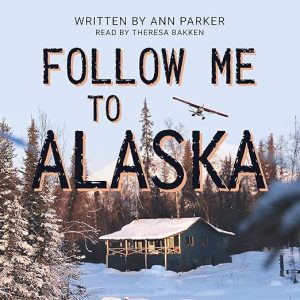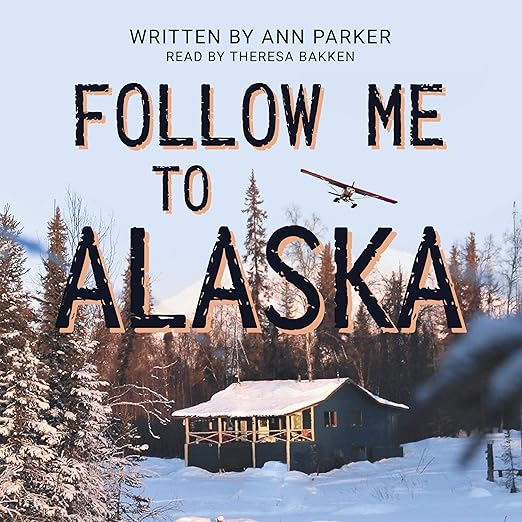
Seven hours at the end of an airstrip is what this record is actually selling, whatever the numbers above the title claim. Ann Parker's account of leaving Texas for a cabin on Cub Lake arrived as an audiobook at the end of November 2020, and the listing built around it has been unreliable ever since. A 4.3 badge sits over a counter that says two ratings. At that population the only displays available are 4.0 and 4.5, so 4.3 is describing a crowd that the counter is not counting. Five written responses sit underneath, spread across more than five years, which means the number and the written texts are not even measuring the same book's reception.
Cub Lake is reachable by bush plane in summer and by snow machine in winter, and by nothing else, which is the fact the entire book runs on. A retired law enforcement officer turned pilot and a former math teacher sold the life they had in Texas and built another one at the end of an airstrip. Hunting, fishing, gardening and flying stop being pastimes there and become infrastructure. Parker is direct about the learning curve being steep and blunter still about the obstacles neither of them had anticipated, and the strongest passages are the ones where competence earned in one life transfers badly into the next, from crazy chickens through bears to a moment the copy describes as looking death squarely in the eyes.
Chronology is the first sign that this page has been assembled loosely. The earliest written response carries five stars and a May 2020 date, six months before the audio edition existed, which makes it testimony about Parker's pages rather than about the recording. Its author signs the handle with a book credit of their own, so the platform is displaying one writer's byline as another writer's reviewer name. It also traces why a law enforcement career and a teaching career set up the move, and it deserves to be read as what it is: a print verdict standing in an audio storefront.
Why Listen to Follow Me to Alaska
Only one response in the column has actually listened, and it is worth the whole rest of the page. Filed in November 2025, that five-star moves between the recording and the ebook and reports that Theresa Bakken reads well and soothingly, then registers a precise complaint: the given name of the Japanese daughter-in-law is mispronounced repeatedly, and that reader, a Japanese speaker, cannot say whether the Alaskan place names fared any better. That is exactly the kind of detail a buyer can use. It also notes that the ebook carries several color photographs, which is the sort of thing an audio edition simply cannot hand you; the plates stay behind, and the landscape has to arrive through description alone.
Description is where Parker turns out to be strong. The October 2025 five-star opens by admitting that memoirs are not that reader's usual territory and closes by calling Parker a storyteller in her own right, praising writing that is engaging, heartfelt and descriptive enough to put the Alaskan bush in front of you. Seven hours is a comfortable length for a book built from episodes rather than chapters, and the episodic construction is the point: this is a run of self-contained encounters with weather, animals, machinery and neighbors, told by someone who was actually cold at the time.
What to Watch For in Follow Me to Alaska
Punctuation, of all things, is the loudest complaint on the record. The October 2020 three-star finds the story and the people genuinely interesting, then spends most of its length on the sheer number of exclamation marks peppering the pages, reading them as a sign of an inexperienced writer who does not trust the prose to carry the feeling. That criticism lands differently in audio, where an exclamation mark is not a mark at all but an interpretive choice a narrator makes or declines to make. A page of them looks frantic. A voice can simply decline the invitation, and this is one of the rare cases where the recording may be the kinder edition.
Repetition is the more durable warning. The December 2023 four-star calls the collection wholesome and family friendly, notes listening alongside a child, and docks a star for the book becoming repetitive toward the end, which is the standard risk of episodic memoir: the twentieth story of surviving something has less charge than the third. Series metadata compounds it, since the record announces a series and a volume one without pointing anywhere at all, and the publisher field simply repeats the author's name. This is self-published, and the page never says so plainly.
Who Should Listen to Follow Me to Alaska
Come to it for the practical texture of an off-grid life rather than for polish. Anyone who has watched homestead footage and wondered what the boring hours actually look like will get them here, along with the flying, which is the detail that separates this from the general run of cabin memoirs: the plane is not a hobby, it is the road. It suits family listening too, since the episodes are short, the subject matter runs to weather, animals and machinery, and seven hours splits neatly into places where you can stop.
Hold off if you want a shaped narrative with a rising line, because episodes are what this offers and the seams between them show. Anyone whose ear snags on a mispronounced name should spend a minute with the sample first, since the book carries names from well outside Alaska. And if the badge was going to be your reason for buying, do not: the arithmetic behind it does not work, the written responses outnumber the counted ratings, and one of them was filed before the recording existed. The book is better than the storefront holding it, which is a sentence I would rather not have to write about a first-hand account of a life this hard to reach.
- Performance: Theresa Bakken draws the record's one listening report, praised as soothing and faulted for repeatedly mispronouncing a Japanese given name.
- What it covers: Off-grid homesteading, bush flying, midlife reinvention, marriage under pressure.
- Feel: Warm, episodic, weather-beaten.
- Our call: A likeable first-hand Alaska memoir on a listing whose rating math does not survive a second look.
Is the audiobook a continuous story or a set of separate episodes?
Episodes. The publisher promises tales that may make you laugh, make you cry and possibly inspire you, which is how a collection gets described rather than a plot. Just under seven hours breaks into short pieces about weather, animals, machinery and neighbors, so it stops and starts easily.
Are the ebook photographs part of the audiobook edition?
No. No companion file is offered with this download, and a spoken edition has no way to carry images anyway. Everything visual reaches you through Parker's description, which for a place accessible only by aircraft or snow machine is most of the writing's actual job.