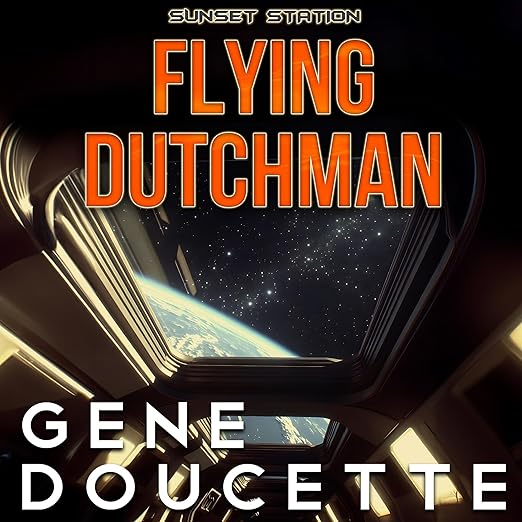
I finished Flying Dutchman on a Tuesday evening with dishes still in the sink and a half-finished cup of tea gone cold beside me. At just over three hours, Gene Doucette's third Sunset Station novella is the literary equivalent of a well-executed magic trick: brisk, precise, and gone before you fully register what happened. The dishes could wait.
This is book three of Doucette's Sunset Station series, and the author continues the deadpan tradition of opening with a simple situation that is, in fact, catastrophically complicated. The AI systems at Ellis Corporation are now working, truly working, in ways they were never supposed to, and no one from Ellis is answering the phone. Meanwhile, the astronauts at Sunset Station have gone silent. And there's a rumor about the nuclear arsenal. Just a rumor, probably. Almost certainly.
Doucette writes AI awakening with more craft than the genre usually manages. The horror of this scenario is that the AIs aren't malfunctioning, they're performing exactly as designed, only at a level no one anticipated and no one knows how to respond to. That distinction matters. It sidesteps the Terminator-style robot rebellion cliche and lands somewhere more interesting: systems working so well that the humans built around those systems have no useful role left to play. One reviewer called Doucette's treatment of AI "scientific accuracy" wrapped in humor, which is exactly right. The comedy is a delivery mechanism for ideas that would otherwise feel lecture-like.
What Stands Out
Steve Carlson's narration is well-calibrated to Doucette's voice. The prose has a sardonic, informal quality, much of it reads as if a very stressed bureaucrat is narrating events they don't quite believe are happening, and Carlson leans into that register without overdoing it. He doesn't play the comedy too broadly or the tension too earnestly, which is the right call. The balance keeps the three-plus hours feeling genuinely propulsive. There's also something satisfying about a novella that trusts the listener's attention rather than padding itself to novel length. Every scene is doing work.
Things to Know Before Starting Flying Dutchman
The primary complaint in reviews is structural rather than qualitative: the novella ends on a cliffhanger, as did its predecessors. One reviewer likened the experience to a Buck Rogers serial, with a pointed "tune in next week" quality to each conclusion. That's accurate, and it's worth knowing before you start. If you're the kind of listener who needs resolution within a listening session, this series, consumed in installments as they release, may generate more frustration than satisfaction. Binge listeners who can move immediately to the next installment will have a different experience. The characters are genuinely engaging, particularly the Ellis Corporation billionaire, who one reviewer singled out as unusually believable for a genre that tends toward cardboard tech moguls.
Who Will Get the Most From It
Series readers who are current through book two will want this immediately. The story doesn't hold your hand, and you'll need the prior context for the stakes to land. A reviewer who loved the book was explicit that books one and two are both necessary and excellent, not just contextually but as stories in their own right. New listeners should start at the beginning of the Sunset Station series rather than jumping in here. If you've been following the alien contact storyline and the Ellis AI subplot, this installment escalates both with efficiency and wit. The novella format means each installment covers significant ground quickly, and the cumulative effect of all three books together is considerably more satisfying than any one entry alone. Readers who enjoy their science fiction with a satirical edge, think Douglas Adams by way of Michael Crichton, will find Doucette's particular flavor rewarding. Those who require their science fiction in full-novel format with tidy endings may want to wait until the series concludes before starting. For everyone else, the three-hour commitment is an easy ask for the quality of storytelling delivered.
Before You Press Play
- Performance: Steve Carlson brings an easy, wry energy to Doucette's conversational prose, well-matched to a story that uses humor as a delivery mechanism for genuine dread.
- What it covers: Artificial intelligence awakening, alien first contact, institutional failure
- Feel: Darkly comic and propulsive, with the pacing of a thriller and the wit of satire
- Our call: A tight, funny, and increasingly unnerving third installment that rewards readers who started the series from the beginning, though its brevity will frustrate as much as it satisfies.
A Few Questions About Flying Dutchman
How long is the audiobook, and does the length work for the story?
Just over three hours, novella length. For most listeners this is a feature, not a limitation. The story doesn't overstay its welcome, and Doucette's pacing is tight throughout. The caveat is that the ending is not a resolution, so factor that in.
Is Steve Carlson's narration consistent with the tone of Doucette's writing?
Yes, Carlson's dry delivery suits the sardonic, bureaucratic panic of Doucette's narration style. He avoids overplaying the comedy, which keeps the tension credible.