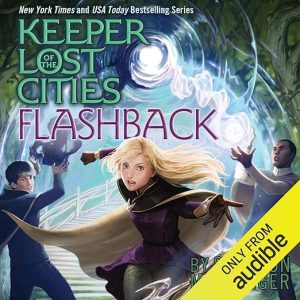
In Brief
- Narrator: Caitlin Kelly is the sole credited voice for twenty-three hours and a cast seven books deep.
- Subjects: elven politics, chosen-one doubt, learning to fight, friendship under threat
- Tone: Sprawling, earnest, high-stakes
- Bottom line: Deep-series comfort listening for readers already invested, and impenetrable for anyone arriving now.
Twenty-three hours and nine minutes is the runtime on this audiobook, longer than most adult literary novels and a long way past the norm for middle grade. Flashback is the seventh Keeper of the Lost Cities book, and the series has clearly stopped pretending to be short. That figure is the first thing a parent should look at, because it changes what the purchase actually is. This is not an evening. It is a month of car journeys, or a summer, or the thing a twelve-year-old disappears into and resurfaces from having missed several meals.
A Twelve-Year-Old Admits Some Parts Drag
Sophie Foster spends this installment unable to work out what, or whom, to believe, which after six previous books is a meaningful escalation rather than a stalling tactic. The Neverseen demonstrate that she is far more vulnerable than she thought, and her response is to learn to fight. That shift matters in a series built on special abilities: the heroine deciding that talent will not save her, and that she needs to be trained, is a proper turn in a long arc.
Book seven also complicates the emotional load. Battle training is useless against the danger facing a friend, and the only available solution requires the biggest risk the group has taken. The synopsis is careful not to say more, which is the right call, and the structure it hints at is a familiar one done well: the skill you spent the book acquiring turns out to be the wrong skill for the crisis that arrives.
Among the five posted responses, the single most useful one comes from a twelve-year-old whose parent transcribed it. That reader counted down 280 days to release, loved that the action starts at chapter six, and then said something no marketing copy will tell you: some parts seemed to drag on. Coming from the exact demographic the book is written for, that is worth more than four adult superlatives, and it stands as the honest note in an otherwise unanimous column.
Kelly Alone Carries a Theme About Erasure
Caitlin Kelly is the only voice credited across all twenty-three hours, and a cast this size makes that a real feat of bookkeeping. The Neverseen, a large recurring friend group, and a roster assembled over six previous books all have to stay distinguishable across a file that takes days to get through. Nothing on this page describes how that goes, but the structural fact is worth knowing: one performer, one continuous interpretation, no handover partway through the arc.
For a young listener already inside this series, the length stops being an obstacle and turns into the selling point. Series fiction at this age is about immersion, and twenty-three hours of a world a child already loves is exactly the point of the purchase. It also solves a specific parental problem, since a reluctant reader who will not sit with a doorstop novel will often listen to one happily, and one response here describes precisely that household dynamic.
Battle training as a plot engine gives the middle stretch something to do, which long series often lack by volume seven. Instead of another round of political maneuvering, Sophie has to be physically drilled, which produces scenes with visible progress and clear stakes. In audio that pays off, because training sequences are dialogue and rhythm rather than description, and they give a narrator something to build with over hours at a time.
Erasure is the actual subject, and the title says so. The deadliest secrets, the copy insists, are always the ones that get erased, and Sophie is asked to let past and present blur together in order to recover them. For a series written to be read at eleven, that is a surprisingly adult proposition: memory treated as evidence, and the deliberate destruction of it treated as a weapon. Delivered in audio, where you cannot flick back to check what you were told six chapters ago, the theme picks up an accidental second layer.
A Review That's Just the Letter Pair II
Two of the five posted responses contain almost nothing. One carries the headline about value for money above a body that is the letter pair ii, repeated three times. Another gives five stars and the two words interesting book. Both count toward the badge exactly as much as the detailed reactions do, which is worth remembering when a score looks unanimous. Three substantial reactions make a thin evidence base for a twenty-three-hour commitment. Dates on the column run from one week after release in December 2018 through to March 2026, which at least confirms the series is still picking up new readers.
One household described in the column runs the series in paper for the adult and on a screen for the child, switching to paperback when the battery dies. Neither of those is this recording. That is the recurring problem with reviews on a long-running series listing: the enthusiasm is real and it belongs to the text, while the thing you are buying is a performance nobody in the column has mentioned. Five visible grades all sit at full marks while the badge reads 4.8 across eight votes, and the people responsible for that gap have written nothing.
Length is the practical risk. The one reader in the target age group flagged dragging, and a twenty-three-hour file gives a slow middle a lot of room to be slow in. If your listener has already stalled on an earlier volume, this is not the one that fixes that. If they finished book six wanting more immediately, the runtime becomes a feature, and the same passages read as depth where they would otherwise read as drift.
A Gift or a Warning, You Already Know
Children and teenagers who have read or listened to the first six books are the only audience that matters here, along with the adults who have been dragged along and secretly got invested. Coming in cold at volume seven is a bad idea, because the opening treats the Neverseen, Sophie's abilities, and the whole friend group as settled knowledge. Anyone looking for a starting point should go back to book one and accept that the series is now a genuinely long-term project.
What you get for the money is a very large quantity of a world that a certain kind of reader will not want to leave. Seven books in, that is either a gift or a warning, and you already know which.
Should I listen to the earlier Keeper of the Lost Cities audiobooks first?
Yes. Flashback is the seventh volume and opens with the Neverseen, Sophie Foster's abilities, and the entire friend group treated as established. The synopsis assumes you know what happened in book six. Starting here would mean picking up an ongoing war and a large cast with no introduction to either.
Will the Flashback audiobook suit the same age range as the print edition?
The content is identical, so yes, but the format changes who can access it. One posted response describes a child who is not much of a reader engaging with the series anyway, and listening removes the decoding load while keeping the vocabulary and the emotional complexity fully intact.
What do the posted reviews tell me about this recording?
Very little about the recording itself. Five responses sit under the title, two of them containing barely a sentence between them, and the detailed ones describe reading the book in print or on a screen. Caitlin Kelly's performance goes unmentioned, so you are judging it from a sample.