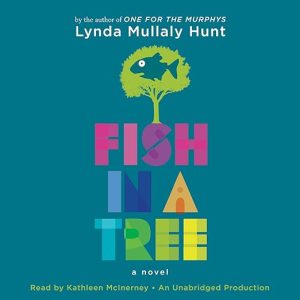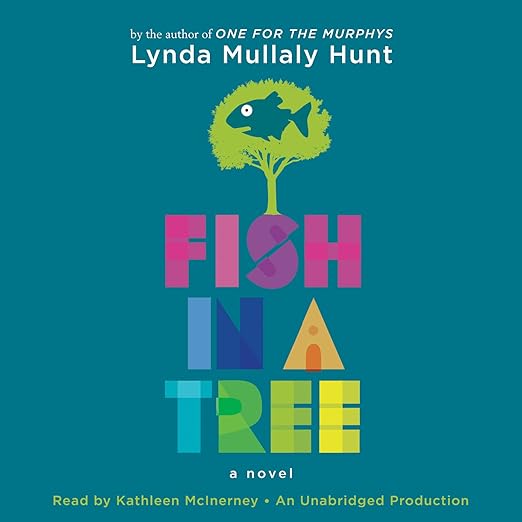
Handing a nonreader's story to a narrator changes the arithmetic of who can reach it. Ally, the girl at the center of Fish in a Tree, has spent years concealing the fact that she cannot read, and Lynda Mullaly Hunt writes the entire novel from inside that head. The audiobook runs five hours and forty-four minutes, read by Kathleen McInerney for Listening Library, and the format quietly removes the exact barrier the story is about. It is why two respondents out of five describe using the book inside their own literacy work, and why a third argues it belongs in front of teachers in training.
Is Fish in a Tree Worth Your Time?
Ally's method is distraction. Every new school gets the same trick: be disruptive enough, be inventive enough, and nobody will look closely at the page in front of you. Hunt makes that strategy exhausting to watch precisely because it keeps working, over and over, at enormous cost. The question the novel circles is not whether Ally is bright, which a listener works out almost immediately, but how a child arrives at the conviction that asking for help is more dangerous than being thought stupid. Mr. Daniels is the first adult who declines to accept the performance.
The description opens with the line that gives the book its title, unattributed: everybody is smart in different ways, and a fish judged by its ability to climb a tree will live its life believing it is stupid. That is a good epigraph and a slightly dangerous one, since it sets up a novel that could very easily have collapsed into a lesson. Hunt mostly sidesteps the trap. Dyslexia is named plainly, but the novel gives far more room to the social cost of concealment than it ever gives to the diagnosis.
What lifts it above the standard issue classroom problem novel is that Hunt surrounds Ally with friends who are also outside the center of things, and gives the teacher a working method rather than a speech. Confidence arrives incrementally and unevenly, which is how confidence actually arrives. By the close the book has made a fairly large claim, that a label is the smallest true thing about a person, and it has banked enough goodwill along the way to carry it off.
The Best Parts of Fish in a Tree
Kathleen McInerney reads all of it, one voice for a first-person child narrator and for the adults circling her. Five hours and forty-four minutes fits inside a couple of long car journeys or a week of bedtimes. The more interesting thing is what the responses document without meaning to: one describes going into a school to read this book aloud to a group of learning disabled fifth graders, a hand-operated version of what the recording does automatically. Those students relate to Ally, that response reports, and stay with her.
A second response goes further and is the most striking item on the page. Its author spent ten years leading a book club for adult learners through Creek County Literacy, students who met a tutor weekly and gathered monthly to discuss a book, adults who had struggled with reading and writing for years before finding the nerve to ask for help. That is Ally's problem, carried into adulthood. A novel written for children landing squarely on grown-ups who lived the same concealment is the strongest endorsement this listing carries.
Between them the five responses stake out an unusually wide age range. One recommends it for kids of eight and up. Another takes it to fifth graders. A third argues for teachers, for aspiring teachers, and for the parents of children who learn differently as well as the parents of children who do not. The two shortest entries on the page run eight words each and justify nothing, which is its own kind of signal: people recommend this book fast.
Before You Commit to Fish in a Tree
The listing is thin in exactly the places a parent would want it thick. No age band, no grade level, no content note, and a genre tag reading Growing Up and Facts of Life, which covers an enormous amount of ground. The description names dyslexia once and otherwise talks about not fitting in. If you are choosing this for a child who is currently struggling with print, know that the book spends real time inside Ally's humiliation before it goes anywhere near relief.
Twelve votes carry the 4.7 here, with five written responses attached, so the score rests on a very small pile. Nothing in those numbers is broken and nothing in them is informative. What is informative is who the five people are: a school volunteer, the organizer of an adult literacy book club, someone making the case for teachers and parents, and two people who wrote eight words apiece. That is a title moving through institutions, not through casual browsing.
Assigned reading is the other risk worth naming, because a book this useful gets set as homework until children resent it. One response recommends it as a good way to start the school year; another describes carrying it into a classroom to read aloud. Children who meet Ally through a required list may push back for reasons that have nothing to do with Hunt at all. The recording is the better route in that situation, since five hours and forty-four minutes of somebody else's voice feels less like an assignment than a paperback with a due date.
Should You Listen to Fish in a Tree?
Children from about eight upward who like realistic school stories are the core audience, and children who find reading itself difficult are the ones this particular format was practically built for. Teachers and tutors will find it does a job no lecture manages. Parents of a child who has started using the word stupid about themselves should consider listening alongside, because the book supplies vocabulary for a conversation that is otherwise extremely hard to open.
It is the wrong pick if you want plot, since the events here are small and domestic and the tension is entirely internal. It is also the wrong pick for a child who wants to be left alone about school, because the setting never once leaves it. Anyone outside those two groups is getting one of the few middle grade novels capable of changing what a young listener believes about themselves. A book about not being able to read, delivered in a form that never asks you to.
Key Details
- Performance: Kathleen McInerney voices a girl who cannot read a page, in a format that asks nobody to.
- What it covers: Dyslexia and hidden shame, a teacher who notices, friendship among outsiders, the cost of pretending.
- Feel: Warm, patient and quietly hard on the adults.
- Our call: The rare classroom staple that works better as a recording than as an assignment.
Before You Listen
Why does Fish in a Tree work so well as an audiobook?
Because the narrator of the novel cannot read, and the format removes precisely that obstacle for the person taking it in. A child who struggles with print receives the story at full strength with no decoding required. One response here describes doing the same thing by hand, reading the book aloud to fifth graders.
What age is this audiobook right for?
The page supplies no age band, so the responses have to fill the gap. One recommends it for children of eight and up, another used it with fifth graders, and a third makes a case for teachers, aspiring teachers and parents. The five hour running time suits a car trip or a week of bedtimes.
Does the book name Ally's condition or dance around it?
It names it outright. The description states that Ally comes to understand dyslexia is nothing to be ashamed of, and her teacher Mr. Daniels is the adult who gets her there. Where the novel spends most of its time, though, is not on the diagnosis but on the years of concealment before it.
Is this a good choice for an adult learner or an older struggling reader?
One of the strongest entries on this listing says yes. Its author spent a decade running a book club for adult learners through a literacy program, students who had wrestled with reading and writing for years. Ally's terror of asking for help is the same terror, and a child's voice makes it easier to name.