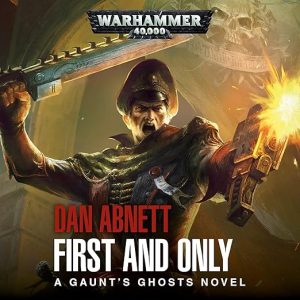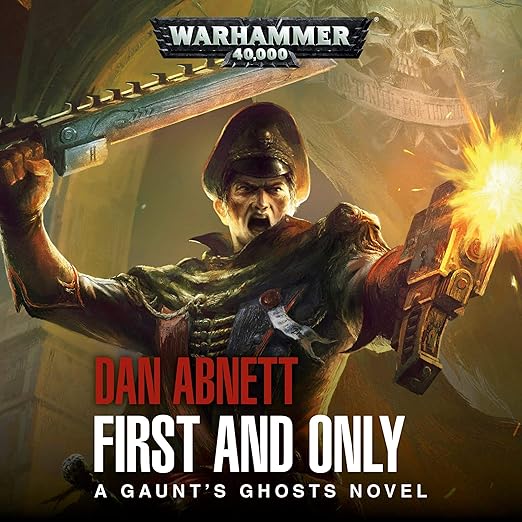
I came to First and Only not through Warhammer tabletop gaming but through a friend who kept insisting that Dan Abnett was simply a good novelist, full stop, regardless of the fictional universe he was operating in. I was skeptical. The Warhammer 40,000 setting is famously dense, ten thousand years of lore, a universe of baroque excess and deliberate absurdity dressed up as tragedy, and novels set within it tend to require some affection for that density to work at all. Abnett mostly disproves this. First and Only functions as a military thriller with its own internal logic, and while it rewards familiarity with the setting, it does not demand it.
The premise is clear from the opening: Colonel-Commissar Ibram Gaunt leads the Tanith First and Only, a regiment of light infantry nicknamed Gaunt's Ghosts, through the Sabbat Worlds Crusade, a massive Imperial military operation to retake a sector of space lost to Chaos for a thousand years. The novel opens during the grinding trench warfare of Fortis Binary and expands quickly into something more complicated: a conspiracy to assassinate Warmaster Macaroth, the crusade's leader, and a web of inter-regimental rivalries and political maneuvering that makes the supernatural threat almost a secondary concern.
What We Made of It
One reviewer expected First and Only to be an origin story for Gaunt's Ghosts and was surprised to find instead a narrative that moves between the present action and flashback sequences that fill in the regiment's founding on Tanith. This structure is smarter than a straightforward origin story would be: you meet Gaunt and his Ghosts already in the field, already shaped by their history, and the flashbacks provide context rather than setup. By the time you understand what happened on Tanith, the destruction of the world that made the regiment refugees, the loss has emotional weight because you've already seen what it means to the men who survived it.
The conspiracy plot, which pulls Gaunt into a situation where he doesn't know who among the Imperial commanders can be trusted, drives the second half with genuine momentum. The trench warfare opening is competent but the novel accelerates sharply once Gaunt starts following a thread he can't ignore into territory where everyone around him is potentially an enemy. One reviewer compares the series to "Richard Sharpe meets Warhammer 40K," which captures something true, Gaunt has the same quality of a competent professional operating in a world that's trying to get him killed by allies as much as enemies.
Why Listen to First and Only
Several reviewers specifically address what First and Only does for readers new to the 40k setting. One describes coming to the book through the Darktide video game and staying up late reading because they couldn't put it down. Another describes it as an engaging introduction for someone just getting into Warhammer lore. A third notes that it's the most-read Warhammer 40,000 novel ever, which reflects the consensus that it functions as a genuine entry point rather than a fan-service document that requires prior investment.
What makes this possible is Abnett's restraint with the setting's more baroque elements. First and Only is not a novel about Space Marines or the most extreme expressions of the Imperium's cosmic horror. It is a novel about ordinary soldiers, the Tanith, who fight in ordinary human scale with lasguns and bayonets rather than power armor and plasma weapons, navigating a war that is simultaneously vast and personal. That human scale is what makes the book accessible without requiring the reader to have absorbed the setting's mythology in advance.
What Might Not Land
Longworth has narrated Warhammer fiction extensively, and his comfort with the material shows throughout First and Only. He handles the tonal range the book requires, the grim professionalism of the military sections, the quieter character moments between Gaunt and his men, the controlled intensity of the action sequences, the handful of scenes that lean into the cosmic horror elements of the setting, without losing the novel's fundamental human register. At ten hours, the runtime is appropriate for the novel's scope, and Longworth's pacing keeps the narrative moving without rushing the scenes that benefit from room to breathe.
For listeners who plan to continue into the Gaunt's Ghosts series, which has grown into a multi-novel saga across more than twenty volumes, Longworth's narration establishes the voices and rhythms that carry through subsequent books. For listeners coming to the series for the first time, the performance is accessible enough that the unfamiliar terminology of the setting doesn't become an obstacle.
Should You Listen to First and Only?
One reviewer makes the practical note that readers who want to continue into the series would be better served by the Omnibus edition collecting First and Only, Ghostmaker, and Necropolis, the first three books plus short stories, which represents better value. That's a fair practical observation. For listeners specifically, the audiobook of First and Only stands on its own as a satisfying ten-hour commitment. If the novel hooks you, the series is long enough to occupy a substantial portion of your listening calendar. If it doesn't, you've lost nothing but ten hours to one of the more accomplished novels in a genre that often settles for competence.
Before You Press Play
- Read by: Toby Longworth brings deep familiarity with the Warhammer 40,000 universe to First and Only, delivering both the grimdark atmosphere and the personal soldier-level drama with authority.
- At its heart: Loyalty tested by internal betrayal, the individual soldier's humanity against the backdrop of an inhuman war, institutional corruption within the Imperium itself
- Vibe: Grimdark and propulsive, with the texture of military fiction rather than pure spectacle
- Short version: First and Only is the strongest entry point into Gaunt's Ghosts and one of the most genuinely readable novels the Black Library has produced, with or without prior 40k knowledge.
Frequently Asked Questions
Do you need to know Warhammer 40,000 lore to enjoy First and Only?
No. Multiple reviewers came to the book with no prior 40k familiarity and found it fully accessible. Abnett writes at human scale, ordinary soldiers rather than Space Marines, and explains the setting's key elements as the story requires them.
Is First and Only primarily a military action novel or does it have significant character development?
Both. The novel balances military thriller plotting with character work for Gaunt and his regiment, using flashback sequences to establish history and motivation rather than delivering it through exposition. The character dimension is what distinguishes the series from straightforward combat fiction.
How does Toby Longworth's narration handle the tonal range between human military drama and cosmic horror elements?
Longworth keeps the novel grounded in its human military register even when the Chaos-aligned elements surface. He doesn't over-dramatize the supernatural sections, which is the correct choice, First and Only's power comes from its human scale, and the narration respects that.