Quick Take
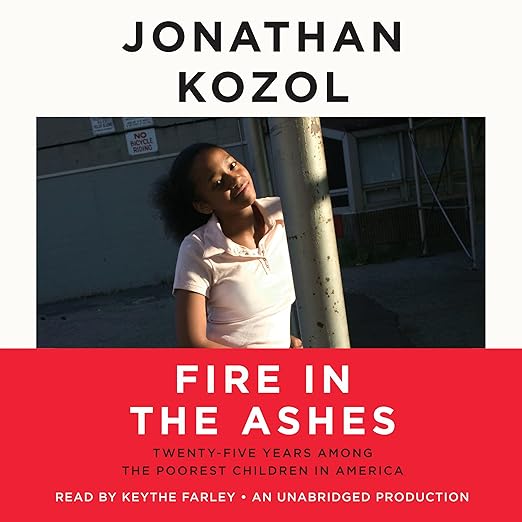
- Narration: Keythe Farley handles Kozol’s prose with the gravity it requires, unhurried and emotionally present, the narration gives space for the personal testimonies to breathe without sliding into sentimentality.
- Themes: Generational poverty and its structural causes, educational inequality, the role of external intervention in individual outcomes
- Mood: Deeply humanizing and occasionally devastating, with genuine instances of hope that never feel manufactured
- Verdict: Kozol’s culminating work on the children of South Bronx poverty is required listening for anyone who thinks seriously about inequality in America.
I came to Fire in the Ashes having read Jonathan Kozol’s Savage Inequalities years earlier, which means I arrived already knowing that Kozol’s method of making structural injustice visible is to make it personal, to put a name, a face, a specific trajectory on what statistics tend to dissolve into abstraction. What I wasn’t prepared for was the emotional accumulation of following children across decades. Kozol has known some of these people since they were very young. In this book, we watch them grow up.
The context matters: Fire in the Ashes is built on the foundation of two earlier Kozol books, Rachel and Her Children and Amazing Grace, about the communities of the South Bronx and the children growing up in conditions of extreme poverty in one of the wealthiest cities in the world. This book is the culminating volume, returning to those children as adults and tracking what happened. Some of them recovered, built lives, found their way to education and stability. Others did not. Kozol does not flinch from either outcome, and the structure of alternating individual stories across all three arcs gives the book an emotional range that single-story poverty narratives often lack.
Our Take on Fire in the Ashes
What distinguishes Kozol’s work from investigative journalism and what makes it sometimes contested as a form is his explicit non-detachment. He is not a reporter observing from outside. He has been in these communities for decades, has been befriended by the children he writes about, and his own life has been changed by the relationships he describes. A four-star reviewer pushes back on this somewhat, finding his writing style occasionally pulling them out of the personal narratives through repetition and rhetorical excess. That is a fair criticism of a writer who sometimes loves his own sentences more than they require. But the question of whether Kozol’s moral investment compromises the work or is precisely what makes it possible is one the book itself raises implicitly.
The central finding, stated most clearly by a reviewer who tracked it carefully, is that the success stories in the book are uniformly the children who received some form of external help: scholarships, mentors, housing interventions, structured support. Those who received nothing tended to stay trapped in the conditions they were born into. Kozol does not present this as a controversial conclusion. He presents it as what he observed, across fifty years of proximity.
Why Listen to Fire in the Ashes
Keythe Farley’s narration is calibrated to the material. He does not overdramatize the testimonies, which would turn suffering into spectacle, and he does not underplay the weight of what Kozol has accumulated here. The pacing gives the individual stories room to register as individual rather than as case studies in a cumulative argument, which is important given how easily poverty narratives collapse into a single undifferentiated image of despair. These are specific people, with specific names and specific trajectories, and the narration maintains that specificity across nearly eleven hours.
One reviewer described the experience of needing to remind themselves that the stories are true rather than fiction, which is perhaps the highest compliment a work of this kind can receive. When narrative that sounds too extreme to be real turns out to be documented and contemporary, the effect is both consciousness-expanding and uncomfortable in exactly the ways it should be.
What to Watch For in Fire in the Ashes
Kozol’s rhetorical style has its weaknesses. The repetition one reviewer flags is real, he returns to certain formulations and images more than the material requires, and occasionally the prose becomes more interested in its own eloquence than in the people it is describing. For a listener who comes to this expecting journalism in the stripped-back documentary tradition, the literary quality of the writing is a feature; for those who prefer lean nonfiction prose, it can create friction.
The book also does not offer policy prescriptions in any systematic form. It is a moral document before it is a policy argument. Readers who come wanting specific recommendations for educational or housing reform will find Kozol less interested in that territory than in the act of bearing witness. Some find this artistically appropriate; others find it a limitation of his approach that becomes more apparent over a long-form work.
Who Should Listen to Fire in the Ashes
Listen if: You are interested in poverty, educational inequality, and structural disadvantage in America and want to encounter the subject through specific human lives rather than data; you have read or listened to Kozol’s earlier work on these communities and want to know what happened to the children; or you appreciate narrative nonfiction that takes moral stance without pretending to false objectivity.
Consider skipping if: You prefer investigative nonfiction with a clear policy argument and lean prose style; or you find reading about generational poverty without resolution more distressing than illuminating. This book contains genuine hope, but it also contains genuine loss, and Kozol does not resolve the tension.
Frequently Asked Questions
Do I need to have read Rachel and Her Children or Amazing Grace before listening to Fire in the Ashes?
Not strictly, but the experience is richer with that context. Fire in the Ashes works as a standalone because Kozol provides enough background on each family and individual to orient new readers. But if you’ve spent time with those earlier books, returning to these same people decades later carries a weight that’s simply not available to first-time readers. Many listeners report doing a cross-read between Fire in the Ashes and the prior books to refresh their memory of who these people were.
How does Kozol handle the stories that don’t end in success, does the book ever feel exploitative in its portrayal of failure?
Reviewers consistently describe the book as deeply humane rather than exploitative. Kozol’s five-decade relationship with these communities and the people in them is evident in how carefully individual dignity is maintained even in the most difficult stories. That said, his literary approach and his explicit moral investment lead some readers to find him more interested in his own emotional response than in clean reportage, a tension that is worth knowing about before you begin.
The book has been classified under money and finance on some platforms, is that genre designation accurate?
Not really. Fire in the Ashes is social justice nonfiction about poverty and educational inequality, not personal finance or economics in any conventional sense. It belongs in the same section as Kozol’s other works on American poverty and urban education. If you arrived here expecting a financial guide or economic analysis, this is something different: narrative nonfiction about the human cost of structural inequality.
Does Keythe Farley’s narration handle the diversity of voices in the book, Kozol’s authorial reflections, direct quotes from subjects, and documentary passages, without the transitions feeling jarring?
Reviewers praise the audiobook’s emotional resonance, which suggests Farley navigates the transitions effectively. The blend of authorial reflection and personal testimony is characteristic of Kozol’s style across his books, and a narrator who can hold the range, from Kozol’s elevated prose to the specific cadences of the people he quotes, is essential. The consensus is that this production handles that challenge well.