Quick Take
- Narration: Simon Vance is in his element here – his measured, authoritative delivery perfectly suits the maester’s chronicle format, lending the sprawling Targaryen history a gravitas that keeps the 26-hour runtime feeling purposeful rather than bloated.
- Themes: dynastic ambition and its costs, the corrupting weight of power, cycles of conquest and collapse
- Mood: Grand, immersive, and occasionally brutal – like sitting with an ancient chronicle that refuses to flinch
- Verdict: An essential companion for anyone who wants to understand the Targaryens on their own terms, though newcomers to Westeros should start elsewhere.
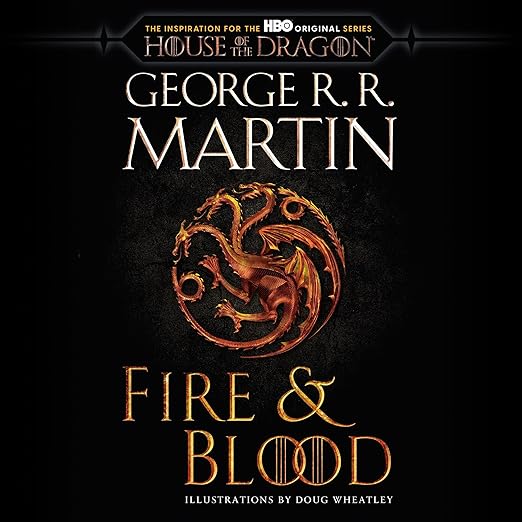
I was somewhere around the third hour of this one – deep into Aegon the Conqueror’s campaigns, the three queens circling each other in Dragonstone’s cold halls – when I understood what George R. R. Martin had actually built. Not a novel, not even really a prequel in the conventional sense, but something closer to what Gibbon achieved with the Roman Empire: a history so thick with character and consequence that the formal distance of the chronicle voice only makes the tragedies land harder. I’d cleared a long weekend for it. By Sunday evening I’d given up on everything else I’d planned.
Fire and Blood covers roughly 150 years of Targaryen rule, from Aegon’s conquest through the Dance of the Dragons, that ruinous civil war that tore the dynasty apart and set the template for every power struggle that follows in the main series. Martin presents all of this through the framing device of a maester’s account, stitched together from conflicting sources – court histories, scandalous pamphlets, the memoirs of septons with obvious agendas. The effect is genuinely literary: you’re never quite sure what’s true, and the book is honest about that uncertainty in a way that mirrors how actual history works.
Our Take on Fire and Blood
What distinguishes this from lesser world-building exercises is that Martin doesn’t use the historical distance as an excuse to flatten his characters. Maegor the Cruel earns his surname across chapters that read like a slow-motion catastrophe. Queen Alysanne pushes against the limits of what a woman of her era can accomplish, and watching her influence ebb as Jaehaerys ages is genuinely affecting. Even figures who appear only briefly – a bastard dragonrider, a disgraced knight, a septon with dangerous ideas – feel like they have lives that exist beyond the page. One reviewer compared the experience to J. R. R. Tolkien’s unpublished mythological histories, the work Tolkien spent a lifetime on but never saw fit to release. That’s not an overstatement. This is the kind of companion volume that makes the source material richer rather than merely larger.
Why Listen to Fire and Blood
Simon Vance is precisely the right narrator for this material. His voice carries natural authority without tipping into pomposity, and he handles the maester’s occasional dry irony – there are moments of genuinely dark comedy buried in the chronicle – without winking at the audience. The scale of the production, at just over 26 hours, could easily become exhausting in less capable hands. Vance keeps it coherent. He differentiates between the many Targaryens, all those Aegons and Aemonds and Viseryses, with enough vocal distinction that you’re rarely lost, which is no small feat. This is an audiobook that rewards the format: the maester’s voice needs to feel removed and yet oddly present, and Vance threads that needle consistently.
What to Watch For in Fire and Blood
Two structural things are worth flagging before you commit. First, this is explicitly Volume One – the Dance of the Dragons ends the account, and the second volume covering the remaining Targaryen kings has not yet been published as of this writing. You will reach the conclusion and feel the absence of what comes next. Second, the character count is substantial. One listener noted the difficulty of tracking the enormous number of characters across approximately 150 years, and that’s fair. This isn’t a book that holds your hand through its genealogy. Some patience is required, particularly in the early chapters before the recurring figures establish themselves. The maester’s device of noting disagreements between his sources can also slow momentum in spots, though I found it one of the book’s more interesting formal choices.
Who Should Listen to Fire and Blood
Readers who loved the main A Song of Ice and Fire novels and wanted more Westeros, especially the political machinery of it, will find this deeply satisfying. Fans of House of the Dragon will hear the backstory for many of that show’s conflicts rendered in much fuller detail – the Dance of the Dragons alone occupies a large portion of the audiobook and is far richer than anything the show has time for. Literary readers who enjoy the form of historical fiction written as actual history – Hilary Mantel’s approach, or the voices in Colm Toibin’s work – will also find something to appreciate here. Skip it if you’re a casual viewer who hasn’t read the novels; the density of names and the absence of a single protagonist to anchor you will make for a frustrating experience. This is a book for the committed.
Frequently Asked Questions
Do I need to have read the main A Song of Ice and Fire novels before listening to Fire and Blood?
Not strictly required, but strongly recommended. The book assumes familiarity with Westeros’s geography, political structures, and some key institutions. Newcomers may find the chronicle format disorienting without a baseline sense of the world.
How does Simon Vance handle the massive cast of Targaryen names – many of which repeat across generations?
Vance does solid work with vocal differentiation and maintains a consistent maester’s register throughout. He won’t entirely solve the problem of a dynasty that reuses names across generations, but his pacing helps listeners track context, and the writing itself usually provides enough situational cues.
Is this a complete story, or does it end on a cliffhanger?
It ends at a natural stopping point – the aftermath of the Dance of the Dragons – but the promised second volume has not yet been published. The book functions as a self-contained chronicle of the first half of Targaryen rule, though readers will feel the truncation.
How does the audiobook compare to watching House of the Dragon for understanding Targaryen history?
The audiobook is considerably richer. The Dance of the Dragons section alone provides far more context, nuance, and competing perspectives than the show can accommodate, and the earlier chapters covering Aegon the Conqueror through the early Targaryen kings have no screen equivalent at all.