Quick Take
- Narration: Jonathan Yen delivers the HBR material cleanly and without fuss, clear articulation, appropriate pacing for instructional content, no distracting affect.
- Themes: financial literacy, managerial decision-making, reading corporate financials
- Mood: Practical and confidence-building
- Verdict: The most efficient entry point into financial fundamentals for non-finance managers who need to get up to speed without sitting through a semester of coursework.
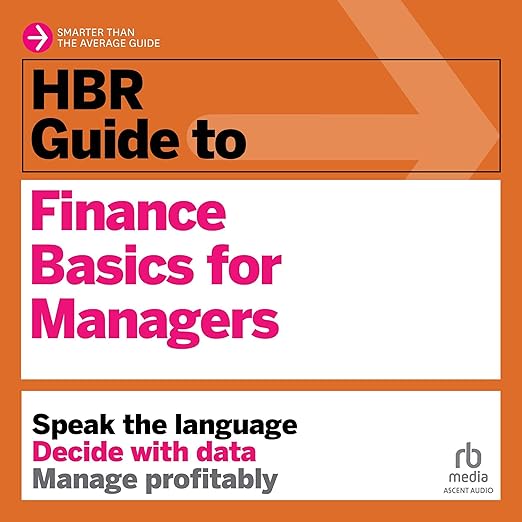
Years ago, when I was managing a small editorial team and kept getting lost in quarterly budget reviews, a colleague slid a copy of an HBR guide across the desk and said, simply, start here. I did not appreciate the gesture enough at the time. It was only later, after sitting through several more meetings where I nodded along to terminology I did not fully grasp, that I understood what a well-constructed primer could actually do. Finance Basics, the audiobook edition of the HBR Guide to Finance Basics for Managers, is exactly that kind of tool: specific, unpretentious, and organized around what a working manager actually needs rather than what a finance course would want to cover.
At just under four hours, this is among the shorter titles I review. That brevity is a feature, not a limitation. Harvard Business Review has designed this guide for a specific audience: managers and professionals who need functional financial literacy without the full architecture of an MBA. It covers income statements and balance sheets, breakeven analysis, cost-benefit frameworks, how to use financial data to defend budget requests, and why a profitable business can still go bankrupt. It does not attempt to cover everything. It covers what matters most.
The Problem With Most Finance Books for Non-Finance People
There is a genre of finance book that mistakes complexity for rigor and leaves readers more confused than when they started. Finance Basics avoids this almost entirely. The structure is hierarchical: foundational vocabulary first, then document literacy, then application to real management decisions. The sequencing matters. One reviewer who used this to survive an MBA program’s financial management course described her world changing after finding it, not because it is simple, but because it explains the underlying logic before drilling into the mechanics. That is the difference between a book that teaches you what something is and one that teaches you why it works the way it does.
Another reviewer, who completed an MBA before discovering the book, noted wishing they had found it sooner because it would have saved many late nights trying to decipher complicated textbooks. A third called it essential reading for anyone managing a business in a field they studied without a finance background. These are not glancing compliments. They are specific accounts of a reference tool that filled a genuine gap in how financial concepts are typically taught.
Jonathan Yen and the Art of Instructional Narration
Technical nonfiction in audio form presents a specific narration problem. Too much expressive flourish and the material feels performed. Too flat and the listener disengages. Jonathan Yen finds the functional middle: clear, unhurried, neither monotone nor theatrical. He makes the distinction between an income statement and a balance sheet feel like an explanation from a patient colleague rather than a lecture from a finance professor. For a book with this much numerical and conceptual density, that register is critical. You want to be able to replay a passage and understand it, not fight through the narrator’s choices to reach the content.
The Ascent Audio production is clean and professionally handled throughout. At just under four hours, the pacing is well-suited to the format: this is a book you can listen to on a single long commute, or break across a few mornings, and either way the structure holds. The chapters are discrete enough that returning to a specific concept is straightforward without needing to navigate through dense continuous argument.
What You Will Retain and What Requires the PDF
This is one of those audiobooks where the supplemental PDF is genuinely necessary rather than optional. Finance Basics includes glossary material, quizzes, and the kinds of visual representations, sample balance sheets, breakeven calculations, that translate poorly to pure audio. I would treat it as essential listening preparation rather than bonus material. Plan to have it accessible during the relevant sections, or use it afterward for reference and review. Multiple reviewers note using this as a reference guide long after the initial listen, which is how HBR guides are typically designed to function.
The Right Listener and the Honest Caveat
One aspect of Finance Basics that reviewers consistently highlight but that deserves emphasis for audiobook listeners specifically: the book is genuinely replayable. Finance concepts tend to require repetition. The first time you encounter breakeven analysis in the abstract, you understand it. The second time, through a worked example, you begin to internalize it. The audio format enables that kind of repeated exposure in a way that academic reading often does not, you can replay the chapter on reading financial statements during a commute where you would not sit down with a textbook. HBR guides are designed with this multiple-contact assumption built in. Jonathan Yen’s narration holds up to repeated listening, which is not a given for instructional audiobooks where the performance can grate on a second encounter. Here it does not.
If you have a financial background or have already completed foundational finance coursework, this will cover familiar ground efficiently but will not expand your understanding. It is not designed for analysts or CFOs. It is designed for the editorial manager who keeps getting lost in quarterly reviews, the marketing director who needs to read a profit-and-loss statement without asking for help, the new team lead about to present a budget for the first time. One reviewer noted they only regret not reading this fifteen years earlier. At under four hours, it costs less time than a single confusing meeting. The return on that investment tends to be substantially larger than the input would suggest.
Frequently Asked Questions
Is Finance Basics useful if you have already completed an MBA, or is it only for people with no finance background?
It is primarily aimed at non-finance managers and professionals. If you have completed MBA-level finance coursework, most of this will be review. Its value is highest for people who need functional literacy quickly, reading financial statements, understanding profitability versus cash flow, defending budgets, without the full academic architecture.
Does the audiobook format work well for this kind of financial content, or is the print version significantly better?
The audio works well for the conceptual and explanatory sections. For the numerical examples, glossary, and visual representations like sample statements or calculations, the supplemental PDF is essential. Plan to use both, the audio for frameworks and explanations, the PDF for reference and active review.
How does Finance Basics compare to other HBR guides in the series in terms of depth and accessibility?
It sits squarely in the accessible, practical tier of HBR guides, more depth than a blog post, less than a textbook. Reviewers who have used multiple books in the HBR Guide series consistently rate this among the more useful entries, particularly because financial fundamentals underpin so many adjacent management topics covered elsewhere in the series.
Can this audiobook help someone currently struggling in a graduate-level finance course, or is it too basic for that purpose?
Based on reviewer experience, yes. At least one reviewer credited it with helping them survive financial management in an MBA program. It works as a conceptual foundation that makes the denser textbook material more legible. It will not replace the coursework, but it tends to make that coursework make more intuitive sense.