
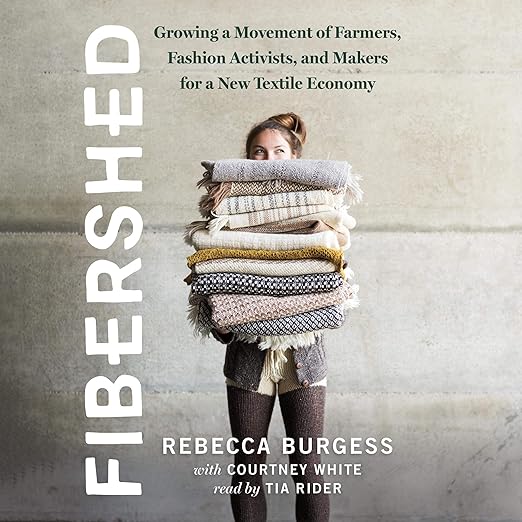
I picked up Fibershed on a rainy Saturday after spending an hour reading ingredient labels on granola bars at the grocery store. I had been deep into thinking about food supply chains and provenance for months, and it occurred to me, somewhere around aisle seven, that I had no idea where the wool in my sweater came from. That thought stayed with me, and when Rebecca Burgess's book landed in my queue, the timing felt almost conspiratorial. I finished the bulk of it over that same weekend, folded laundry included.
What Burgess has built here is not a polemic dressed up as a how-to guide, though it contains elements of both. It is, more precisely, the record of a vision taking shape in real time. Burgess, a weaver and natural dyer based in North Central California, began wearing only clothing made from fiber grown, processed, and sewn within her own bioregion. That origin story is remarkable not for its radicalism but for how quickly it became something larger. As she describes networking with ranchers, farmers, and artisans in her home community, the listener starts to understand that this was not one person's eccentric project. It was the rediscovery of an infrastructure that had been allowed to collapse.
Wool's Supply Chain From Grazing Contract to Garment
Burgess makes a compelling case that the severing of people from textile production is a relatively recent phenomenon, and that reconnecting those chains is both ecologically necessary and economically feasible. She grounds her argument in specifics that most environmental books avoid: milling capacity, contract grazing arrangements, the chemistry of natural plant dyes, and what it actually takes to build a supply chain from wool clip to finished garment. The depth of research here is genuine, and Tia Rider's narration treats the technical sections with appropriate care rather than glossing over them.
The book draws an explicit parallel to the food sovereignty movement, arguing that we have invested enormous cultural energy in knowing where our tomatoes come from while remaining almost entirely incurious about the origins of our second skin. It is a fair point, and Burgess makes it without condescension. She is writing for fiber farmers, ranchers, slow-fashion entrepreneurs, and conscious consumers in equal measure, and the text feels genuinely inclusive rather than narrowly activist.
Tia Rider's Warmth for Ranchers Rebuilding Regional Wool
The audio format works especially well for the sections built around interviews and firsthand accounts. Rider's voice brings warmth to the profiles of ranchers and weavers who are making regional textile production work in practice, and those portraits are among the most memorable parts of the listening experience. One reviewer described the book as inspiring precisely because it offers examples of people making a difference in their own local communities, and that quality of concrete hopefulness runs throughout the runtime.
Burgess does not shy away from the structural obstacles. The concentration of textile manufacturing in fast-fashion supply chains, the erosion of domestic milling infrastructure, and the economics of competing with mass-produced garments at scale all receive serious attention. This is not a book that pretends the problem is simple. But it also refuses to be defeatist, and that refusal feels earned rather than manufactured.
Long on Vision, Shorter on Step-by-Step Tactics
Listeners coming from a strictly practical standpoint, looking for a step-by-step guide to starting their own fibershed, may find that the book spends more time on vision and principle than on tactical instruction. The accompanying PDF, which is available in the Audible library alongside the audio, apparently contains additional resources, so the full package addresses more of the practical dimension than the audio alone. Worth noting before you dive in.
There is also a tension in the book between its ambitions as a movement manifesto and its function as a practical resource. Burgess mostly holds these two modes in productive balance, but occasionally the visionary passages extend longer than the argument strictly requires. For listeners already committed to the cause, this is unlikely to register as a problem. For skeptics who need the economic case made more tightly, a few sections may try patience.
From Food Ethics to Fiber, an Easy Jump
This one is for readers who came to food ethics through Michael Pollan or Anna Lappe and are ready to apply the same framework to textiles. It is also for crafters, knitters, weavers, and anyone who makes their own clothes and wants a richer understanding of material provenance. Farmers and ranchers curious about diversifying into fiber production will find substantive, specific content here. Listeners who are primarily looking for a fast-fashion exposé without the constructive alternative may want something more polemical - Burgess is fundamentally interested in building, not just critiquing.
A Few Questions About Fibershed
Is the accompanying PDF essential, or is the audio sufficient on its own?
The audio stands alone as a complete listening experience. The PDF, referenced in the Audible listing, contains supplementary resources that practical readers may find useful, but the core argument and most of the content is in the narration.
Does Tia Rider's narration handle the more technical agricultural and textile content well?
Yes. Rider maintains a clear, steady delivery through the more specialized sections on milling, soil carbon, and dye chemistry without losing the warmth she brings to the interview-based and personal narrative passages.







