Quick Take
- Narration: DiMartino Booth reading her own book gives the critique an immediacy and personal authority no hired narrator could replicate.
- Themes: institutional capture, academic theory versus real-world consequence, the costs of unchecked financial power
- Mood: Angry and precise, like sitting across from someone who has been waiting years to say this
- Verdict: One of the sharper insider accounts of post-2008 Federal Reserve behavior, worth the time for anyone trying to understand where the last decade of economic policy actually came from.
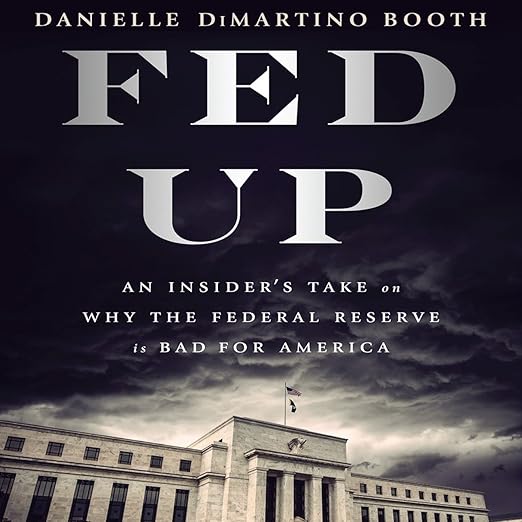
I started listening to Fed Up on a Sunday morning with coffee, expecting the book to function as economic background noise while I caught up on correspondence. By the time I looked up, two hours had passed and the coffee was cold. Danielle DiMartino Booth writes with the energy of someone who has been holding this particular argument back for years and has finally decided to let it go all at once. Whether you think she is right or wrong about the Federal Reserve, you cannot say she is dull.
The credential that structures everything in this book is unusual: DiMartino Booth correctly predicted the housing crash of 2008, quit her Wall Street job on that basis, and then found herself recruited as an analyst at the Federal Reserve Bank of Dallas, one of the regional nodes of the institution she had already identified as a primary problem. She spent nine years there, working alongside Dallas Fed president Richard Fisher, trying to push back against policies she believed were causing lasting damage to ordinary Americans. Fed Up is her account of what she found inside the building that runs American monetary policy.
The Tunnel Vision She Found Behind Closed Doors
The portrait DiMartino Booth paints of the Fed’s internal culture is not flattering. She describes a cabal of unelected academics making consequential decisions without any real-world economic experience, people who never looked away from their theoretical models long enough to notice what was happening on the ground outside. The specific critique she mounts against quantitative easing and the decision to reduce interest rates to zero in December 2008 is detailed and consistent throughout the book. She argues that those policies served Wall Street and the wealthy while leaving ordinary Americans, small business owners, retirees dependent on interest income, young people who couldn’t afford to form households, systematically behind.
A reviewer who had managed investments for over forty years described the book as pulling back the curtain and letting readers see how the unelected and unaccountable people inside this opaque and mysterious institution actually come up with the monetary policies that have so damaged the economy. That framing aligns with DiMartino Booth’s own rhetoric. She is explicitly populist in her critique, and she does not pretend otherwise. Whether that populism strikes you as accurate or as oversimplified will shape your experience of the book considerably, but the argument is made with enough specificity and firsthand detail to demand engagement rather than dismissal.
The Structural Choice to Avoid Strict Chronology
One reviewer noted, fairly, that DiMartino Booth does not maintain strict chronological presentation. She is writing as a storyteller rather than as a historian, and the timelines move around in service of argument rather than sequence. For readers accustomed to conventional business nonfiction, this can feel disorienting at first. For readers who approach the book as a memoir-shaped argument rather than a policy history, it is much less of a problem. Understanding what kind of book you’re reading matters considerably here.
The self-narration is the right choice for this material. DiMartino Booth’s voice carries the irritation and the conviction that the prose expresses, and hearing her tell this story herself closes the gap between the argument and the arguer. She is not a dispassionate analyst presenting findings; she is a participant in the events she is describing, and her narration communicates that distinction in a way that a third-party reader couldn’t fully replicate. One reviewer described her as an immensely engaging storyteller who is hard to stop once started, and that description holds across the full nine hours and fifty-seven minutes of the listening experience.
The Last Chapter and the Structural Argument
An Australian reviewer noted that the last chapter is the key to the entire book, that after mapping out Fed dysfunction and regulatory capture, DiMartino Booth makes her affirmative case for reform. That observation is worth foregrounding for listeners who might otherwise wonder whether this is pure critique or critique with a constructive dimension. There is a constructive dimension. The book doesn’t end in despair; it ends in prescription. Whether you find her reform proposals adequate is another matter, but they exist and they are argued with the same energy as the nine chapters of critique that precede them.
The 4.6 rating across 853 reviews reflects a readership that skews toward people already skeptical of central bank policy, but the critical reviews are thin on the ground and tend to reflect stylistic rather than substantive objections. One reviewer wrote simply that the author does not explain herself well, which is a minority position given how many other readers describe the book as impossible to put down once started.
It’s also worth noting that DiMartino Booth’s warning, that when the next financial crisis arrives the Fed will have no tools left for managing the panic that ensues, was written in 2017. Listeners who pick this up now bring the context of everything that happened between 2017 and the present to her predictions, which gives the book an additional and unintended documentary layer. Whether you find that context validating or complicating depends on how you assess the last several years of monetary policy. Either way, the book does not read as abstract history; it reads as an ongoing argument about how the institution still operates.
Who Should Listen and Who Should Skip
Listen if you’ve wondered what was actually happening at the Fed during and after the 2008 crisis, if you want an insider account that doesn’t spare the institution it describes, or if you want your economic policy reading to have human stakes and a personal voice. Skip if you want rigorous academic treatment with peer-reviewed sources, or if populist economic criticism reliably puts you off before you can evaluate the underlying argument on its merits.
Frequently Asked Questions
Do I need a background in economics or finance to follow this book?
Not really. DiMartino Booth writes for a general audience and explains Fed mechanisms in accessible terms throughout. The book is more memoir and argument than technical treatise, and the human stories carry the difficult concepts.
Is this book politically partisan, and in which direction?
DiMartino Booth is critical of academic elite culture at the Fed from a market-oriented perspective, but she criticizes both parties’ relationships with the institution. The critique is more anti-establishment than strictly partisan in the conventional left-right sense.
Since this was published in 2017, is the material still relevant for understanding current monetary policy?
The historical account of post-2008 Fed policy is as relevant as ever, and the structural critique of central bank culture has only gained more context since publication. The book doesn’t cover developments after early 2017, so readers will need supplementary sources for more recent events.
How does DiMartino Booth’s narration of her own book compare to professional audiobook narrators?
She is not a polished narrator in the technical sense, but the authenticity of her own voice telling her own story is a genuine asset here. The emotional investment comes through in ways a neutral professional reading couldn’t fully capture.