Quick Take
- Narration: Richard Brock delivers the action sequences with conviction, matching the high-energy tone of the Chosen for Greatness series.
- Themes: Chosen hero mythology, friendship under pressure, escalating threat scales
- Mood: Propulsive and action-forward with occasional levity from the demon companion
- Verdict: Satisfying for readers following Ace Winters from the start; the fourth book raises stakes convincingly without resetting the character.
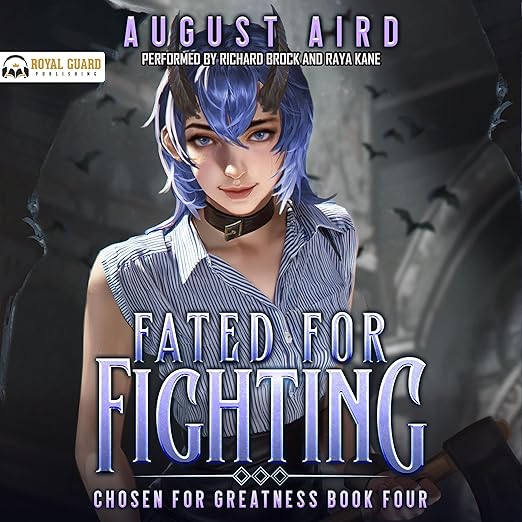
I started listening to this one on a Tuesday morning commute with coffee that had gone slightly cold, which turns out to be the right temperature for a book that opens with the world literally shaking with anticipation of something terrible. Fated for Fighting is the fourth installment in August Aird’s Chosen for Greatness series, and by this point the series has committed fully to its escalating premise: Ace Winters, Chosen of a Goddess, must now prepare to fight something that even the gods feared. A creature called the Sleeper is drawing near, and the world is bracing in ways that suggest the previous three books were, in some sense, prologue.
The setup is classical progression fantasy mythology. The Chosen hero framework has a long lineage, from genre-defining isekai to Western epic fantasy, and Aird does not pretend to reinvent it. What the series offers instead is consistent forward momentum and a protagonist who has been earning his power over four books rather than arriving pre-loaded. Readers who reviewed this installment noted specifically that they appreciated watching Ace slowly come into his power across the series, which is exactly the promise this genre makes and often fails to keep. By book four, that slow accumulation has compound interest.
Our Take on the Sleeper as a Villain Concept
The Sleeper is an interesting choice of antagonist because its threat is structural rather than personal. A creature the gods themselves feared operates at a scale that makes individual combat decisions feel either meaningless or mythically significant, and Aird navigates that carefully. Ace cannot simply power up fast enough to meet the Sleeper on equal terms in a single volume; the novel is about preparation, alliance-building, and the question of whether any preparation could be sufficient. That uncertainty gives the nine-and-a-half-hour runtime genuine tension even in its quieter passages.
The inclusion of a sassy and intriguing good demon in Ace’s traveling party is a sensible tonal choice. Extended preparation arcs can drag without character friction, and the demon provides it without becoming a full antagonist. Several reviewers seemed particularly curious about where the various female characters in Ace’s orbit would eventually intersect, which suggests the social architecture of the series is doing quiet work alongside the action sequences.
Why Listen to Richard Brock Read This Entry
Brock has been with this series long enough that his performance feels lived in by book four. The action sequences, which are genuinely frequent in this installment, land with physical clarity. He handles the tonal shift between the comedy of the demon companion and the more serious threat register of the Sleeper preparation without making the transitions feel abrupt. At nine-and-a-half hours, the runtime is compact for the genre, and Brock’s pacing keeps it from feeling rushed even when the preparation sequences require patience.
What to Watch For in the World Race Sequences
The plot involves Ace and his companions racing around the world to find a way to stop the coming threat, and these travel sequences are where the novel establishes the scope of its world most clearly. Pay attention to what Aird chooses to show versus skip during the journey. The selections reveal a lot about where the series is heading in terms of geography and political structure, and they do so without extended exposition detours.
One element worth noting about Aird’s series overall is its pacing discipline. Nine and a half hours is a notably compact runtime for a fourth-series installment, and the choice to keep it tight rather than expanding into the forty-plus-hour territory of some LitRPG series reflects authorial restraint. The Sleeper threat is large enough to justify a longer build, and the fact that this volume resists that expansion suggests Aird is saving scope for the confrontation that presumably follows. That discipline makes the existing content feel purposeful rather than padded.
Who Should Listen to Fated for Fighting
This is book four of an ongoing series with a developing cast and cumulative power progression. Starting here would mean missing the context for Ace’s relationships, his Chosen status, and why the threat scale of the Sleeper registers as it does by this volume. For existing readers, this installment delivers on its escalation promises and sets up what appears to be a significant confrontation ahead. Readers new to the series should begin at book one of Chosen for Greatness and let the progression work as intended.
Frequently Asked Questions
Is Fated for Fighting a good entry point into the Chosen for Greatness series?
No. The series has four volumes of character development and power progression behind it. Starting at book four means losing the context for Ace’s relationships, his goddess bond, and the established threat hierarchy.
How is the demon companion handled narratively? Is she a romantic interest or purely comedic?
The synopsis describes her as sassy and intriguing, and reviewer interest in the character suggests she occupies a meaningful role in Ace’s ensemble. Whether the relationship becomes romantic is not addressed in available synopses for this volume.
Does this book resolve the Sleeper threat or end on a cliffhanger?
Based on the synopsis framing, volume four focuses on preparation rather than resolution. The Sleeper appears to be a threat built toward across multiple installments rather than concluded here.
How does Richard Brock handle the tonal range between comedy and cosmic threat in this book?
Brock has narrated this series consistently and manages the shift between the demon companion’s lighter moments and the serious Sleeper threat with reasonable fluency. Readers who have followed his work through earlier volumes should find his performance here consistent.