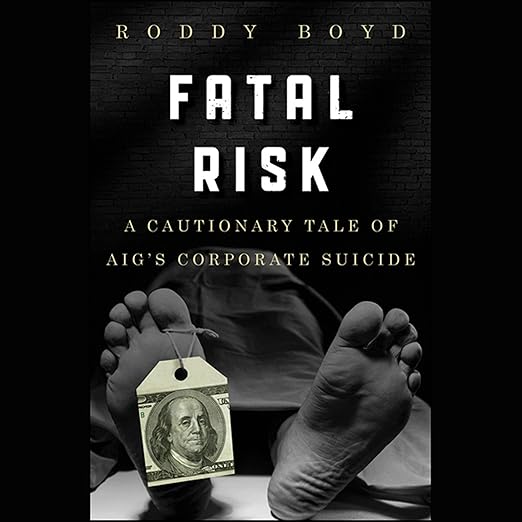
Quick Take
- Narration: Joe Barrett delivers the dense financial material with authority and clarity, keeping complex concepts about credit-default swaps and regulatory failure from becoming an audio blur.
- Themes: Corporate hubris and regulatory failure, the limits of risk modeling, the 2008 financial crisis from the inside
- Mood: Forensic and methodical, with the slow-building tension of a disaster that was always coming
- Verdict: The most complete account of AIG’s collapse yet written, essential for anyone who wants to understand the 2008 crisis at its structural root, some passages require close attention for non-specialist listeners.
I was familiar with the broad outlines of the 2008 financial crisis, I had read Too Big to Fail and The Big Short, and I thought I understood the rough shape of how it all came apart. Roddy Boyd’s Fatal Risk corrected that assumption within the first two hours. The AIG story is not a subplot of the larger crisis. It is the story, and Boyd is the first journalist to have gained access to the sources, including Hank Greenberg’s personal notes, that make it possible to tell it fully.
The book is long-listed for the FT and Goldman Sachs Business Book of the Year Award for 2011, which is not a minor credential. More telling is the detail: Boyd had access that other journalists did not, and he uses it to reconstruct not just the events but the logic, the internal reasoning, the regulatory battles, the specific financial mechanisms, that explain how AIG Financial Products became a wrecking ball for the global economy while everyone inside the building convinced themselves they were managing risk intelligently.
Our Take on Fatal Risk
The heart of the book is the credit-default swap operation at AIGFP and specifically the distinction, which turns out to be catastrophic, between how AIGFP structured its contracts and how traditional insurers handled similar instruments. A monoline insurer only settles claims on actual defaults. AIGFP’s contracts required the posting of collateral as soon as the market value of insured bonds fell, even before any credit event occurred. When subprime-backed securities started declining in value, the margin calls came immediately and in quantities that made the company insolvent faster than anyone had modeled.
Boyd explains this clearly. That sentence understates the achievement: explaining credit-default swaps, collateral posting requirements, and their intersection with the subprime market in a way that is both accurate and listenable is a genuinely difficult thing. One reviewer with a critical eye notes that some descriptions of key financial products remain unclear, and that is a fair observation for a few specific passages. But the broader narrative is coherent and, in the hands of narrator Joe Barrett, well-paced enough to follow without losing the thread.
Why Listen to Fatal Risk
Joe Barrett is a strong choice for this kind of material. His narration is measured and authoritative, giving the financial terminology the weight it needs without making the book feel like a textbook reading. At nearly twelve hours, this is a substantive listen, and Barrett’s consistency across that length is part of what makes it work. The material about Hank Greenberg, his building of AIG into a global insurance colossus, his forced departure in 2005, and what happened to the company in his absence, is some of the best biographical portrait work in the crisis-finance genre.
One reviewer who worked at AIG decades before the collapse writes that the book confirmed what they had suspected since learning of Greenberg’s forced exit: that the institutional knowledge and risk discipline he embodied could not be replaced. That is a striking confirmation from an insider, and the book earns it through specificity.
What to Watch For in Fatal Risk
This is dense nonfiction that rewards attentive listening rather than background noise. Some passages, particularly those dealing with the mechanics of AIG Financial Products’ specific contract structures, benefit from being paused and replayed. Listeners who are not already familiar with basic derivatives concepts may find a few sections in the middle third challenging. This is not a failure of the book; it is the nature of the material. Boyd is not writing for specialists, but neither is he simplifying to the point of inaccuracy.
The scenes inside the Federal Reserve Bank of New York and the US Treasury during the bailout negotiations are riveting in a way that the dryer technical material is not. Boyd clearly had good sources in those rooms, and the reconstruction of the decision to bail out AIG, the urgency, the alternatives considered and rejected, the specific numbers, is the kind of contemporaneous history that will be read for decades.
Who Should Listen to Fatal Risk
Anyone who wants to understand the 2008 financial crisis at the level of mechanism rather than narrative will find this indispensable. It works well alongside The Big Short (for the investor perspective) and Too Big to Fail (for the broader institutional view). Less suited to listeners who want a fast-moving story or are not willing to give close attention to financial detail. The twelve-hour runtime is substantial, but it is not padded, every hour covers ground the others do not.
Frequently Asked Questions
Do I need a finance background to follow Fatal Risk?
Not a deep one, but some familiarity with basic concepts like insurance, derivatives, and credit markets helps. Boyd explains the key mechanisms clearly, but a few technical passages will reward listeners who already have some context for how financial instruments work.
How does this compare to The Big Short or Too Big to Fail as an account of the 2008 crisis?
It is narrower in focus but deeper on AIG specifically. The Big Short covers the short-sellers who saw the crisis coming; Too Big to Fail covers the government response broadly. Fatal Risk fills a gap in the center, the story of the company that was most directly responsible for the systemic risk.
Is Joe Barrett’s narration well-suited to dense financial nonfiction?
Yes, reviewers and listeners consistently note that Barrett’s measured, authoritative delivery keeps the material accessible across nearly twelve hours. He does not over-dramatize but brings enough energy to prevent the dense passages from becoming monotonous.
Does the book cover what happened to AIG after the bailout?
Yes, the book addresses the aftermath of the government intervention, the conditions of the bailout, and the consequences for key figures including Hank Greenberg. It is comprehensive rather than stopping at the moment of crisis.