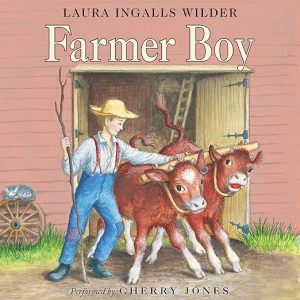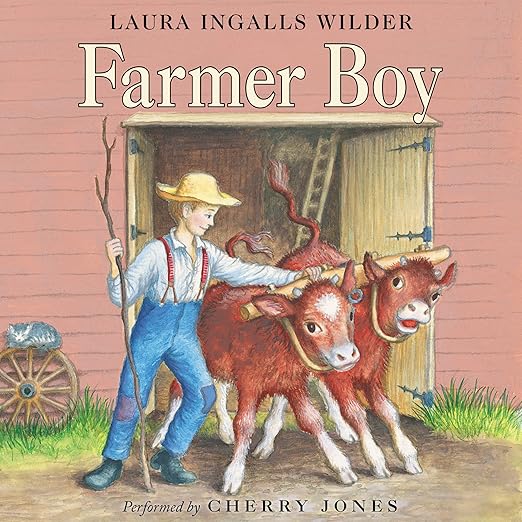
Almanzo Wilder spends most of Farmer Boy worrying about a horse he is not yet allowed to own, and that small, patient ambition is enough to carry a full audiobook. This is the second book in Laura Ingalls Wilder's Little House series, though the synopsis is upfront that it leaves Laura herself behind for the entire runtime: while she grows up on the prairie, this installment follows her future husband instead, on a demanding farm across the state line in New York, run by rules that leave very little room for idleness.
Closer to a Farm Almanac Than a Storybook
Farmer Boy is built almost entirely out of work, and that turns out to be the point. Almanzo's family sows and reaps its own crops, builds and repairs its own equipment, raises its own livestock, and trains its own horses and oxen, all under a father one reviewer calls a wealthy farmer whose household still works tirelessly to keep that standing. Winter brings wood chopping and the cutting of river ice into slabs for storage; summer brings planting and, eventually, the county fair. None of it reads as filler. The book's real subject is what it takes to run a household this self-sufficient, and Wilder trusts young listeners to find that interesting on its own terms, without a villain or a rescue plot to dress it up.
The horse Almanzo wants sits at the center of all that labor as a single, concrete stake: he has to prove he is responsible enough to earn it, which gives every chore a quiet second purpose. His siblings, Royal, Eliza Jane, and Alice, round out a household that feels lived in rather than illustrative, and the tin peddler's visits and the county fair function as the book's only real breaks from routine, which makes them land harder than a modern listener might expect. Farmer Boy has no interest in rushing toward a climax, and anyone who goes in expecting one may be surprised by how content it is to just watch a farm run through a full year.
Location matters more than the synopsis lets on, too: one reviewer places the farm specifically near Malone, in far upstate New York, close enough to the Canadian border that winter is not a mild inconvenience but a structuring fact of the whole year. Wilder wrote the nine Little House books from lived memory of exactly this kind of frontier calendar, and Farmer Boy is arguably the most calendar-shaped of them all, moving from spring planting through summer haying, a county fair in early fall, and a winter defined by ice harvesting and the wood supply. Almost nothing happens that could be called a plot event in the conventional sense, and that is very much the design rather than an oversight, closer in spirit to a farm almanac than to a storybook with rising and falling action.
Jones Keeps Four Speaking Parts Straight
Cherry Jones has already handled a companion volume in this same series, Little House in the Big Woods, with a restrained warmth that never tips into performance, differentiating a household of voices through cadence rather than caricature. That approach maps well onto Farmer Boy's own demands: the book has no traditional plot arc to lean on, so a narrator able to hold interest across seasonal, episodic chapters, and willing to treat a chore-heavy afternoon with the same seriousness as a moment of real danger, is exactly what this material needs. Almanzo's household alone gives a narrator several distinct speaking parts to keep straight, a stern father and three siblings of different ages and temperaments, without ever letting the performance tip into broad voice acting that would undercut the book's matter-of-fact tone.
The reviews attached to this listing are almost entirely about the book rather than the recording, but they make a strong case for the material itself across generations. One listener describes replacing a personal copy after thirty years of use; another remembers a third grade teacher reading it aloud back in the 1960s; a third describes recognizing this same upbringing directly, having gardened, canned vegetables, and raised livestock as a kid. That range, a listener today recognizing real life in an 1880s farm, is the clearest evidence that the book still works, audiobook format included.
A Whole Book Without Laura Growing Up
One quirk worth flagging for anyone trying to track down the rest of the series in order: this listing's own series field names the franchise Little House on the Prairie, while the synopsis text calls it simply the Little House series (elsewhere describing nine total books). The two do not quite agree with each other, so do not assume the series field is pointing toward book three specifically. And worth saying plainly, since at least one reviewer went in expecting otherwise: this is Almanzo's book, not Laura's, and anyone hoping for a direct continuation of her voice from the previous volume should adjust expectations before pressing play.
The listing's own rating math does not fully resolve either. Three ratings are on record, yet five separate written reviews sit directly beneath that count, four of them full five stars and one a four. It is a small, harmless inconsistency rather than anything a listener needs to solve, but it means the displayed average is worth taking loosely rather than literally. That gap, three counted against five visible, is not unique to this listing, but it is worth remembering before treating 4.8 as a precise measurement rather than a rough signal.
Farmer Boy Asks for a Different Attention
This one rewards patience more than plot hunger: listeners who want frontier history rendered through everyday labor rather than danger, families listening together, and especially adults with their own memories of gardens, livestock, or canning will get the most out of it. It also works well as an introduction to frontier era daily life for homeschool or classroom use, given how specific and accurate its depiction of 1860s farm labor reads, and it holds up equally well as a calmer bedtime listen for families already partway through the earlier books.
Skip it, or at least adjust expectations, if you are hoping to pick up directly where Laura's story left off, or if a child in your household needs constant incident to stay engaged; Farmer Boy asks for the opposite kind of attention, and rushing it tends to undersell what it is actually doing. For everyone else willing to slow down to a farm's own pace, this remains one of the sturdier, more quietly rewarding entries in the series.