At a Glance
- Voice: Paul Hecht handles a first-person motorcycle journal, a hired professional standing in for a famously particular voice.
- Big ideas: Rush's R40 anniversary tour, seventeen thousand miles of backroads, fifty years behind a drum kit, retirement
- Atmosphere: Reflective, unhurried, valedictory
- Worth it?: Travel writing of real quality that happens to be by a drummer. Come for the roads, not for a plot.
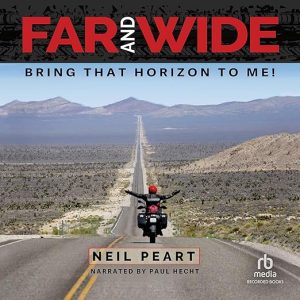
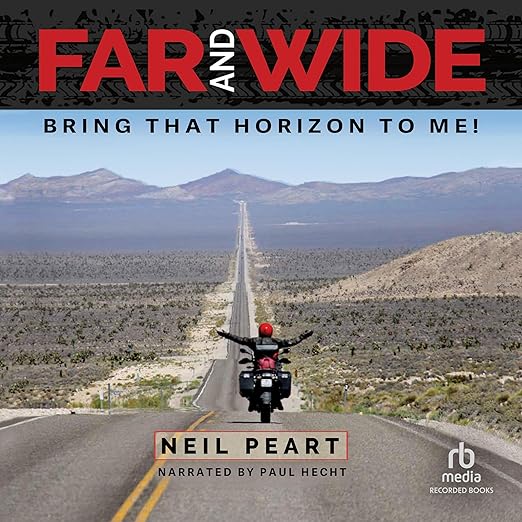
How does a drummer say goodbye? In Neil Peart's case, by riding seventeen thousand miles between thirty-five concerts across three months and then writing the whole thing down. Far and Wide is the audiobook of that stretch, nine hours and twenty-six minutes, read by Paul Hecht for Recorded Books, covering Rush's R40 tour from May 2015, the band's fortieth anniversary and, as the description carefully allows, perhaps a farewell. The riding is the book. The concerts are the reason the riding is possible at all. Listeners who have only ever met Peart behind a kit will find the proportions genuinely surprising, because the drums are memory here and the motorcycle is the present tense.
First, the Big Picture
Travel writing is the real genre, and the description is upfront about the shape: a scrapbook rather than a narrative. Peart moves from the scenic grandeur of the American West to a peaceful lake in Quebec's Laurentian Mountains to the mean streets of Midtown Los Angeles, and every stop gets its own piece. Threaded through the geography are recollections drawn from fifty years of playing drums. Nothing builds toward a climax, which is either the appeal or the objection depending on what you came for, because a book organized by road instead of by plot asks a listener to enjoy the company rather than to wait for a payoff.
Series placement deserves a look before you buy. The record calls this volume three and files it under a series named A Prize Every Time, while the description says only that it is the third volume in Peart's travel series and never names that series at all. The numbering agrees with itself; the label is something this page asserts without evidencing. In practice it changes little, since each volume is organized around a separate tour and nothing here suggests the earlier two are prerequisites. Even so, a buyer hunting the sequence deserves a page that can say what the sequence is called.
Why Listen to Far and Wide
Prose is why this survives outside the fan base, and a December 2024 five-star puts the case in one line: the writing is excellent and very descriptive, and it lands whether or not you have any feeling about the man producing it. The description makes the same promise in publisher language, an intimate narrative voice that has won the hearts of many listeners, and the claim is testable inside the first chapter. What arrives is a working professional describing landscape, weather and roadside food with unusual precision, at the end of days spent playing to arenas, which is a rare vantage point on North America.
Paul Hecht reads it, and the casting decision deserves its own paragraph. This is a first-person journal by a man with a famously particular sensibility, and the copy sells an intimate narrative voice, which in print means the writing and in audio means somebody else's throat. Hecht is not the author and makes no attempt to impersonate him, so what a listener receives is a professional reading rather than a confessional one. Some will prefer exactly that distance, since a hired reader holds the self-mythology at arm's length. Others want the actual man, and should know before purchase that this recording does not supply him.
A Few Reservations
Chronology decides what these responses are actually grading. One carries a filing date of September 5, 2016, roughly seven weeks ahead of the October 24 release, so the first verdict posted here belongs to a printed copy that already existed. The others sit later on the calendar and read the same way, graded on prose and on affection for the writer. None of that makes them useless, because the words are the same words in either format. It does mean the column reports on a book and hands the question of the performance straight back to you.
Then the star row, which is not usable. Round a single vote in any direction you like and 4.8 never appears, so the 4.8 displayed here, with a lone rating logged beneath it, did not come from that rating, whatever else it came from. Five full responses sit below it, and that is the population to consult. The content caveat is more useful anyway, and it comes from the copy itself: R40 is framed as a celebration and perhaps a farewell, approached as though it might be the last tour and the last great adventure. A valedictory tone runs the entire length.
The Right Listener for Far and Wide
Rush listeners are the built-in audience and require no persuading. The more interesting recommendation goes to motorcycle travelers with no particular investment in the band, because the riding here is genuine riding: backroads chosen deliberately, weather accepted as it arrives, and a route planned around a working schedule that will not move for anybody. Anyone who likes place writing organized by movement should find the structure congenial, since each chapter is a leg, no leg outstays a short sitting, and the whole thing can be picked up and put down without losing the thread.
Plot hunters should stay well clear, because nine and a half hours of a man enjoying roads is precisely what this is and it never develops into anything else. Listeners who need an author's own voice for a first-person memoir should read the credit line carefully and decide from there. The proposition otherwise is simple: good prose, one specific summer, a band's fortieth year, and a rider who suspected this was the last time and wrote it down while it was still going on around him.
A Few Questions About Far and Wide
Is the Far and Wide audiobook read by Neil Peart himself?
No. Paul Hecht is the credited reader on this record, and nothing on the page suggests the author took part in the recording. That is worth knowing going in, because the publisher promises an intimate narrative voice, and in audio that intimacy arrives through a professional standing at one remove from the material.
Do you need the earlier volumes before starting this audiobook?
Not really. The description positions it as volume three of Peart's travel writing and builds the whole thing around a single tour, so it stands alone. The record files it under a series name the description never uses, which muddies the sequence, but nothing suggests the earlier books are prerequisites.
Do the Rush concerts get much of the running time?
Less than the setup implies. Thirty-five shows across three months provide the skeleton and the deadlines, while the substance is the seventeen thousand miles ridden between them. Memories reaching back across fifty years of drumming thread through the travel writing, so the band is present throughout without the concerts becoming the subject.
Where does the route actually go?
Across North America over three months. The description anchors the route on the American West, a Quebec lake in the Laurentian Mountains, and Midtown Los Angeles at the far end, with backroads filling in everything between them. Expect wide geographic range organized by leg rather than by any single region.