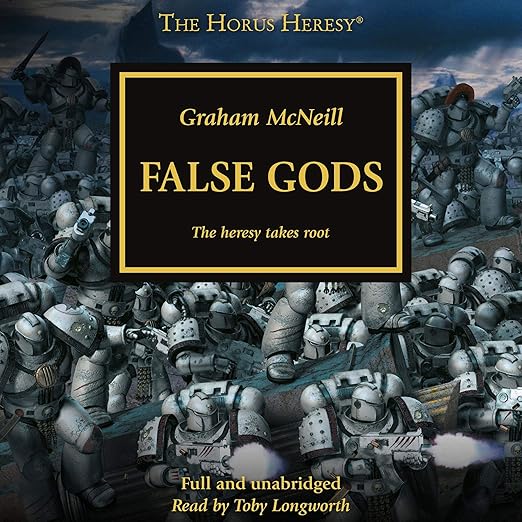
Quick Take
- Narration: Toby Longworth brings the right kind of gravitas to the Horus Heresy’s increasingly dark register, his voice suits the epic scale without tipping into the pomposity that Warhammer adaptations can sometimes invite.
- Themes: corruption and temptation, the tragedy of misplaced loyalty, Chaos as psychological seduction
- Mood: Grimdark and psychologically intense, with mythic weight
- Verdict: Essential listening for Horus Heresy readers, this is where the fall begins in earnest, and McNeill handles it with more psychological depth than the first volume’s battlefield spectacle.
I listened to False Gods over two evenings, which felt appropriate for a book about the moment when the trajectory of an entire civilization begins to bend. Graham McNeill is working in a universe that Warhammer 40,000 readers know well, the 41st millennium’s grimdark is a product of exactly what this novel depicts, but the Horus Heresy series takes on a different quality when you realize you are reading a tragedy in the classical sense. You know how it ends. The weight of that knowledge is part of the experience.
This is book two of the Horus Heresy, following Dan Abnett’s Horus Rising. McNeill takes over the narrative and shifts the center of gravity from Garviel Loken, the Sons of Horus captain who was the protagonist of the first volume, toward Horus himself. The move is necessary and well-executed. This book is about the Warmaster’s corruption, and it would not work as well if we were watching it entirely from outside.
Our Take on False Gods
What McNeill does with the corruption arc is more interesting than it might initially appear. Horus is not simply tempted by power, he is tempted by a constructed vision of treachery that is specifically designed to appeal to his genuine grievances. The jealousy and resentment of his brother primarchs, the frustration of carrying responsibility while the Emperor removes himself from the campaign, the wound sustained on Davin that opens him to Chaos’s influence, each element is carefully prepared. One reviewer noted that the novel digs deep into each character in a way that is more than just blind good versus evil, but a matter of degree, and that is precisely what makes the fall feel tragic rather than merely dramatic.
The battles are present, but they are not the point. The pivotal sequences in this novel take place in Horus’s mind, in the space between who he has been and what he is becoming. McNeill keeps those scenes strange and unsettling without making them abstract, which is a significant craft accomplishment for a novel in a franchise built on titanic physical conflict.
Why Listen to False Gods
Toby Longworth’s narration is one of the things that makes the Horus Heresy series work as an audiobook franchise. He understands the register these novels require, not quite Shakespearean, not quite military procedural, but something in between that takes the mythology seriously without becoming self-important. His reading of the scenes where Horus confronts his inner daemon is particularly strong, maintaining the tension between the Warmaster’s genuine greatness and the thing reaching for him.
At eleven hours and eighteen minutes, the audiobook is a solid investment for the payoff it delivers. Listeners who have read Horus Rising will immediately feel the tonal shift McNeill introduces, the first book had a sense of adventure and idealism underneath its violence, and this one begins systematically dismantling both. One reviewer described the feeling of watching the beginning of the grimdark emerge and wanting to reach into the story to change the outcome, knowing they could not. That feeling is the intended effect, and McNeill earns it.
What to Watch For in False Gods
New listeners to the Horus Heresy should absolutely begin with Horus Rising before this volume. McNeill’s book assumes familiarity with the characters established in Abnett’s first entry, and the emotional impact of what happens to Horus is considerably diminished without that foundation. The series is designed to be read in order, and the payoff compounds across books.
Readers looking for the dense action-per-page ratio of some military science fiction will find False Gods slower in places than they might expect. The novel’s most significant battles are internal. If you came to the Horus Heresy for the spectacle and are not as interested in the psychology, this volume may ask more patience than you want to give. But the long-term readers of the series consistently regard it as essential, and that consensus is well-founded.
Who Should Listen to False Gods
Warhammer 40,000 readers who want to understand the cosmological backstory of the universe they love will find this series indispensable, and False Gods is where that story’s stakes become fully visible. Listeners who enjoy mythic-scale science fantasy with genuine character psychology, as opposed to pure military action, will find McNeill’s contribution to the series among its strongest. Start with Horus Rising, then move immediately here.
Frequently Asked Questions
Do I need Warhammer 40K knowledge to enjoy False Gods?
Basic familiarity with the 40K universe helps, but the Horus Heresy series is designed to be accessible to readers who know the broad strokes, the Emperor, the Space Marines, the fall of Horus, even without deep game lore knowledge.
How does False Gods compare to Horus Rising in terms of tone and focus?
Horus Rising has more of an adventure and idealism register despite its violence. False Gods systematically dismantles that, it is darker, more psychologically focused, and more concerned with what corruption looks like from the inside.
Is False Gods primarily action-driven or character-driven?
Character-driven. The major battles are present but function as backdrop for the more significant internal conflicts. The pivotal sequences involve Horus’s mind and conscience rather than the battlefield.
How does Toby Longworth’s narration handle the scenes in which Horus confronts the temptations of Chaos?
Longworth maintains the right tension between Horus’s genuine greatness and the corruption reaching for him, he does not over-dramatize the daemon scenes, which keeps them unsettling rather than theatrical.