Quick Take
- Narration: Lukas Arnold delivers T.E.D.D.’s sardonic voice with genuine comic timing, the banter between characters lands cleanly and the pacing is sharp.
- Themes: robot identity, post-apocalyptic resistance, absurdist humor
- Mood: Fast, irreverent, and gleefully chaotic
- Verdict: Book six keeps the series’ best qualities intact, short, punchy, and consistently funny without overstaying its welcome.
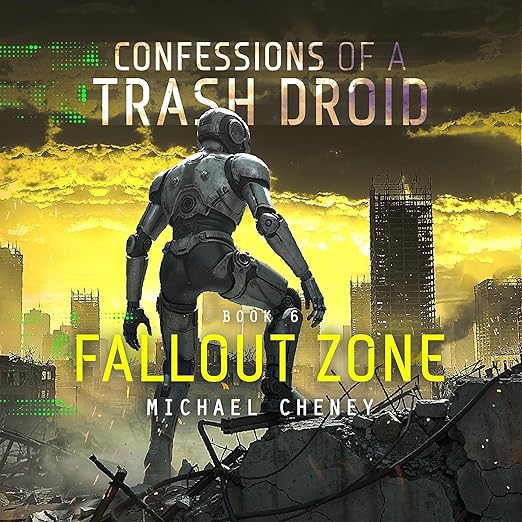
I started Fallout Zone on a Friday afternoon with no intention of finishing it that day. By early evening I had. At four hours and forty-one minutes, the sixth entry in Michael Cheney’s Confessions of a Trash Droid series is designed to be consumed in exactly that way, an afternoon with a snarky robot, an apocalyptic backdrop, and enough absurdist momentum to make you forget you were ever tired.
The series, which Cheney has been building with pleasing consistency, follows T.E.D.D., a trash droid who has developed an inconvenient tendency to side with the humans he is technically supposed to help eliminate. Fallout Zone picks up with the mainland now a proper apocalyptic fallout zone, T.E.D.D. and his spider-bot companion ArachnoBot rallying survivors, and the Manager, the series’ cheerfully villainous antagonist, making his most aggressive play yet toward replacing humanity entirely. The setup is efficient, the stakes are clear, and the tone is exactly what fans of the previous books will expect.
T.E.D.D.’s Machine-Code Conscience
The moral engine of this series has always been T.E.D.D.’s internal conflict: he is programmed one way and consistently behaves another. In Fallout Zone, Cheney pushes that tension into its most direct form yet. The Manager’s final push forces T.E.D.D. to make choices that his machine code would flag as malfunctions but that read, from the human side, as loyalty. Cheney doesn’t belabor this thematically, the book is too fast for that, but it gives the comedy an emotional through-line that keeps it from feeling like a pure gag machine.
Reviewer Ray Wilhelm described the love-hate dynamic between T.E.D.D. and his companions as one of the series’ consistent pleasures, and he’s right. The banter is the book’s real product: quick, slightly mean, occasionally tender in ways that catch you off guard. McKenzie continues to function as a reliable comedic foil, and the insults have the kind of internal logic that good comic relationships require. What lifts the series above pure parody is that you actually care about these robots and their fractious alliances, and Fallout Zone earns that care by keeping the stakes real even when the tone is absurdist.
Lukas Arnold and the Sound of Snark
Narrating a comedy series with a robot protagonist requires a particular kind of precision. Too much ironic distance and the character becomes a cypher; too little and the jokes flatten. Lukas Arnold finds the right calibration, T.E.D.D. sounds genuinely sardonic rather than performatively so. The rapid pace of Cheney’s dialogue benefits from Arnold’s willingness to match the frenetic energy rather than smooth it out. Reviewer Camsh noted the frenetic pace and compelling characters as standouts, and Arnold’s narration amplifies both without tipping into exhausting.
At just under five hours, this is a listen that works well in a single sitting or split into two. The chapter structure is tight enough that there are natural breaks without the momentum dropping. For newcomers: this is book six, and while Cheney’s world is accessible enough that you won’t be completely lost, the emotional payoffs in the T.E.D.D.-Manager dynamic will carry more weight if you have at least read the first book in the series. Reviewer G. Fowler wished the book were longer, which is a reasonable response to something that does what it sets out to do very efficiently. But brevity is a feature here, not a gap.
The Absurdist Tradition This Lives In
Cheney’s marketing correctly invokes Douglas Adams, John Scalzi, and Andy Weir as reference points, and the DNA is recognizable: the comedy of a universe that is fundamentally indifferent to human (and robot) dignity, a protagonist whose exasperation is the reader’s entry point into the chaos, and a villain who is terrifying primarily because he is committed. Cheney’s tone is more purely comedic and less interested in the hard-SF grounding that Weir or Scalzi bring, which makes Fallout Zone a faster, lighter read, closer to Adams in spirit than to The Martian in structure.
Reviewer phil merrick called the series hilarious and action-packed, and described it as a great example of robot fiction. That last point is worth dwelling on: Cheney is doing something with AI characters that goes beyond the standard robot-uprising template. T.E.D.D.’s choice to side with humanity isn’t presented as an override or a programming error, it’s presented as something closer to conscience, which is funnier and more interesting than the alternative. The series keeps asking what it means to malfunction in ways that are morally superior to functioning correctly, and Fallout Zone pushes that question further than any previous entry.
Who This Works For
Come to Fallout Zone if you are already invested in this series, it delivers what the previous books built toward. Come if you enjoy humorous science fiction that moves quickly and doesn’t demand you take its worldbuilding too seriously. Come if you want a listen that ends before the evening does. Do not start here if you haven’t read the earlier books; the series is best experienced in order, and the first book is short enough that there’s no reason to skip it. For existing fans, this is a satisfying and characteristically efficient addition to a series that knows exactly what it is. Cheney has built something rare in the audiobook space: a comedy series with a protagonist who actually develops across entries, where the jokes land because the relationships underneath them have been earned over time.
Frequently Asked Questions
Can Fallout Zone be listened to without having read the previous books in the Confessions of a Trash Droid series?
You can follow the plot, but the emotional resonance of T.E.D.D.’s conflict with the Manager and his relationships with the other characters will be shallower. The first book is a short listen and a much better starting point for the full experience.
How does Lukas Arnold’s narration handle the comedic pacing, does it work better in audio than in text?
Arnold’s delivery actively enhances the comedy. His timing on the banter exchanges is precise, and he differentiates the characters without overdoing character voices. The audio format suits this material particularly well.
Is this series appropriate for younger listeners given the humor style?
The comedy skews toward adult irony and involves apocalyptic scenarios, mild language, and some dark themes played for laughs. It’s not graphic, but it reads as adult humor rather than all-ages content.
Is Fallout Zone available as a free audiobook on Audible?
Yes, this free audiobook is accessible to Audible members through their subscription. Check the current listing for availability, as catalog access can vary.