The Short Version
- Narrator: R.C. Bray is down as narrator, holding a human commander and two very different machine intelligences across nineteen hours.
- Subjects: Series finale stakes, buddy comedy in space, structurally hopeless odds, invented alien taxonomy
- Tone: Bleak premise, relentlessly funny execution
- Bottom line: Close to essential if you are fourteen books deep, and a poor place for anyone else to start.
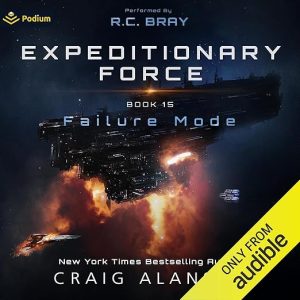
What does a fifteenth book owe the fourteen behind it? Craig Alanson answers with nineteen hours and twenty-two minutes of consequence, and this audiobook’s review pool splits hard on whether the debt gets paid. One reviewer files it as the "Best conclusion to a series I can recall reading." Another, at four stars, heads a notice "Game of Thrones style ending?" and intends it as a complaint.
Craig Alanson’s setup is bleak on purpose. The galaxy is doomed, says the description, repeating the word for emphasis, and Skippy, styled The Idiot Who Got Played, knows this is a fight he cannot win because he was designed not to win it. Salvage is the only objective left standing. Whether the Merry Band of Pirates comes through hangs over the entire runtime.
Is Failure Mode Worth Your Time?
Skippy is why this series works and why a fifteenth volume can still surprise anybody. An artificial intelligence who is simultaneously the most powerful entity in the story and its most insufferable personality makes a comic engine that never runs down, and one reviewer names the trio carrying it: "Joe, Skippy and Nagatha are interesting, funny." Another goes further, calling Skippy and Joe "the best buddy comedy in this spacetime."
Humor is load-bearing rather than decorative. A five-star reviewer praises how "the dialog is almost always just right" and notes the customary bantering and bickering, while another recalls the invented names with obvious affection: the alien races Maxohlx, Rindhalu and Jeraptha, plus a Jeraptha starship christened "We Don’t Want to Brag about that Thing You Can’t Prove We Did." A joke that long is a written joke. Spoken, it has to arrive as a name, in one breath, with the punchline still intact.
Casting a single reader for this is the bet the series made long ago, and R.C. Bray is down as narrator. Consider what that entails across nineteen hours: a human commander, an artificial intelligence with a god complex, a second one of entirely different temperament, and a roster of species names one reviewer took the trouble to list out. Consistency is the whole job. Anyone fifteen books deep will catch a drifting voice instantly, and the comedy runs on timing between characters produced by a single throat. That is the demand the material makes, and it is why this particular series lives or dies on casting rather than on prose.
A runtime past nineteen hours is a serious commitment, and it is the right size for the job in hand. Fifteen volumes of accumulated setup need room to resolve, and a compressed finale would land worse than a long one. Length in a series conclusion is a form of respect, and readers who have carried fourteen books tend to notice when the last one is rationed. The single substantial complaint in this pool concerns pace at the very end rather than the total.
Doom as a comic register is unusual, and it is what separates Expeditionary Force from grimmer military science fiction. The description states outright that the odds against Skippy are structural rather than merely long, that he was built to lose, and the book still finds space for what one reviewer catalogues as cheeseburgers and fluffernutters going "a long way to overcoming the dangers of low morale in space." Tonal control across that width is genuinely difficult. Very few writers can hold a joke and a genuine threat in the same paragraph without one cancelling the other, and the reason I keep returning to comic science fiction is that the good practitioners of it are doing something structurally harder than the solemn ones.
Loyalty to these characters is the real currency, and the pool spends it without embarrassment. One farewell reads "Good bye you magnificent goofballs. And goodbye Smythe." Another reviewer reports being hooked from the origin story onward, pulled in by the fantasy of walking away from a job for a completely different career. Fifteen books manufacture that kind of attachment, and this volume was written for people who already carry it. Judged as a standalone novel it would read as thin; judged as the last chapter of something enormous, which is the only fair way to judge it, the emotional arithmetic works. Series endings are judged on debts settled rather than on pages, and that is the ledger this pool keeps arguing over.
Before You Commit to Failure Mode
Four ratings. That is the entire quantitative record on this listing, paired with a 4.7 average, and four ratings cannot produce 4.7, because four whole-star scores can only land on a quarter. Beneath that count of four, five separate people have posted reviews, which is another way of saying the two figures track different populations. Stars here are noise, and the write-ups are the only signal.
Endings are the live disagreement, and it is worth knowing about before committing twenty hours. The four-star notice calls the finish "rushed a bit, with too many loose ends needing tied up in a hurry and an impossible outcome handwaved into existence," and wishes the problem had been solved "in a realistic (for this series) way." Against that, two reviewers reach for conclusion and ending as compliments, one of them praising a "Slam bang ending to a great series." Complicating both positions, the most recent notice, from October 2025, signs off with "I can’t wait for the next release." Whether this closes Expeditionary Force is not something the listing settles.
Newcomers should not begin here, and nothing in the packaging warns them off. This is the fifteenth entry in a continuous story, the description assumes you know who Skippy is and why the phrase Merry Band of Pirates carries weight, and every reviewer writes from inside fifteen books of shared history. Starting at volume fifteen would squander the best thing about the whole enterprise.
Who Should Pick Up Failure Mode
Veterans of the series are the only genuine audience, and for them this comes close to mandatory, because it is where the arc finally lands and the pool’s affection is unmistakable even in the notice from the reviewer who was let down. Space opera fans who want the register funny, profane about morale, and built on a double act rather than on hardware will recognize it from the first fourteen volumes.
Stay away if you have not read the series, if you want hard science fiction with rigorous physics rather than an omnipotent machine intelligence solving problems, or if a hurried resolution would sour fifteen books of investment, because one reviewer’s experience was exactly that. Everybody else already knows whether they are buying this, and most of them bought it years ago.