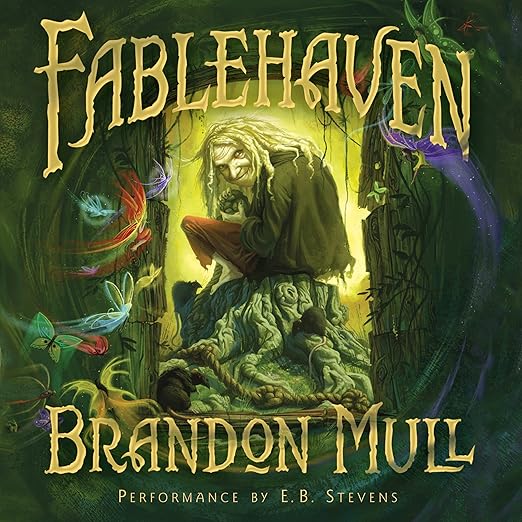
Under the five written responses on this audiobook page sits a wall of other people's books. Narnia. The Hobbit. Harry Potter. Bartimaeus. Percy Jackson. Hogwarts. J.K. Rowling, Jonathan Stroud, C.S.Lewis and R.R.Tolkien all get named, most of them before anybody describes what actually happens in Fablehaven. Five responses, ten borrowed reference points. That says something real about how this book gets recommended, and it also means the recommendation arrives pre-loaded with expectations no single novel was ever going to meet.
Stevens Keeps Five Creature Types Apart Alone
Most of the premise lives in the first two sentences of the description. For centuries, mystical creatures of all description were gathered to a hidden refuge called Fablehaven to prevent their extinction, and the sanctuary survives today as one of the last strongholds of true magic in a cynical world. Kendra and her brother Seth have no idea their grandfather is the current caretaker. Then the rules get broken, an arcane evil is unleashed, and Kendra has to find the courage to do the thing she fears most.
At the level of performance, one line of that description does more work than all the rest combined. Inside the gated woods, ancient laws give relative order among greedy trolls, mischievous satyrs, plotting witches, spiteful imps, and jealous fairies. Five categories of creature, each defined by a different temperament, and E. B. Stevens has nine hours and thirteen minutes in which to keep them apart. Nothing on the record points to a second performer or to any production beyond a straight reading, so each and all of those separations have to come out of one voice.
That the badge reads 4.7 while every visible grade reads five is this page's own small mystery. All five written responses award the maximum. Not one of them dips below it, not even the entry filed a dozen years after the recording came out. Whatever holds the displayed figure under five is invisible from here, so a buyer scanning the number instead of the text comes away with a slightly worse impression than the people who bothered to write anything down. It is a small distortion, and it runs in an unusual direction. Pages more often flatter themselves than undersell, and a listener who trusts badges over text will pass over this one for the wrong reason entirely.
Both Formats Punish the Same Weaknesses
The age guidance in these responses is unusually precise, which is both rare and useful. One gives a magical book for both boys and girls from age 10 to 14. Another recommends it for middle school readers and adds that it is fun for adults too. A third describes reading it aloud to a ten-year-old. Between them they converge on a bracket of roughly ten to fourteen with tolerance on either side, and that is a far better guide than the blanket children's category the record applies.
Listeners with a family should notice where one of those responses comes from. It is written by an English teacher of age eleven and up who is, in the same sentence, the parent of two boys, and who read the book aloud to a ten-year-old son and enjoyed the experience. A book that survives being read aloud by an adult is a book built for audio, because both formats punish exactly the same weaknesses: flabby dialogue, unclear speakers, and chapters that stop in the wrong place.
Here is what the book actually delivers, according to the people who finished it: the traditional good against evil battle, very well written, with some great unexpected twists. The satyrs are funny, one response still remembers years afterward. Another would rather visit Fablehaven than Hogwarts. Those are modest claims, and they happen to be the right ones. This is not a book that reinvents anything. It is a well-constructed sanctuary story with rules that matter, which is precisely why breaking them carries weight. Magic with no cost attached is scenery, and the whole engine of this book is that the laws inside the woods were written by somebody who understood what happens when they lapse.
The Missing Grandmother the Marketing Left Out
Whether the comparisons help or hurt depends on which one a listener turns up carrying. Each of those ten names sets a different expectation, and none of them matches what this actually is: a single estate, a set of laws, two siblings and a grandfather, across nine hours. A child promised the next Harry Potter and handed a story about a magical preserve in the woods may feel short-changed by a promise that nobody inside the book ever made. The fix is easy enough: describe the estate, the caretaker and the broken law, and let the other ten names stay on their own shelves.
Both the copy and the written entries reward being read together, because each supplies what the other withholds. The copy never mentions that the grandmother is missing; one response does, in a parenthesis, and it is the hook the marketing declined to use. The copy promises a sanctuary that is enchanting, exciting and quite the opposite of safe, then stops. The written entries meanwhile span more than a decade, from January 2015 to September 2025, on a recording issued in 2013, which is a long tail for a children's title.
Built for a Listener Between Ten and Fourteen
Because the responses are so specific about age, the recommendation nearly writes itself. A listener between about ten and fourteen who likes rules-based magic, sibling stories, and consequences that stick. A family in a car, since nine hours and thirteen minutes covers a long drive with chapters to spare at either end. An adult who reads middle grade without apologizing for it. And a child who has finished the obvious franchises and needs somewhere to go that is not simply more of the same thing.
This will not suit everyone. A listener who needs the scale of a school full of students, or an ironic narrator, or an arc that runs for years, will find one estate and one summer comparatively small. Anyone much under nine may find the arcane evil and the broken laws genuinely frightening, since the description promises the opposite of safe and means it. And anyone buying on the badge should read the grades underneath before trusting the number on top. Hand it to a ten-year-old who enjoys being told the rules and then watching somebody break them.
In Brief
- Performance: E. B. Stevens has nine hours and thirteen minutes to separate trolls, satyrs, witches, imps and fairies with no second performer in the credits.
- What it covers: A sanctuary with laws, sibling mistakes with consequences, a grandfather's secret, magic that bites back
- Feel: Bright, mischievous, and considerably less safe than it looks
- Our call: The right first fantasy for a ten-year-old, provided nobody promises them a different book first.