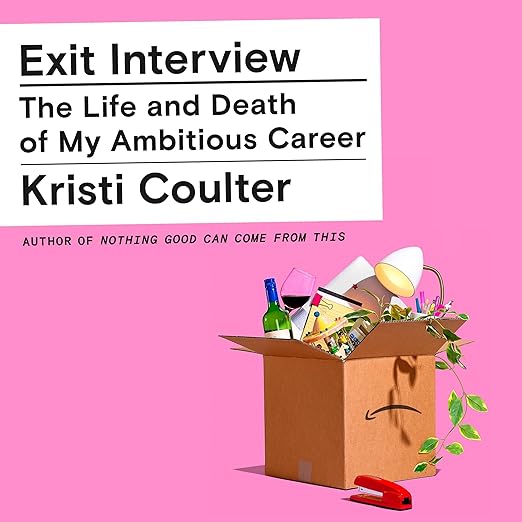
Kristi Coulter reading Exit Interview herself is not a minor detail. This audiobook about twelve years inside Amazon, narrated in the first person by the woman who lived them, carries a quality of self-examination that the text alone cannot fully convey. The author of Nothing Good Can Come from This - a 2018 essay collection about sobriety that became a beloved piece of personal writing - brings the same unflinching self-awareness to this longer form, and you can hear it in the way she reads certain sentences: not triumphantly, not bitterly, but with the particular precision of someone who has spent real time understanding what happened to her and why.
Coulter joined Amazon in 2006, when it was fast-growing and exciting and offered exactly the scale of challenge she had outgrown at her previous job. What she found was seven-day workweeks, lifeboat exercises - a practice in which teams compete to justify their survival during budget cuts - widespread burnout, and a culture driven by fear as thoroughly as it was driven by ambition. The stock options proved intoxicating enough that she stayed for twelve years. Exit Interview is about why she stayed, what the staying cost, and the moment she stopped recognizing the face in the mirror.
The People-Pleasing, the Oversized Responsibility
The book is wickedly funny in the way that very precise writing about very painful things can be funny - the comedy emerges from accuracy rather than performance. Coulter's prose has the quality described by multiple reviewers as relatable beyond tech: one reader, whose career spanned government, PR, and higher education, notes that Coulter told their story despite having never worked at Amazon. The specifics are Amazon-specific; the architecture of the experience - the people-pleasing, the oversized sense of responsibility, the "am I invisible or did I just say that?" sensation of watching someone else take credit for your contribution - is not.
The gender dimension of the book is central rather than incidental. Coulter argues that Amazon loves the idea of female ambition while balking at the reality of it, and she documents this not through statistics or secondhand testimony but through her own carefully observed experience. The reviewer who described the book's treatment of this as "constant man-hating" is reading the text uncharitably - what Coulter is describing is institutional rather than individual, and she is careful to distinguish between the men she respected and the structural dynamics that her gender made navigating differently. The distinction matters, and she makes it clearly.
Losing an Entire Day to Coulter's Prose
The ten-hour-and-forty-eight-minute runtime is longer than most business memoirs, but it earns the length. Coulter is not padding a shorter book with anecdotes - she is building a sustained argument about ambition, gender, and the psychology of institutional loyalty that requires time to establish properly. The early chapters, which establish the appeal of the Amazon culture and the genuine excitement Coulter felt in her first years there, are as important as the later ones. You cannot understand the cost without first understanding the seduction, and Coulter gives both their due.
The reviewer who described starting the book over morning coffee and willingly losing the entire day to it speaks to the prose quality as much as the story. Coulter writes with enough structural control that the narrative moves - there is no point in ten hours where you are waiting for something to happen. The structure is roughly chronological but organized around emotional and professional developments rather than calendar years, which keeps the arc of the story legible without reducing it to a timeline of promotions and crises.
Lifeboat Exercises Rendered With Dark Humor
The book is explicitly about one person's experience of Amazon's culture during a specific period - roughly 2006 to 2018 - and it does not attempt to be a comprehensive account of the company. Readers who know former Amazonians will recognize much of what Coulter describes; readers who have worked in comparable high-intensity corporate environments will recognize even more. This is not a whistle-blower account or an institutional investigation. It is a memoir, and memoir operates by selection and angle rather than comprehensiveness. Coulter is making an argument about her experience, not filing a report, and that distinction shapes both the book's limitations and its considerable strengths.
The connection to her previous book - Nothing Good Can Come from This, about sobriety - surfaces in Exit Interview in ways that add dimension without requiring familiarity with the earlier work. Coulter is interested in the things people stay with past the point of benefit, and the corporate loyalty she examines here operates in parallel to the addiction she examined before. The resonance is never explicit or self-congratulatory, but listeners who know both books will find the conversation between them rewarding.
It is also worth noting the specific way Coulter frames the book's relationship to the company she is writing about. Exit Interview does not read as a grievance document, and this is not because Coulter softens what happened to her but because she is consistently more interested in understanding the mechanism than in assigning blame. The lifeboat exercises she describes, in which teams compete to justify their own survival during budget cuts, are rendered with the same precision and dark humor as the moments of genuine excitement and accomplishment. The book holds both without collapsing either into the other, which is what separates serious memoir from either score-settling or nostalgia.
More Resonant Than the Amazon Framing Suggests
This audiobook is essential for anyone who has ever stayed somewhere past the point it was healthy, wondered why ambition and self-worth got so tangled up, or wanted a precise account of what it is actually like inside a company that prides itself on a culture of high expectations. Corporate professionals in any industry will find it more resonant than the Amazon-specific framing suggests. Skip it only if you are looking for a business analysis of Amazon as a company - Exit Interview is personal testimony rather than institutional diagnosis. The testimony is more valuable for it.
- Voice: Kristi Coulter narrates her own audiobook, and the self-narration is essential - her delivery of the book's dry, precise, often furious humor lands with a specificity that no third-party narrator could replicate.
- Big ideas: Ambition and its costs, gender dynamics in corporate culture, the slow erosion of self in service of an institution
- Atmosphere: Sharp, funny, rueful, and finally unflinching
- Worth it?: One of the most precise accounts of what corporate life actually costs, and Coulter narrating her own story adds a layer of reckoning that makes the already excellent prose hit harder.
Does Kristi Coulter narrate the Exit Interview audiobook herself?
Yes, and the self-narration is central to the experience. Coulter's delivery of the book's dry humor and its more painful passages carries a quality of hard-won understanding that third-party narration could not replicate. It is one of those audiobooks where the author's voice reading their own words changes what the words do.
Is this audiobook primarily about Amazon, or is it relatable to people in other industries?
Multiple reviewers with careers in government, education, and PR describe it as telling their story despite never having worked in tech. The Amazon specifics provide the setting and texture, but the emotional architecture of the experience - ambition, gender dynamics in institutions, loyalty past the point of benefit - is broadly recognizable.
Is the Exit Interview audiobook suitable for someone who has never worked at Amazon?
Entirely. The book's power comes from the universality of its observations about ambition, institutional loyalty, and gender, not from insider knowledge of Amazon's specific practices. The Amazon context provides credibility and texture, but familiarity with the company is not required to find the memoir compelling.