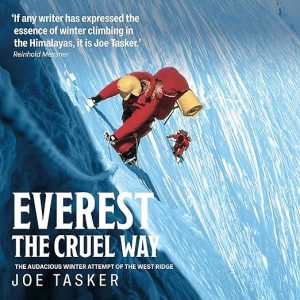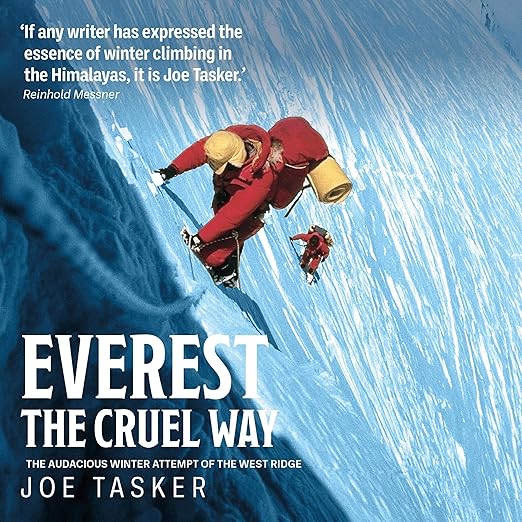
Joe Tasker begins this audiobook at 24,000 feet on the west ridge of Everest on January 30, 1981, with the team below him functionally incapacitated and further progress looking impossible. Everest the Cruel Way, narrated by Stewart Crank and running 6 hours and 44 minutes, is Tasker's account of the attempt to climb the world's highest peak by its most dangerous route - the west ridge - in winter, without supplemental oxygen. That combination of variables, which no team had previously attempted together, gives the audiobook its dramatic stakes before Tasker has described a single day of the expedition. The book is also, inevitably, read with the knowledge that Tasker died on Everest the following year.
Tasker was, by the early 1980s, one of the most accomplished alpine-style climbers alive. His lightweight-approach philosophy - small teams, no fixed ropes across the full route, no high-altitude porter support - had already produced landmark ascents in the Greater Ranges with partners including Peter Boardman and Dick Renshaw. The Everest west ridge winter attempt was a direct application of that philosophy to the hardest possible objective at the worst possible time of year. The Himalayan winter means sustained winds that have driven other expeditions from lower on the mountain, temperatures that turn manageable cold into cellular-damage cold, and days so short that useful climbing time compresses to a fraction of what summer expeditions enjoy.
Tasker writes with intelligence and self-awareness. He does not romanticize the suffering into nobility; he describes it with the forensic honesty of someone who found the question of why he does this genuinely difficult to answer. One reviewer called the book "totally absorbing" specifically because of its day-to-day fidelity - the life in snow caves, the systems for melting water, the degradation of physical capacity over weeks at altitude. That reviewer was right that this level of granularity will not suit every listener, but for those who find the interior of expedition life compelling, the detail is the point. Another reviewer, less satisfied, called it slow-paced and gave it three stars, noting that the daily-life sections outweighed the dramatic incident. Both responses are honest and both are describing the same book.
The Strengths
Stewart Crank's narration carries the tone of the material well. Tasker's prose is deliberate and specific rather than cinematic, and Crank does not attempt to impose drama where Tasker has chosen understatement. The measured pacing works particularly well in the sections where exhaustion is the dominant condition on the mountain - a reading style that telegraphed urgency would actually undercut those passages. Crank captures the accent and sensibility of a British mountaineering account without making it feel like a period piece, which is a genuine challenge given that this is a 1981 text about 1981 events.
The shadow over the entire listening experience - one that any reader engaging with Tasker's work eventually confronts - is the knowledge that he died on Everest the following year. In 1982, attempting a new line on the northeast ridge with Peter Boardman, Tasker and Boardman disappeared at high altitude and were never found. The audiobook does not reference this, as it could not, but listeners who know the biographical context hear every sentence from 1981 with the knowledge of what comes next. That knowledge adds a weight to passages that might otherwise read as straightforward adventure documentation, turning the account of this one expedition into something that feels like a final statement on what he valued about the mountains and why he kept returning to them.
Things to Know Before Starting Everest the Cruel Way
The audiobook also asks listeners to accept a degree of mountaineering technical vocabulary without glossary support. Tasker assumes his reader understands what fixed ropes, siege-style versus alpine-style climbing, and high-altitude physiological degradation mean in practical terms. The audio format does not allow the glossary check that a print reader might do, so listeners without prior exposure to mountaineering literature may find some technical passages harder to follow than they would on the page. The internal dynamics of the expedition team - specific tensions and negotiations that any small team enduring months at altitude develops - are described with a honesty that is admirable but that also requires the reader to do some interpretive work without the benefit of the other climbers' perspectives.
The retreat in this book is honorable and the writing is honest about why it happened, but the absence of a summit is real and the middle sections are demanding for listeners expecting conventional adventure pacing with an escalating arc toward resolution. This is not that structure.
Recommended For
Listeners who have already read Into Thin Air or Touching the Void and want to move deeper into Himalayan mountaineering literature will find Tasker's writing a step up in literary seriousness and a step down in narrative accessibility - which is to say, it rewards more. Anyone interested in the history of lightweight alpine-style climbing in the Greater Ranges will find this audiobook essential source material. The west ridge winter attempt sits in a specific tradition of technically ambitious British mountaineering, and Tasker's account of it is as close to primary source as this genre produces.
Listeners who need narrative propulsion to sustain six hours of audio, or who want expedition writing that builds to a triumphant summit, should choose a different title. The reward of this audiobook is in the quality and honesty of the writing, not in what the climbing achieves.
- Narration: Stewart Crank suits the measured, unsentimental quality of Tasker's prose - deliberate pacing that matches the physical and psychological attrition the text describes.
- Themes: Limits of the human body at extreme altitude, Alpine-style philosophy against the mountain, posthumous biographical weight
- Mood: Austere and physically immersive, demanding of the listener's patience
- Verdict: A serious Himalayan mountaineering audiobook that rewards patient listeners and history-of-climbing enthusiasts - not for those who want conventional adventure thriller pacing.
Common Questions
Does this audiobook require prior knowledge of mountaineering to enjoy?
Some background helps. Tasker assumes familiarity with concepts like alpine-style versus siege-style climbing and the physiological effects of high altitude. Listeners who have read books like Into Thin Air or Touching the Void will have enough context to follow the technical passages. Total newcomers can still follow the human story but will lose some of the significance of the tactical choices.
Is this audiobook appropriate for casual adventure listeners or does it require specialized interest?
Specialized interest helps significantly. The book is detailed and deliberately paced, with sustained focus on the daily texture of high-altitude life rather than dramatic incident. Listeners who find the interior of expedition logistics compelling will be rewarded; those who need conventional adventure narrative beats will struggle.
Does the audiobook address Joe Tasker's death on Everest the following year?
No - the book is Tasker's own account written in 1981, before his 1982 death on Everest's northeast ridge. The biographical notes in some editions reference it, but the narrative itself does not and cannot. Listeners who know the context will hear the audiobook through that shadow, which adds considerable weight to the material.
How does this audiobook compare to other classic Himalayan expedition accounts?
Tasker's writing is more literary and introspective than most expedition accounts, which tend toward heroic narrative. The closest comparison in tone is Peter Boardman's writing - unsurprisingly, since the two climbed together regularly. It sits in a specific tradition of thoughtful British mountaineering literature that prioritizes honesty about failure and uncertainty over triumphalism.