The Short Version
- Performance: Lisa Flanagan delivers each City Spy with a distinct energy, handling the multi-city sprint of Rome, Paris, London, and Amsterdam with clean pacing and no blurring of voices.
- What it covers: International espionage, found-family loyalty, code-breaking under pressure
- Feel: Kinetic and propulsive, with genuine stakes for middle-grade readers
- Our call: Book seven earns its place as one of the strongest entries in the series, deepening Sydney's arc while keeping the globe-trotting action completely fresh.
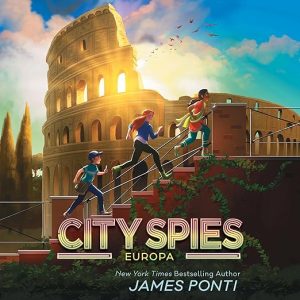
Umbra's ultimatum arrives in the City Spies audiobook's seventh installment with cold precision: release me from prison, or high-level targets across Europe will fall. James Ponti, Edgar Award winner and author of the New York Times bestselling City Spies series, narrated by Lisa Flanagan, has constructed Europa as a genuine ensemble piece, splitting his team across four capitals simultaneously and trusting his audience to track every thread. It is a bold structural bet for a middle-grade thriller, and it pays off in ways that make this the entry reviewers call the best in the series.
Ponti has always been skilled at the mechanics of espionage plotting, but Europa elevates the emotional stakes in a way that earlier books in the City Spies series only gestured toward. The decision to give Sydney a second focal arc addresses what reviewer Michelle Halbert identified as a gap in the second book, where her character lacked sufficient backbone. Sydney now carries scenes on her own terms, and the series is richer for it. Tru's shift from boss to mentor adds institutional depth that keeps the team's dynamics from feeling static across seven volumes. Ponti knows that the best spy fiction is not really about the mission; it is about what the mission reveals about the people running it, and the ensemble format gives him more people to reveal than a solo-hero structure would allow.
The Great Dismal Swamp Grounds a Global Chase
The codes and puzzles embedded in the Rome-to-Amsterdam chase are genuinely clever rather than decorative. One reviewer notes they are imaginative and interesting without becoming frustrating, which is the exact calibration Ponti is aiming for: solvable enough to keep younger readers engaged, surprising enough to feel earned. The action is steadily paced, never lurching into chaos, which is a real discipline when you are managing four plot threads across as many cities simultaneously.
The Great Dismal Swamp sequence functions as the structural centerpiece of the book even though it is technically a side thread rather than the main Umbra plot. Ponti uses Virginia Beach hurricane aftermath as a texture that grounds the European spy work in something more immediate and tangible, a reminder that the real world's disasters create the conditions in which criminal networks thrive. Readers who have been following Clementine's arc from the cold will find her new position in the team satisfying without being sentimental. Ponti does not linger; he trusts the reader to feel the weight of the change.
Flanagan Differentiates the Team Across Europe
Lisa Flanagan has been the voice of this series long enough to have built genuine character profiles for each spy, and that investment shows here. When the team splits across Europe, she differentiates their scenes cleanly, so there is no moment of disorientation when the narrative cuts from London back to Amsterdam. Her read of Umbra's menace is restrained rather than theatrical, which is exactly the right call for a villain whose power comes from leverage rather than spectacle.
At six hours and forty-two minutes, Europa runs at a pace that fits naturally into a family listening routine: long enough to feel complete, short enough to finish over a weekend. The reviewer Lauren captures something real when she says she wishes the series never ended, and that sentiment lands hardest in a format where Flanagan's voice has become as familiar as the characters themselves. Parents who have been reading these aloud at night, as several reviewers mention doing, will find the audio version an equally engaged experience. Flanagan's ability to keep each spy's voice distinct across the full cast prevents the four-capital structure from becoming confusing even when the narrative cuts between locations rapidly.
Trust Tested When the Team Can't Coordinate
Watch for how the book handles the question of trust across the split-team format. When the spies cannot coordinate in real time, they have to rely on what they know about each other, and Ponti uses that constraint to test each character's judgment independently. It is a craft move that a series this long can afford to make, and it distinguishes Europa from earlier installments where the team operated more cohesively. The Umbra plot resolves with the kind of satisfying complexity that rewards attentive readers without punishing those who missed a clue, which is harder to achieve in multi-thread structure than it appears.
Series veterans will also find the long-arc payoffs in this volume more emotionally substantial than the individual-mission structure might suggest. Ponti has been building character histories for seven books, and Europa draws on those histories in ways that pay off quietly, without announcement, in the way that earned continuity always does. The book's confidence in its audience is part of what makes it work so well as the series matures: it does not stop to explain what readers already know, and that trust is itself a reward for the investment in earlier entries.
The Ensemble Choice Over a Solo Hero
This is built for middle-grade readers who have already invested in the series, and the series-entry warning applies firmly: starting at book seven means missing the character histories that give Sydney's arc and Tru's evolution their emotional weight. Begin with the first City Spies volume. For families who are current on the series, this is the most ambitious and satisfying entry yet. Adults reading along will find the geopolitical scaffolding more developed than they might expect from the genre, and the puzzle construction respectful of their intelligence as well as the children's. Readers who enjoy the Alex Rider or Spy School series will find Ponti working in the same register but with a stronger emphasis on the ensemble over the solo hero.