Quick Take
- Narration: Scott Luu narrates his own material in English, with native Japanese speakers handling all target-language content, the shadowing practice sections, where you listen and repeat after native speakers, are the most distinctive feature of the audio format.
- Themes: Travel-specific language acquisition, scenario-based learning, practical confidence before arrival
- Mood: Focused and encouraging, like a knowledgeable friend walking you through what you will actually encounter
- Verdict: A practical, travel-specific Japanese audio resource that prioritizes real-world usefulness over comprehensive grammar coverage, best suited for first-time Japan travelers.
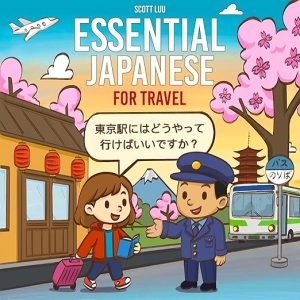
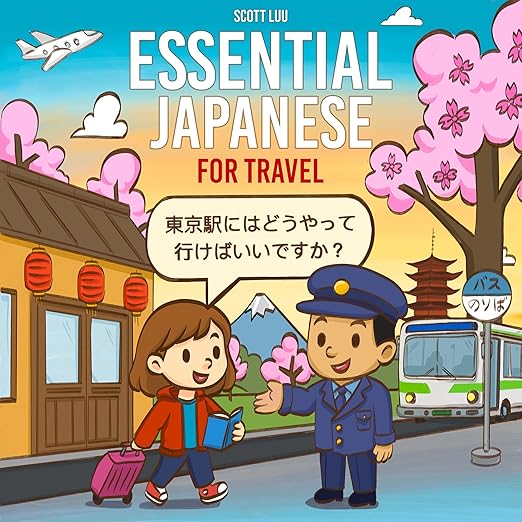
I have made enough trips to countries where I do not speak the language to know the specific anxiety that arrives about a week before departure: the sudden awareness that knowing how to order coffee and ask for directions in a foreign language would make everything easier, and the equally sudden awareness that you do not. Scott Luu’s Essential Japanese for Travel targets that exact window, the pre-trip crash course for people who want functional phrases, not a language degree.
Luu’s background gives him useful credibility here. He lived in Japan and experienced firsthand the frustration of not understanding what service workers were saying to him repeatedly, in contexts that did not change much from day to day. That specific experience, being in a convenience store or navigating a train station and missing the same exchanges again and again, is what shaped the book’s structure. Each chapter covers an inevitable scenario: the convenience store, stating dietary restrictions, the train station, directions, ordering food, making reservations, dining, buses, accommodations, making friends. These are not arbitrary categories. They are the actual situations you will encounter.
Our Take on the Shadowing Practice Sections
The most genuinely useful feature of this audiobook is the Shadowing Practice sections, where native Japanese speakers model the dialogue and listeners repeat after them. Shadowing, listening and repeating simultaneously or just after, is one of the more evidence-backed methods for building pronunciation fluency and internalizing rhythm. Most travel phrase books give you romanized Japanese to read; Luu’s audio format gives you native-paced speech to imitate. That is a meaningful difference for audio learners.
Reviewer P. Chen’s account is illuminating: after a first Japan trip where not knowing basic phrases was genuinely inconvenient outside major cities, they found this book’s scenario-specific structure cut straight to what they needed. That directness, skipping vocabulary that sounds impressive but never appears in daily life, is Luu’s explicit design philosophy. The accompanying PDF booklet, available in the Audible library alongside the audio, adds written reinforcement that helps consolidate what the listening sessions introduce.
Why Listen to This Over Duolingo or a Standard Phrasebook
Duolingo’s gamified structure is useful for building daily habits but notoriously inconsistent about what it prioritizes. You might spend weeks on vocabulary that never appears in a convenience store, which is where you will actually be spending time in Japan. Standard phrasebooks give you text but not pronunciation. Luu’s audiobook is designed specifically for the travel context, with native-speaker audio modeling the sounds you need to produce, not just the text you need to read.
Theresa Ellsworth’s review notes that even with minimal Japanese skills, the clear explanations and hands-on exercises built real confidence. The key word there is hands-on, this is not a passive listen. It requires participation, which makes it less suitable as background audio and more suitable as a focused practice session.
What to Watch For in This Audiobook Specifically
The basics sections, numbers, time, counters for objects and food, dates, are scattered through the course rather than front-loaded, which some listeners may find disorienting if they want to do the foundational work first. The twelve-hour runtime is also longer than the scenario-driven content alone might suggest, because each chapter includes explanation, dialogue breakdown, vocabulary review, and shadowing practice. The format is thorough, but it requires genuine engagement. Listeners who want a quick-reference tool will be better served by the PDF; the audio is for active learning, not lookup.
Who Should Listen to Essential Japanese for Travel
First-time Japan travelers who want to arrive with functional spoken Japanese, particularly outside the Tokyo-Kyoto tourist corridor where English signage becomes less reliable, will find this the most practical audio resource available for that specific purpose. It also suits learners who have done some Japanese study through apps and want a spoken-language complement that addresses real-world scenarios. Skip it if you are at an intermediate level or above, the content is aimed squarely at beginners and will not cover grammar or vocabulary beyond what the named scenarios require.
Frequently Asked Questions
Does this audiobook teach any reading of Japanese, such as hiragana or katakana?
No. The focus is entirely on spoken Japanese for travel scenarios. The accompanying PDF handles some written reference, but the course does not teach the Japanese writing systems. For that, a dedicated resource would be necessary.
What are the shadowing practice sections, and how do they work?
After each explanation chapter, native Japanese speakers model the dialogue for the scenario. The shadowing practice involves listening to those lines and repeating them, copying pronunciation, rhythm, and intonation. This technique is used in language acquisition research and is one of the more effective methods for building spoken fluency through audio alone.
Is the PDF booklet included automatically, or does it need to be downloaded separately?
According to the publisher, the accompanying PDF is available in your Audible Library alongside the audio. It should appear with the audiobook purchase and functions as a written reference to reinforce the audio content.
How does this compare to Paul Noble’s Japanese beginner course for a first-time learner?
Noble’s course is broader, covering general conversational Japanese with an emphasis on grammar scaffolding. Luu’s course is narrower and more scenario-specific, oriented entirely around travel situations you will actually encounter in Japan. For someone planning a trip soon, Luu is the more immediately practical choice; for someone building toward general Japanese ability, Noble’s course covers more ground.