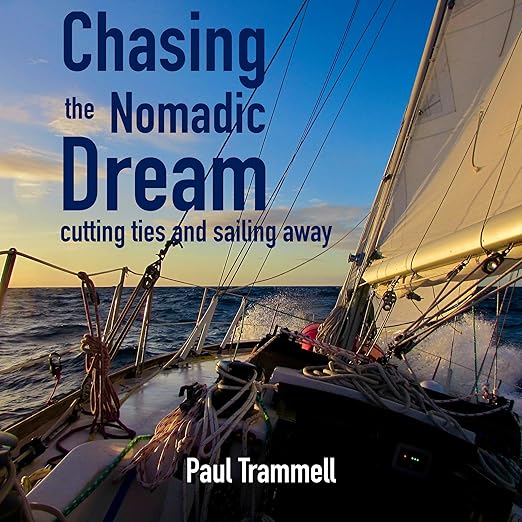
Selling the house comes first in this audiobook, which tells you what kind of sailing story it intends to be. Paul Trammell disposes of everything that will not fit aboard, buys an old boat in Massachusetts, moves onto it, and leaves alone with a deadline: reach the Bahamas before winter catches him on the way down. No crew, no sponsor, no camera team. One person, a secondhand hull and a calendar that will not negotiate.
How Chasing the Nomadic Dream Holds Up
What follows is a singlehanded passage down the coast and across to the islands, written as a logbook with the dull parts left in. Weather that shows up early. Gear that fails at the least convenient hour. The particular exhaustion of a solo watch schedule, where nobody relieves you so that you can sleep. The description is honest that this is nonfiction adventure rather than instruction, and the distinction shapes everything that follows.
December 14, 2024 brought the only report filed after this recording existed, and it maps the contents accurately: a first-person account of a solo trip from the east coast of North America to the Bahamas aboard a recently purchased forty-foot boat, taking in bad weather, equipment glitches and the joys and regrets of a maiden voyage. Spearfishing, island trails, anchorage logistics and the occasional new friend are threaded through the sailing itself.
Nothing in the book presents Trammell as an expert, which is its most appealing quality. Skills develop across the voyage and the errors stay in the text. That is unusual in a genre where the narrator generally knows everything by chapter two, and it makes the passages of real jeopardy land harder, because a reader has already watched the same person misjudge much simpler things earlier in the same voyage.
An everyday person approach to cruising life is how a January 2023 five-star describes it, and that phrase sells the book better than the copy does. The same report frames it as encouragement for an aspiring solo offshore sailor on a budget, which is the genuine proposition here. Not a millionaire's circumnavigation with a professional delivery crew, but somebody with an old boat and a plan doing what most people who own the books never quite get around to.
Trammell reads it himself, and on this material that is the natural arrangement rather than a compromise. A first-person logbook full of decisions and second-guessing sits closest to its writer's own voice, and the description already pitches the audio at offshore sailors looking to gain experience through listening. The person who made the calls is the person explaining them, which counts for something when the explanation is the entire value.
The island half is the reward for the passage half. Spearfishing, surfing, hiking, and what the copy calls exploring both above and under the water, alongside the practical business of finding somewhere safe to drop an anchor. Anyone who has read cruising accounts knows the arrival usually gets compressed into a paragraph. Here it receives real time, and the change of pace from ocean to reef is the most satisfying transition in the book.
Weak Spots in Chasing the Nomadic Dream
Dates on the responses need reading carefully. This recording arrived in February 2024, and four of the five reports beneath it were posted earlier: November 2020, January 2021, September 2022 and January 2023. The oldest predates the audio by more than three years. Those grades belong to a book that existed only on the page when they were written, which is ordinary practice on a merged listing and still worth knowing before you lean on them.
Norm, filing four stars in January 2021 after reading it on a screen, reports that the formatting and the photos came through fine, which raises the question this listing never addresses. The description promises GPS locations of anchorages, photographs and poems. Coordinates read aloud are unusable. Photographs cannot travel at all. Poems survive the crossing better than either, but anchorage data is precisely why a cruising sailor would buy this, and none of it can be scrubbed back to on a phone at sea.
The number on the page, 4.2 across 210 ratings, sits below the five written reports, which average out at 4.6 between them. Roughly two hundred people graded this without writing a word, and the handful who did write liked it rather more than the crowd did. The record is also entirely self-owned, with author, narrator and publisher fields all carrying the same name, which explains both the missing marketing apparatus and the unusually personal book.
The Right Listener for Chasing the Nomadic Dream
A September 2022 four-star praising a direct, conversant writing style, and noting that the author's developing sailing skills get discussed openly, identifies the core audience precisely. Readers who want prose rather than performance, and who would rather follow somebody learning than somebody lecturing, belong here. That report also signs off promising to read more of the same, which remains the most reliable compliment in the whole business.
Armchair sailors are named in the description and genuinely well served, since the account is immersive enough to work as vicarious travel on its own. Anybody actually preparing a first offshore passage on a small budget gets considerably more: a realistic account of what breaks, what it costs in sleep, and how an ordinary person manages both. Divers and spearfishers will find the Bahamas chapters reason enough by themselves.
Manuals exist, and this is not one of them, because every lesson here arrives embedded in a story rather than set out as a checklist. Anyone who needs the reference material, the coordinates above all, will want a printed edition sitting beside this one. Sailors after studio polish should know what a self-produced recording is, and then decide whether they would rather hear the voice of the person who was actually out there at three in the morning.
- Narrator: A self-produced recording of a first-person logbook, read by the person who kept it, with no label, no engineer and no second voice named anywhere on the record.
- Subjects: Singlehanded offshore sailing, downsizing onto a boat, the Bahamas above and below the water, learning in public
- Tone: Plain-spoken and occasionally hair-raising
- Bottom line: The most honest kind of sailing memoir, provided you accept that the reference material the copy promises does not survive the format.