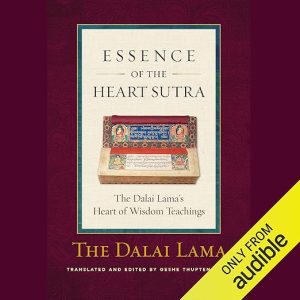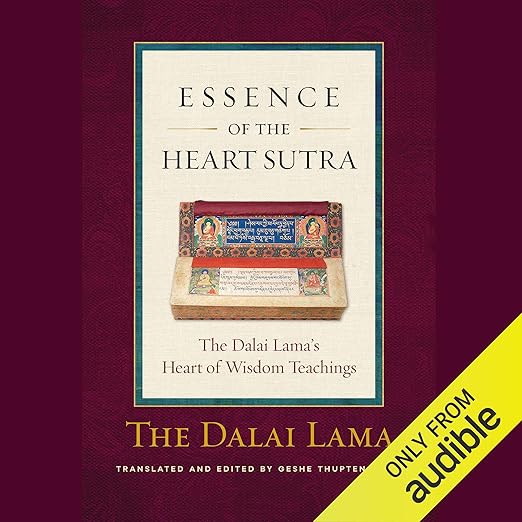
Tenzin Gyatso the Fourteenth Dalai Lama's Essence of the Heart Sutra is the kind of audiobook that rewards a particular kind of listening: not the distracted half-attention of a busy morning, but the deliberate quiet of time set aside to sit with something difficult and important. At three hours and forty minutes, narrated by Gabra Zackman, it is not long. But the Heart Sutra itself is famously brief; its full text can be recited in minutes. The Dalai Lama's commentary works by depth rather than breadth, unpacking a text that has been part of daily Buddhist practice for more than two thousand years with patience and precision that repays close attention. The audiobook preserves those 2001 Heart of Wisdom talks delivered to thousands of listeners, making them available to any listener regardless of background in Buddhist philosophy, which is both the Dalai Lama's specific intention and the book's most significant practical achievement.
The Heart Sutra's central teaching concerns emptiness, sunyata in Sanskrit, and the radical philosophical claim that all phenomena, including the self, lack inherent independent existence. For people new to Buddhist philosophy, this can sound like nihilism or a form of denial. The Dalai Lama's entire commentary project is to demonstrate why it is the opposite: understanding interdependence and the absence of a fixed, permanent self is precisely what releases us from suffering and makes genuine compassion possible. He is writing and teaching for a broad audience, and the accessible overview of Buddhist philosophy he provides alongside the sutra itself gives listeners who have never encountered these ideas before a genuine foothold from which to engage with the teachings rather than simply absorbing their surface form without comprehension.
Scholar and translator Thupten Jinpa's contributions to this edition are worth naming explicitly. Jinpa is His Holiness's principal English translator and one of the foremost scholars of Tibetan Buddhism working in English today. The near-symbiotic relationship between the Dalai Lama's teaching and Jinpa's translation and annotation, as one reviewer described it, gives the book a coherent exposition that one might not expect from material compressed into under four hours of audio. The result is a careful, layered commentary that functions both as an explanation of this specific sutra and as a usable introduction to the Madhyamika philosophy that underpins all of Mahayana Buddhist thought and practice.
The Strengths
Gabra Zackman narrates with a calm authority well-suited to the material's intellectual and spiritual character. The Dalai Lama's prose, in translation, is precise and measured; it does not reach for rhetorical effect or emotional manipulation of the listener. Zackman's delivery honors that quality consistently across the audiobook's runtime. She handles the Sanskrit and Tibetan terms that appear throughout the text with confident pronunciation, which matters considerably for listeners encountering terms like prajna paramita, bodhisattva, and Madhyamika for the first time and needing those terms to sound stable and reliable rather than uncertain. The pacing gives complex philosophical passages room to register rather than rushing past them in the way a more performative reading might choose to do.
The audiobook's 4.7 rating from 235 listeners represents a genuine consensus about the book's quality built across a sustained period of readership. One reviewer described the experience with the sensation of the audiobook ending too soon and then realizing that quality itself was the revelation, a sign of fully realized teaching rather than insufficient content. Another described the commentary as the best summary of Madhyamika philosophy they were likely to find anywhere in a single accessible text. At under four hours, the audiobook is accessible enough to be listened to more than once, and the structure supports repeat engagement naturally: each pass through the commentary tends to surface dimensions that prior listenings had not fully registered.
Before You Commit to Essence of the Heart Sutra
The audiobook is taught content, not narrative. Listeners expecting a story, a memoir, or a collection of personal anecdotes will find the philosophical lecture format, even in the Dalai Lama's warm and accessible form, requires a different mode of attention than most audiobook listening. The concepts build on each other carefully, and a listener who drifts in the middle sections may find the later passages less accessible without the earlier framework properly in place. The relatively brief runtime makes this manageable, but the audiobook rewards consecutive listening over fragmented sessions more than most titles of equivalent length.
The Buddhist framework is foundational rather than decorative throughout. Unlike some spiritual audiobooks that apply religious vocabulary loosely to secular self-help content, this is a genuine teaching on Buddhist doctrine and practice. Non-Buddhist listeners will find it welcoming, as the Dalai Lama explicitly addresses practitioners and general readers alike, but the teaching is always situated within a Buddhist understanding of reality, suffering, and liberation rather than a generic modern spirituality without doctrinal content or philosophical substance.
Recommended For
This audiobook is a genuine gift for curious listeners at any level of Buddhist knowledge or practice. Complete beginners will find the Dalai Lama's overview of Buddhist philosophy a more generous and useful introduction than most dedicated introductory texts manage to be within a comparable scope. Practitioners with existing knowledge will find the commentary on emptiness and interdependence nuanced enough to reward sustained attention and multiple return visits. Listeners interested in comparative religion, philosophy of mind, or the nature of compassion and suffering as intellectual questions rather than exclusively matters of personal faith will find Tenzin Gyatso the Fourteenth Dalai Lama a rigorous and welcoming guide. Anyone who has found other Buddhist introductions either too simplified or too technically demanding should make this audiobook their next attempt at engaging with these ideas.
At a Glance
- Narrator: Gabra Zackman brings respectful clarity to the Dalai Lama's commentary, managing the philosophical density with steady pacing that gives difficult concepts room to settle.
- Subjects: Emptiness and interdependence, compassion as practice, Buddhist philosophy in daily life
- Tone: Quiet, instructive, and deeply settled
- Bottom line: The Dalai Lama's commentary on the Heart Sutra is among the most accessible entry points into Mahayana philosophy available in any format, delivered with appropriate gravity in this audiobook.