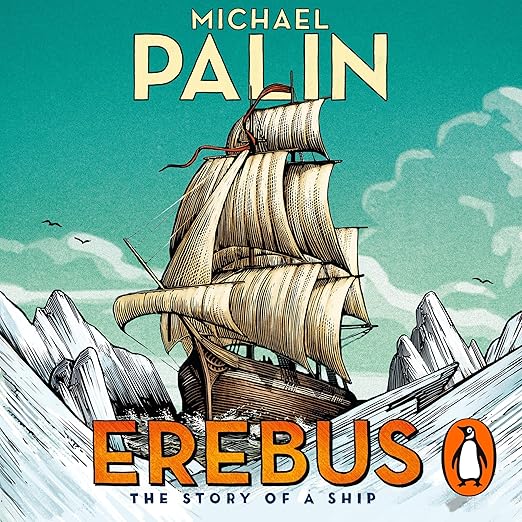
The Short Version
- Read by: Palin reads his own book for Penguin Audio, so the writer on the page and the traveler who went to the places are the same person at the microphone.
- At its heart: Two voyages of a single ship, polar ambition in the early years of Queen Victoria's reign, a disappearance that stayed open for 160 years
- Vibe: Companionable, cold, quietly elegiac
- Short version: Popular history at its most durable, held back only by a listing that conceals what the book is actually about.
Penguin Audio published this in 2018, and the listing has gathered exactly six ratings since, a strange total for an audiobook whose own copy calls it a Sunday Times bestseller and a BBC Radio 4 Book of the Week. Five of those six are written responses, graded five, five, four, five and five, which totals twenty-four. No whole-star sixth vote turns that into the 4.6 on display: a three would give 4.5 and a four would give 4.7.
How Erebus: The Story of a Ship Holds Up
HMS Erebus made two voyages that between them define nineteenth-century polar ambition. On the first she went further south than any human had been. On the second she disappeared into the wastes of the Canadian Arctic with a crew of 129 and with HMS Terror beside her, and stayed lost for more than 160 years before she was found in 2014. Palin's structural decision is to follow the ship through all of it rather than any single man aboard her, which proves to be the choice that makes the book work.
Palin is a travel writer by trade and the instinct shapes everything. He goes to the places, and the research arrives folded into the visiting rather than reported from a desk somewhere warm. Writing in September 2025 at the top grade, Suzanne LeGette describes the effect precisely: the story of a ship that carried a generation of explorers to their destinies, and delivered them either to wealth and fame or to a cold lonely death above the Arctic circle. That double ending is what the book is really about.
Antarctic material comes first and it is the genuine surprise. The Erebus is remembered almost entirely for vanishing, so the earlier voyage usually gets handled as prologue, and here it carries weight of its own. That reordering is what makes the second half land. By the time the ship turns north you have spent hours aboard her in her competent years, which converts the disaster from a piece of information into an actual loss.
Why Erebus: The Story of a Ship Works as an Audiobook
Michael Palin reading Michael Palin is the version of author narration that works, and a buyer confirms it in passing rather than as a set piece. One four-star buyer, posting in March 2022 under the handle julie, notes that his voice is lovely as usual, a judgment formed across decades of hearing him elsewhere and then carried into this recording. That same response values how the book is peppered with his own research and his visits to the places central to the story, which is where the added context comes from.
One thing the copy never tells you is that this is a Franklin book. The description names the ship, the crew of 129, the Terror and the 2014 discovery, and never once names the expedition itself, which is the phrase most buyers hunting for this story will be typing. Buyers supply it themselves in the written responses instead, a fair sign of the distance between how this listing was written and how the book actually gets found.
Blurb stacking is the other oddity worth noting. The description carries endorsements from Bill Bryson, the Guardian, Nicholas Crane, the Sunday Times, David Baddiel writing in the Daily Mail and The Times, then interrupts itself with a line announcing that Michael Palin's North Korea Journals is now available. A promotion for a different book sits inside the copy for this one, directly beneath a row of garbled underscores nobody bothered to clean up before publication.
Weak Spots in Erebus: The Story of a Ship
Eleven hours is a manageable commitment, and the real caution here concerns expectation rather than length. The description sells a mystery with a solution attached, and the solution arrives as a location rather than an explanation. Anybody hoping the 2014 discovery closes the question of what happened to the men aboard should understand that finding a wreck and knowing a fate are separate achievements, and no amount of narrative skill can make the record say more than it says.
Bill Bryson's line, beyond terrific and I didn't want it to end, is the most useful of the endorsements because it also flags the genre. Of the six quoted notices, five praise storytelling, wit and energy, and exactly one reaches for the research. This is narrative history written for general readers, and anybody wanting an academic reconstruction of the expedition will find the register companionable rather than forensic.
Skeptics leave the most useful testimony on this listing. Posting five stars in January 2025, JJGites went in loving Python and Palin while frankly doubting a nonfiction history book, and came out reporting work that is very well researched and very well written and impossible to stop. That is a reasonable proxy for the general reader's risk: the comedy credential raises a suspicion the book has to spend its opening hour quietly disposing of.
The Right Listener for Erebus: The Story of a Ship
Polar history readers are the obvious buyers and they are not the only ones. Elizabeth Newton, whose five stars date from February 2024, calls Palin a keen observer and a very good storyteller and values this as a different approach to a well known tragedy, which is exactly the right recommendation to pass along. If the broad shape of what happened is already familiar, the ship-first structure hands you a new angle on material you had filed as closed.
Approach with care if you want technical naval history or a forensic reconstruction of the final months. The pleasures on offer are literary and atmospheric, and the method is a writer walking the ground and following the record rather than a specialist adjudicating contested evidence. Anybody who came for that adjudication will find the register too relaxed and the attention drifting too often toward what those places feel like to stand in now.
Past that reservation, the pairing of writer and reader is about as good as author narration gets, and the subject is one of the few genuine epics the nineteenth century left unfinished. The listing undersells it comprehensively, with six ratings, a cross-promotion for a different title and no mention anywhere of the expedition everybody is searching for. The book underneath deserves considerably better packaging than it has been given.
Good to Know
Is the audiobook enough on its own, or does the subject need maps and pictures?
One buyer, Andrew Biggart, whose March 2025 response runs to five stars, recommends running the audio alongside a copy you can look at, and that advice is sound. Ship routes, latitudes and Arctic geography reward a glance at a chart. The listening stands alone perfectly well, but the illustrated edition adds something audio cannot.
Should a six-rating total put me off buying this audiobook?
Not at all. It reflects how few buyers on this storefront found a title whose quoted notices come from the Guardian, the Sunday Times and BBC Radio 4, not any weakness in the book. A small pool makes the average close to meaningless as a signal, so read the written responses instead, which run enthusiastic and specific about what they liked.