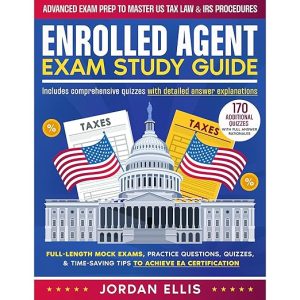
Enrolled Agent certification sits at a specific and demanding intersection: it requires mastering the US tax code well enough to represent taxpayers before the IRS, and the three-part Special Enrollment Examination covers individual taxation, business taxation, and representation, practices, and procedures in considerable depth. Jordan Ellis's Enrolled Agent Exam Study Guide, narrated in eleven hours and fifteen minutes via Virtual Voice, enters this market as a structured prep tool with full-length mock exams, practice questions, and chapter-end quizzes built around the exam's actual blueprint.
The target audience is specific and the audiobook knows it. Ellis writes for accountants, tax preparers, and financial services professionals who want to expand their credentials rather than for newcomers to tax concepts entirely. One reviewer identifies herself as a tax preparer who wants to up her skill set, and the guide's structure, moving through individual and business taxation before addressing IRS representation and ethics, maps directly to the three-part examination architecture. That alignment between content organization and exam structure is a deliberate and practical choice.
AI Narration Aside, Exam-Takers Report Passing
Virtual Voice AI narration is the elephant in the room for this audiobook, and it warrants direct engagement. For a study guide of this kind, where the content is predominantly definitional and procedural rather than narrative or character-driven, AI narration carries fewer liabilities than it would in fiction or memoir. The listener's primary need is accurate, clearly articulated information delivered at a manageable pace, and Virtual Voice fulfills that function competently for structured instructional content. That said, the narration lacks the strategic emphasis a skilled human narrator would bring to key exam concepts: what is a critical rule versus background context will sound identical unless Ellis's prose signals the distinction through structural choices rather than vocal cues.
The content itself draws strong praise from verified exam-takers. One reviewer passed the EA exam on her first attempt and credits the guide as her primary preparation tool, noting its comprehensiveness and logical categorization. Another reviewer, who had previously taken the exam without passing and felt undermined by second-guessing her answers, reports that the guide rebuilt her confidence through its structured approach to specific content areas. These are not generic endorsements; they are outcome-specific, and outcome specificity is the most credible form of praise in exam preparation publishing.
A third reviewer, already working as a tax preparer, notes the guide covers areas she needed to improve and makes the review process manageable at her own pace. The ability to pause, rewind, and absorb material at a self-determined rate is one of the genuine advantages of audio study for working professionals managing competing demands on their time and cognitive resources.
Five Promises for an Eleven-Hour Study Plan
Ellis structures the guide around five distinct value propositions: mastering core subject material through in-depth review, eliminating exam-day stress through mock exams and quizzes, optimizing a study schedule with time-saving tips, achieving tax code retention without cognitive overload, and bridging theory to practice through situational judgment scenarios. For an eleven-hour audiobook, that is a dense agenda, and the guide earns its length by following through on each element rather than expanding thin content to meet a runtime expectation.
The time-saving and schedule-optimization sections are particularly relevant for the stated target audience, working professionals who are studying around existing job responsibilities, family commitments, and client work. Ellis understands that the primary obstacle for most EA candidates is not intelligence or access to information but sustained, organized preparation under real workload pressure. The guide addresses that logistical challenge explicitly rather than assuming the reader has unlimited study time available to allocate at will.
The coverage of situational judgment and problem-solving for real-world scenarios is one of the more substantive differentiators in this category. Many exam prep guides focus on rule memorization at the expense of application, and candidates who pass the knowledge questions but freeze on application scenarios often find this the source of their failure. Ellis's explicit attention to bridging theory and practice reflects an understanding of where EA exam candidates actually struggle.
Passive Listening Cannot Replace Answering Mock Questions
This audiobook format has a real structural limitation for exam preparation content: the mock exams and chapter-end quizzes are fundamentally interactive. Listening to exam questions read aloud is a passive activity; answering them requires a different and more effortful cognitive mode. Listeners who use this audiobook as a supplement to the print or digital edition will get significantly more from the practice question sections than those relying on audio alone. The conceptual review sections covering taxation frameworks, IRS representation procedures, and ethics translate well to audio. The interactive testing components require supplementary materials to be used effectively.
The 4.6 rating across ninety reviews is robust and unusually credible for this genre. Exam prep books attract honest reviewers because the stakes are concrete and the test of effectiveness is objective. When multiple verified reviewers report passing on a first attempt or on a subsequent attempt after using this guide specifically, that is meaningful signal about its actual utility rather than its surface presentation.
Best for Commutes, Paired With the Print Edition
This audiobook works best for tax professionals preparing for the EA exam who want a comprehensive audio review to run during commutes, gym sessions, or other passive listening windows, ideally paired with the print edition for active practice. It is not a fully standalone tool for those who prefer exclusively interactive learning. Those with no existing tax background will find the pacing assumes at least foundational familiarity with tax concepts. For the intended audience, working professionals with some tax experience who are preparing to sit the SEE, it delivers structured, outcome-tested preparation that multiple verified candidates have turned into a passing result.
In Brief
- Narrator: Virtual Voice delivers the material clearly enough for study purposes but lacks the tonal emphasis a skilled human narrator would bring to priority exam concepts.
- Subjects: US tax code mastery, IRS representation certification, structured exam preparation under real-life time pressure
- Tone: Dense and methodical, built for utility over engagement
- Bottom line: A well-structured EA exam guide with verified first-pass success stories, best used as an audio supplement alongside the print edition rather than a fully standalone listening experience.
Does the Enrolled Agent Exam Study Guide audiobook cover all three parts of the Special Enrollment Examination?
Yes. The guide addresses Individual Taxation, Business Taxation, IRS Representation, Practices and Procedures, and Ethics, which maps directly to the three-part SEE structure. Multiple reviewers who sat the actual exam confirm the coverage aligns comprehensively with the tested content.
How well does Virtual Voice narration work for a dense tax exam audiobook?
For definitional and procedural content it is functional. The limitation is the absence of strategic vocal emphasis around high-priority exam concepts. Listeners should supplement with active note-taking rather than relying on tonal cues to signal what deserves the most attention during review.
Are there real EA exam success stories tied specifically to this audiobook?
Yes. Multiple verified reviewers report passing the exam after using this guide, including at least one who passed on a first attempt and one who had previously sat the exam without success. Outcome-specific endorsements of that kind carry more evaluative weight than general praise.