Quick Take
- Narration: Sean Pratt handles Mauldin’s dense economic argumentation with the measured pace financial content requires, making complex material navigable over nearly ten hours.
- Themes: Sovereign debt crisis, the limits of government spending, the long-term cost of kicking financial problems down the road
- Mood: Sobering, analytical, and deliberately unsettling about the available options
- Verdict: A serious, well-argued framework for understanding sovereign debt that rewards patient listeners willing to engage with economics at a level beyond headlines.
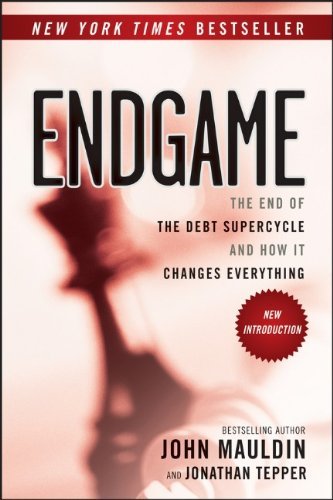
I came back to Endgame during a stretch of news dominated by debt ceiling debates and deficit projections, which is probably the correct context for a book about what happens when governments run out of road on their borrowing. John Mauldin wrote this when Greece was the headline example of a country drowning in debt, and the argument he makes is that Greece was a preview rather than an exception. The Debt Supercycle, his central concept, is still working through the developed world, and revisiting his framework in audio form felt less like reading financial history and more like reading a diagnosis that has not yet been fully metabolized by the patient.
Mauldin is a financial analyst and newsletter writer known for his ability to translate complex economic dynamics for sophisticated non-specialist readers. This is not a pop finance book. It presupposes a certain level of interest in how government debt accumulates, how it constrains policy, and what the eventual reckoning looks like. At nearly ten hours with Sean Pratt narrating, Endgame rewards patient listeners more than it rewards casual ones. The price point is above the free audiobook tier, which is worth factoring in, but for listeners engaged with macroeconomic questions the framework it provides has proven durable across years of subsequent events.
The Debt Supercycle as an Analytical Framework
The book’s central concept is the Debt Supercycle: decades of manageable debt growth that eventually produces a sovereign debt crisis when governments can no longer service obligations without printing money, imposing austerity, or defaulting. Mauldin argues this is not a cyclical problem with a standard recovery curve. It is a structural reckoning, and the choices available to governments at the endgame are uniformly painful. Restructure the debt or reduce it through austerity. There is no option three that leaves things approximately as they were.
The framework is analytically useful because it reframes what looks like a series of separate national crises, Greece, Ireland, Portugal, and eventually larger economies, as different expressions of the same underlying dynamic. Mauldin moves through demographic trends, government spending patterns, currency dynamics, and yield curves in a way that builds a coherent picture rather than surveying disconnected data points. For listeners who want to understand why sovereign debt crises happen rather than simply that they happen, this is genuinely informative. The book is organized to build its argument sequentially, and Sean Pratt’s narration respects that architecture with a pacing that allows each layer to land before the next arrives.
What the Book Gets Right About Austerity
The austerity analysis is the most practically useful section. Mauldin does not argue that austerity is politically easy or socially painless. He argues that the alternative, continuing to borrow against a future that cannot support the debt, is simply worse. The distinction he draws between countries that can print their own currency and those that cannot, the latter being the central problem for eurozone members, is handled with unusual clarity for a book covering this material. The EU case studies are vivid because the constraints are so starkly visible: currency union without fiscal union creates exactly the conditions that make sovereign debt crises hardest to manage.
The book also avoids the false comfort of partisan frameworks. Mauldin is not making an argument that the left or the right created this problem. He is arguing that the incentive structures of democratic politics, where politicians are rewarded for spending and punished for cuts, produce debt accumulation regardless of ideological affiliation. That structural critique is more useful than partisan blame-assignment and more durable across political cycles. It is also more uncomfortable, because it implies that the problem is not solvable by electing different people.
Sean Pratt and the Challenge of Dense Financial Audio
Sean Pratt is a reliable presence for nonfiction narration, and Endgame benefits from his measured, authoritative delivery. Financial content in audio form is hard to execute well because charts and data visualizations cannot travel across the medium. Pratt compensates with a pace that gives listeners time to process numerical information without allowing it to become a blur. He does not editorialize or perform the material. He delivers it, which is the right approach for content this technically dense.
Listeners who want to follow along with the quantitative content may find it useful to have reference material accessible for the more data-intensive sections, particularly those covering yield curves and debt ratios for specific countries. The oral format is less suited to tables and comparative data than the print edition, but Pratt’s delivery minimizes the loss as much as narration can.
Who Has the Patience This Book Requires
Listen to this if you want a serious analytical framework for understanding sovereign debt and the choices available to governments trapped by it. Particularly relevant for listeners interested in macroeconomics, the eurozone crisis, or long-range fiscal policy questions across developed economies. The book has held up well since publication because it is arguing a structural point rather than a specific political event, and the Debt Supercycle framework remains applicable to the current fiscal environment in the US, Japan, and Europe. Skip it if you are looking for personal finance advice or accessible money management guidance, since Endgame operates at the macroeconomic level throughout. Also not well-suited to listeners who want narrative drive in their nonfiction; this is an argument book, and the nearly ten-hour runtime reflects that density honestly.
Frequently Asked Questions
Is Endgame still relevant given that it was written during the Greek debt crisis, which has since receded from the headlines?
Yes, because Mauldin’s argument is structural rather than event-specific. He is not primarily writing about Greece but using Greece as the most visible early expression of a debt dynamic he argues applies to the US, Japan, and other developed economies. The framework for understanding sovereign debt accumulation and its eventual reckoning remains applicable.
Does the book require a background in economics to follow, or is it accessible to motivated non-specialists?
It sits between popular economics and specialist finance writing. Motivated non-specialists who are comfortable reading financial journalism will follow the argument. It is more demanding than pop finance titles but does not assume professional economic training. Patience with dense material is more important than prior knowledge.
How does Sean Pratt’s narration handle the quantitative content and data that are central to an economics book?
Pratt narrates numerical data clearly and at a pace that allows processing, but the audio format loses the visual context that charts provide. Listeners who want to follow along may find it useful to have the print edition accessible for the more data-intensive sections, particularly those covering yield curves and debt ratios.
Does Mauldin offer concrete predictions about which countries will face crisis, or is the book more of a general framework?
Both. He provides specific analyses of individual countries and regions, including the US, Japan, and eurozone members, assessing their particular debt dynamics and policy constraints. But the core argument is a framework applicable across different national contexts rather than a specific prediction with a timeline attached.