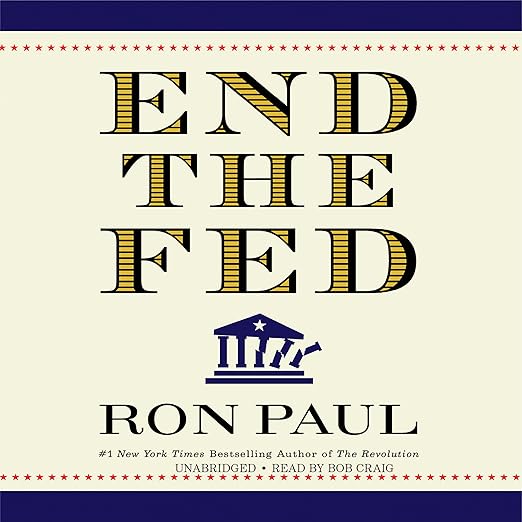
Ron Paul's central argument in End The Fed, narrated by Bob Craig, is not that the Federal Reserve is merely inefficient or poorly managed, it is that the institution is constitutionally illegitimate and structurally designed to serve the interests of those who created it rather than the broader public. That is a more specific and more historically grounded claim than the title's rhetoric might suggest, and Paul builds it with reference to American history, economic theory, and his own decades in Congress. This is an audiobook that takes seriously the possibility that a listener might disagree and attempts to address that disagreement rather than simply preaching to the converted.
At six hours and four minutes, the runtime is appropriate to the depth of argument. Paul covers the Federal Reserve's founding history, the private meeting at Jekyll Island that he presents as evidence of the institution's original design to serve the Morgan and Rockefeller interests rather than the public, the mechanisms by which currency inflation functions as a form of taxation, and the Austrian economic theory that underlies his alternative vision for monetary policy. Listeners need not share Paul's libertarian conclusions to find the historical and economic material substantive. The analytical sections hold up even for readers who come in skeptical of the political framing.
What separates this audiobook from simpler anti-Fed polemic is Paul's willingness to explain the mechanism of what he is criticizing rather than simply asserting that the Federal Reserve is corrupt. The sections on how inflation erodes purchasing power and functions as what he calls a hidden tax are genuinely instructive, and the comparison to Weimar Germany and Zimbabwe, however contested, gives concrete reference points for abstract monetary concepts. Whether listeners ultimately accept Paul's policy conclusions, the underlying economic concepts are explained clearly enough to be evaluated rather than merely accepted or rejected on political grounds.
Bob Craig's narration is well suited to this material. He delivers Paul's historical claims and economic arguments with a measured pace that allows the more technical passages to register, and he does not editorialize into Paul's more provocative statements, which is the right call for a narrator working with charged political material. The narration treats the listener as capable of forming their own judgments, which is consistent with the audiobook's own rhetorical stance. Craig's voice has a quality of considered authority that suits the congressional memoir sections particularly well, these are not abstract arguments but accounts of Paul's direct experience attempting to hold the Fed accountable, and Craig delivers them with appropriate weight.
The Jekyll Island story, the secret 1910 meeting between banking representatives and Senator Nelson Aldrich that Paul presents as the Fed's actual origin, is one of the most compelling sections of the audiobook regardless of where listeners come down on Paul's conclusions. The founding history of the Federal Reserve is not a topic that gets mainstream attention, and Paul's account, told from a specific ideological perspective, contains historical material that the conventional economic conversation tends to overlook. The specific names, the specific location, the specific interests represented, these details give the history a texture that abstract institutional critique cannot match.
What Stands Out
The personal political memoir elements are also useful context. Paul recounts episodes from his congressional career that illustrate his argument rather than simply asserting it, and those anecdotes give the abstract economic theory a specific human texture. His account of asking Federal Reserve chairs questions that they declined to answer is particularly illuminating, not because it proves his case but because it demonstrates the practical difficulty of applying democratic accountability to an institution with the Fed's particular structure. These sections are where Paul's decades of experience become an asset that no academic economist writing from outside the political process could replicate.
The Austrian economics framework that underlies Paul's critique is also worth engaging with seriously rather than dismissing on political grounds. The Austrian school's critique of central banking, the argument that monetary authorities cannot effectively manage complex economies because they lack the distributed information that market prices provide, is an intellectually serious position held by a number of respected economists. Paul presents it as established rather than contested, which is a framing choice listeners should note, but the underlying argument deserves consideration on its merits rather than on the basis of its association with libertarian politics.
Before You Commit to End The Fed
The sections on Austrian economics versus Keynesian economics are where Paul is most explicitly working within a contested theoretical tradition rather than presenting straightforward historical fact, and listeners should note that distinction. The Austrian school's critique of central banking, while intellectually serious, represents one side of an ongoing debate among economists. This does not undermine the historical material, but listeners doing due diligence on Paul's economic conclusions will want to supplement this audiobook with perspectives from other schools of thought.
The contemporary applications Paul draws, his comparisons of Federal Reserve inflation policy to the historical extreme cases of Weimar Germany and Zimbabwe, are the most contested parts of the argument and the ones that critics of the book, like the Jan Willem reviewer who notes the book's views are generally plausible with exceptions, are most likely to push back on. These sections reward critical attention rather than passive acceptance. The mechanisms Paul describes are real; the scale of comparison is where the argument becomes more contentious.
Who Will Get the Most From It
Economically curious listeners who want to understand the institutional critique of central banking from one of its most prominent and persistent advocates. Listeners interested in alternative monetary policy perspectives, including the gold standard and commodity-backed currency arguments that Paul develops in the later chapters. Those who already agree with Paul's libertarian framework will find this a rigorous articulation of familiar principles; those who disagree will find it a more honest engagement with the opposing view than they might expect. Listeners seeking a purely neutral economic analysis should supplement this with additional sources, Paul is an advocate, not an academic surveyor of competing theories, and he would be the first to say so.
- Narrator: Bob Craig delivers Ron Paul's argument with appropriate gravity and clarity, he does not editorialize, which is the correct approach for a politically charged audiobook that wants to be taken seriously on its merits.
- Subjects: Central banking and monetary policy, constitutional limits of federal power, inflation as hidden taxation
- Tone: Urgent and polemical, genuinely informative beneath the advocacy
- Bottom line: Ron Paul's case against the Federal Reserve is more rigorously argued than its provocative title suggests, and Bob Craig's narration gives it the measured delivery the economic history sections need.