Quick Take
- Narration: Ron Butler delivers a clear, professional read that suits the no-nonsense business tone, authoritative without being stiff, which keeps the four-hour runtime from feeling like a lecture.
- Themes: Private equity and M&A strategy, scaling from small business to billion-dollar exit, foundation-first growth methodology
- Mood: Practical and energizing, with real-world urgency
- Verdict: A concentrated, actionable business roadmap from someone who has actually done it, valuable for owners serious about scaling, less so for those just exploring the idea.
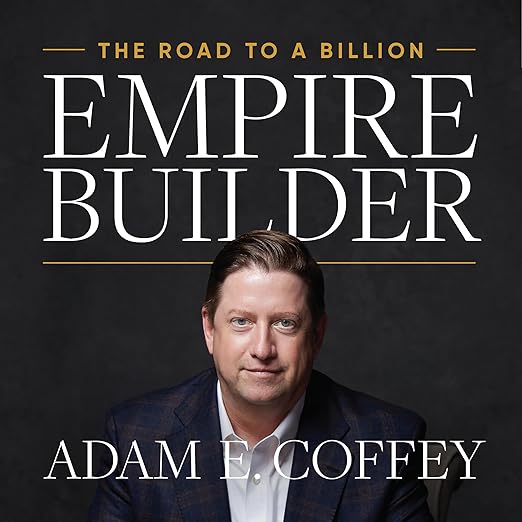
Business audiobooks fall into two camps more reliably than almost any other genre: the ones that spend ten hours saying what could have been said in twenty minutes, and the ones that are genuinely dense with usable information from the first chapter. Empire Builder by Adam Coffey lands firmly in the second category, and I say that having listened to more than my share of the first kind. At just over four hours, it does not waste your time, which is itself a kind of argument for its central thesis about efficiency and value creation.
Coffey is a CEO coach and executive who has built and sold billion-dollar businesses. That context matters here in a way it often does not in the genre. The advice does not feel borrowed from theory or assembled from other people’s war stories; it feels like someone is walking you through the actual decisions, in sequence, that led to results. The specific framing, triple-digit growth is the target, 10% growth “sucks” by his explicit accounting, sets the tone early.
Our Take on Empire Builder
The book’s structure follows its own advice: foundation first, then tools, then scale. Coffey begins by framing the conditions a business needs to meet before any growth strategy makes sense, then moves through the mechanics of private equity, mergers and acquisitions, and the specific levers that bend growth curves upward. The blueprint metaphor that runs through the book is not decorative; it reflects a genuinely architectural approach to business building where each element has to be load-bearing before the next layer goes up.
What I appreciate most is Coffey’s willingness to be specific. He does not talk about growth in abstract percentages or inspirational language; he talks about the actual decisions an owner faces at each stage of scale, from the first million to the billion-dollar exit. Multiple reviewers note that they have already begun applying concepts from the book, which is the practical test of business writing that most titles fail.
Why Listen to Empire Builder
Ron Butler’s narration is well-matched to the material. The delivery is confident and unhurried, which gives the denser sections room to land without feeling rushed. Business audiobooks often suffer from narrators who are technically proficient but who make financial and strategic content sound like terms-and-conditions recitation. Butler avoids that trap; he sounds engaged with the material, which makes it easier for the listener to stay engaged too.
The four-hour runtime is a genuine asset for this kind of content. It is long enough to develop its arguments properly but short enough to get through in a day of commuting or a weekend morning. Coffey has prioritized density over padding, and the result is an audiobook that rewards a second listen rather than testing your patience through the first.
What to Watch For in Empire Builder
The book is explicitly oriented toward owners and business leaders who are already running something and want to scale it significantly. If you are pre-revenue or early-stage, some of the content around private equity and M&A will feel premature. The foundation-building sections will be useful at any stage, but the full value of the later chapters depends on having a business that has already cleared some basic thresholds of operational stability.
Reviewers consistently note that the book assumes ambition. Coffey is not writing for someone who wants to run a comfortable lifestyle business; he is writing for someone who has looked at the gap between where their company is and where it could be and decided they want to close it aggressively. If that is not your orientation right now, the book may feel more aspirational than applicable.
Who Should Listen to Empire Builder
Business owners who are serious about scaling and want a framework that goes beyond generic growth advice will get the most from this. Entrepreneurs who have hit a plateau and are trying to understand why, or who are starting to think about exit strategy for the first time, will find specific and actionable material here that more general business books tend to skirt around.
It is a less natural fit for early-stage founders, employees rather than owners, or those primarily interested in the philosophical side of entrepreneurship. Coffey is results-oriented and transactional in the best sense; the emotional and identity dimensions of running a business are not his primary concern here. If you want permission-giving or motivational content, look elsewhere. If you want a working blueprint with teeth, this earns its runtime.
Frequently Asked Questions
Is Empire Builder relevant to small business owners, or is it aimed at larger enterprises?
It is explicitly built for small business owners who want to grow. Coffey begins with how to build a foundation business from the ground up, then details the path from first million to billion-dollar exit. The private equity and M&A content becomes more relevant as a business scales, but the foundational chapters address concerns that any owner at any stage can apply.
How does Empire Builder differ from Coffey’s earlier books?
Reviewers who have read his previous two business books describe Empire Builder as a culmination and practical synthesis of his methodology. It is designed to work as a standalone roadmap rather than requiring familiarity with his prior work, though readers who know his earlier writing will recognize the through-line of his private equity-backed growth philosophy.
Does the audiobook format work well for the business frameworks Coffey presents?
Generally yes. Ron Butler’s narration handles the strategic content clearly, and the book’s structure is logical enough that the frameworks come through in audio without requiring visual aids. For listeners who want to reference specific frameworks later, the four-hour runtime makes it practical to revisit key sections.
Is the book’s focus on the billion-dollar exit relevant to someone whose goals are more modest?
Partially. The growth methodology and foundation-building framework are applicable regardless of your target scale. The private equity and large M&A content is less immediately applicable if your ambitions top out at a mid-market exit. Coffey does address the range from first million upward, so listeners can extract value relative to where they are aiming.