Quick Take
- Narration: Gemma Lawrence reads with a warmth that suits Mumby’s personal tone, though the voice occasionally feels more uniform than the emotional range of the material demands.
- Themes: Animal cognition and memory, human-wildlife parallels, the ethics of conservation fieldwork
- Mood: Reflective and empathetic, with moments of genuine scientific wonder
- Verdict: A personal and scientifically informed portrait of elephants that is more memoir than textbook, and stronger for it.
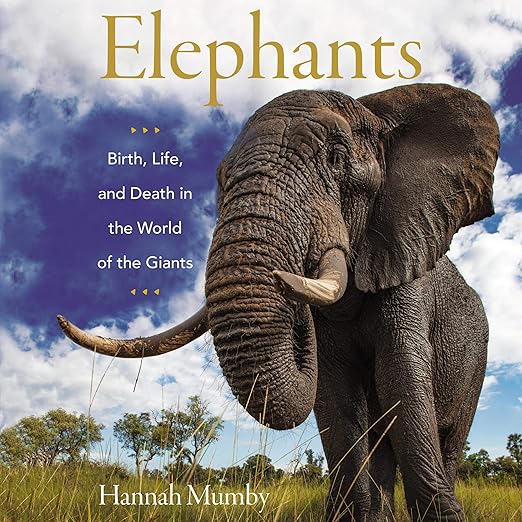
I came to Hannah Mumby’s Elephants expecting something closer to a natural history survey, the kind of book where scientific findings are laid out in ordered chapters with clear thesis statements and supporting evidence. What I got instead was something more interesting and, honestly, more honest: a researcher’s account of how loving a subject transforms the work you do on it. Mumby does not pretend to be a neutral observer. She fell in love with elephants when she was twenty-four, and she has spent the years since living with the consequences of that attachment.
Gemma Lawrence narrates with a tone that matches Mumby’s prose, engaged, thoughtful, occasionally reverential. The reading is clean and unhurried, which is the right choice for material that rewards patience. Lawrence does not have the vocal range to make every passage feel dynamically different, but the consistency serves a book that is trying to build cumulative understanding rather than surprise.
Our Take on Elephants
The comparison to Jane Goodall in the publisher’s framing is both apt and slightly misleading. Like Goodall, Mumby is a scientist who has let herself be changed by sustained contact with a nonhuman species. But where Goodall’s early work was characterized by a kind of methodological revolution, observing rather than experimenting, naming rather than numbering, Mumby is working in a tradition that Goodall helped create. The question is not whether elephants have inner lives but how those inner lives work, how they are transmitted socially, and how trauma reshapes them across generations.
The sections on elephant memory are the most compelling in the book. Mumby’s field research with orphaned elephants and solitary males adds a dimension to the standard conservation narrative that popular science writing often omits: the psychological cost to individuals within a species under pressure. The connection she draws between human PTSD and the behavioral patterns she observed in traumatized elephant groups is not analogical in a loose sense. It is grounded in observable data about stress responses, social withdrawal, and intergenerational behavioral transmission.
Why Listen to Elephants
Because the book covers ground that neither pure science writing nor pure memoir tends to reach. Mumby is candid about the limitations of her research, what fieldwork in remote locations can and cannot tell you, what inference is legitimate versus what is projection. That candor is rarer than it should be in popular science, and it makes the moments when she does draw firm conclusions feel genuinely earned.
The writing is also accessible in a way that does not simplify. Elephant communication, including the infrasound channels that allow herds to coordinate over distances invisible to human observation, is explained with enough precision that a reader without a biology background can follow the mechanism while still appreciating how strange and sophisticated it is. This is the kind of book that expands your intuitions about animal cognition without requiring you to first have a scientific framework to plug the findings into.
What to Watch For in Elephants
One reviewer offered a fair critique: the book is more personal narrative than systematic study. Mumby’s voice and experiences occupy a significant proportion of the text, which is a deliberate stylistic choice but not a universally satisfying one. Readers who want dense, chapter-by-chapter coverage of elephant ethology, social structures, reproductive strategies, habitat use across species, will find the memoir-leaning format frustrating. The natural history is present but threaded through personal narrative rather than organized systematically.
That said, the criticism misses something important. The reason Mumby’s account of elephant grief is more affecting than a textbook entry on the same subject is precisely because she has watched specific animals experience it. The personal voice is not a compromise of the science. It is the lens through which the science becomes emotionally legible.
Who Should Listen to Elephants
Readers drawn to the tradition of naturalist memoir, think Sy Montgomery, Carl Safina, or Bernd Heinrich, will find Mumby’s book entirely at home in that company. Wildlife conservation advocates will find the sections on human impact and population stress useful and accessible. Readers seeking a comprehensive species monograph will want supplementary material. Anyone who has ever watched elephants at a sanctuary or in the wild and wondered what was happening beneath the visible behavior will find Elephants a generous and honest answer to that question.
Frequently Asked Questions
Does the book cover all three elephant species, or primarily African savanna elephants?
Mumby’s fieldwork spans multiple elephant groups including African savanna, forest, and some Asian elephant research. The book is not rigidly divided by species but touches on all three within its thematic structure.
How much of the book is devoted to conservation advocacy versus scientific content?
The advocacy is present throughout but integrated into the narrative rather than separated into a final polemic chapter. Mumby makes her case for conservation through accumulated evidence and personal witness rather than direct argument.
Is the connection Mumby draws between elephant trauma and human PTSD scientifically supported or speculative?
Mumby grounds the comparison in observable behavioral data, stress responses, social withdrawal, and intergenerational transmission, while being careful to distinguish what observation supports from what remains inference. The comparison is informed by data rather than established as clinical equivalence.
How does Gemma Lawrence’s narration handle the more technical scientific passages?
Lawrence reads the scientific sections clearly and without rushing, which is the right approach. The terminology is not so dense that a naturalistic reading style causes comprehension problems, and her pacing through the fieldwork sequences gives those passages appropriate weight.