Quick Take
- Narration: Cat Gould handles the book’s wide emotional range with measured sensitivity, maintaining the warmth of Pincott’s voice while honoring the difficulty of the material without becoming overwrought.
- Themes: Human-animal bonds and what they cost, the beauty and corruption of Zimbabwe, the price of staying when leaving would be easier
- Mood: Deeply moving and occasionally harrowing, with the quality of testimony from someone who witnessed more than most people will ever see
- Verdict: One of the most honest wildlife memoirs written in the last two decades. Pincott writes without restraint and it shows on every page.
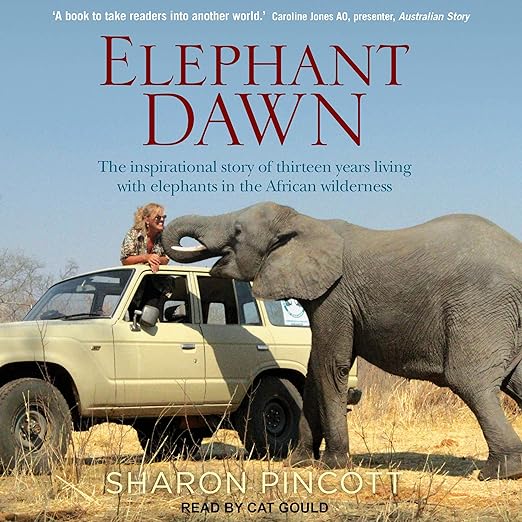
I was halfway through Elephant Dawn on a Sunday afternoon, sitting at a window while it rained outside, when I realized I had been holding my breath through the previous chapter. Sharon Pincott had just described a moment with one of the Presidential Elephants of Zimbabwe that I cannot adequately summarize without diminishing it: a moment of recognition between a human and an animal that had no reason to extend trust, and everything to lose by doing so. Books about humans and animals can tip easily into sentiment, and sentiment can obscure the actual texture of what the relationship costs and requires. Pincott does not let that happen. This is a book about profound love and equally profound difficulty, and neither quality is allowed to soften the other.
The facts of Pincott’s story are extraordinary enough without embellishment. In 2001, she was a high-flying corporate executive in Australia. She traded that life, unpaid and self-funded, to begin thirteen years of work with the Presidential Elephants of Zimbabwe, a specific group of elephants living in the Hwange bush during the worst period in Zimbabwe’s turbulent modern history. She had no training, no salary, and no institutional backing. She had only the commitment that made her stay when virtually everyone around her expected her to leave, and that eventually made the extraordinary possible: she was accepted by these elephants as something close to family. That acceptance is the book’s emotional center, and Pincott earns the reader’s belief in it because she is equally honest about the violence, corruption, and heartbreak that surrounded it.
Zimbabwe Under Mugabe as a Character in the Story
Pincott is explicit that she writes without restraint, sequentially through the years, and the Zimbabwe that emerges from those years is not the exotic African backdrop of romantic wildlife memoir. It is a country under increasing pressure from Mugabe’s rule, with the corruption, land seizures, and political violence that characterized that period woven into the day-to-day reality of working in the bush. One reviewer who described themselves as someone who grew up in Zimbabwe and visited Hwange regularly as a child described the book as stirring up memories of a childhood taken for granted, noting that Pincott’s account of the ambience of life in the bush captures the sights and sounds with accuracy. For readers without that connection, the Zimbabwe sections of the book provide historical grounding that makes Pincott’s eventual departure feel like a loss rather than a conclusion. The friends who urged her repeatedly to leave before she was harmed are part of the story’s texture, and Pincott gives them their due while making clear why she could not respond to their concern in the way they hoped.
The Elephants as Individuals and Why That Matters
Pincott names the elephants she works with, knows their family structures, and describes their individual personalities with the specificity of someone who has spent years learning to read them. This is not anthropomorphization in the sentimental sense; it is the result of sustained observation by someone who needed to understand these animals as individuals in order to protect and advocate for them effectively. One reviewer described the extraordinary and life-changing bond she formed with the elephants as the book’s central testament, and another described reading about the poachers who laid wire snares and the animals who suffered before Pincott could intervene as some of the most difficult passages in the book. The difficulty is real and Pincott does not minimize it. The book is, as its subtitle suggests, a story of love and of loss, and some of the losses are depicted with a plainness that is more affecting than heightened prose would be.
Cat Gould’s Narration and the Demands of This Material
Cat Gould faces the challenge of narrating a thirteen-hour memoir that moves between extreme emotional registers: the joy of genuine connection with wild animals, the grinding frustration of working within a corrupt bureaucracy, the fear of specific threats that were not theoretical, and the grief of specific losses. The narration needs to honor all of these registers without collapsing them into a single emotional note. Gould manages this effectively, finding a voice for Pincott that is warm without sentimentality and direct without hardness. The long runtime, thirteen hours, reflects the book’s ambition: this is not a selective highlight reel of the thirteen years, but an attempt to convey the full texture of what living that life actually required. The narration sustains the listener across that length by keeping the emotional stakes clear and the specific moments vivid rather than retreating to generality.
Elephant Dawn is one of those memoirs that makes you reconsider the categories available to you for understanding relationships between humans and other species. Pincott does not argue a philosophical position about animal consciousness or animal rights. She simply tells you what she observed and what it cost, and leaves you with the evidence. That restraint is the most honest thing about a book that is honest throughout.
The Conservation Reader Versus the Memoir Reader: Both Find Something Here
Essential for anyone interested in African wildlife, conservation memoir, or the specific history of Zimbabwe in the early 2000s. The book will also resonate deeply with anyone who has ever made a commitment to something that everyone around them considered impractical or dangerous. Skip it only if you find detailed accounts of poaching and animal harm too difficult to process through audio, where the proximity of narration makes difficult passages particularly immediate.
Frequently Asked Questions
Is Elephant Dawn primarily about elephants or about Sharon Pincott’s personal experience in Zimbabwe?
Both are inseparable. The elephants are the reason Pincott stayed, and they are the central relationship of the book. But the Zimbabwe context, the political situation, the corruption, the personal relationships she built, are fully integrated into the story rather than serving as backdrop to a purely wildlife narrative.
How much does Pincott cover the darker aspects of Zimbabwe under Mugabe, and is it handled respectfully?
Pincott writes without restraint about the corruption, land seizures, and political pressure that characterized the period, based on thirteen years of direct experience. She writes from a position of genuine familiarity with Zimbabwe rather than as a foreign observer, and her account is grounded and specific rather than sensationalized.
Does the book have a hopeful ending, or does it resolve in loss?
The book contains both. Pincott eventually leaves Zimbabwe safely, which readers who had been worried for her described as a genuine relief. Some of the elephant stories end in loss. The book does not resolve into a simple conclusion because the reality it describes does not resolve into one.
How does Cat Gould’s narration compare to an author-read version for a memoir this personal?
Gould finds a voice for Pincott that is warm and direct without over-dramatizing the emotional content. Reviewers found the narration supportive of the material rather than competing with it, which is the right goal for a memoir with this emotional range.