Quick Take
- Narration: Author-read with warmth and intimacy, Loxton’s voice carries both the historian’s precision and the pilgrim’s fatigue, making the 200-mile walk feel genuinely lived-in.
- Themes: Forgotten women of history, pilgrimage and grief, medieval England brought to life
- Mood: Elegiac and walking-paced, with pockets of wonder and dry humor
- Verdict: A beautifully personal journey that resurrects a neglected queen through boots-on-ground history writing.
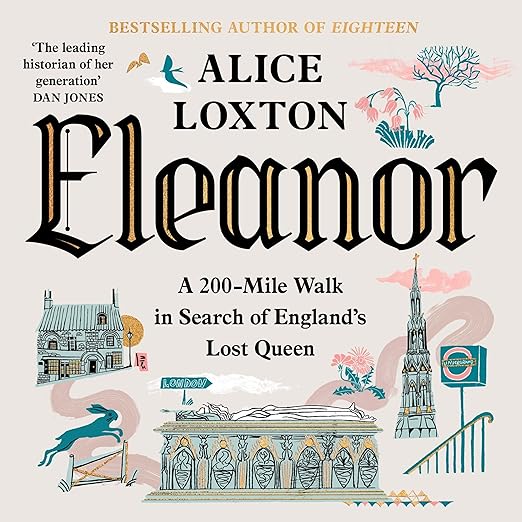
I started listening to Eleanor on a long Saturday walk, which in retrospect was exactly the right choice. There is something about moving your own body through a landscape while someone describes moving theirs through another that creates a double exposure of experience I rarely find in audiobooks. Alice Loxton narrates her own book, and within the first ten minutes of listening I could tell this was not going to be a dry historical account. It was going to be something closer to a confession.
The premise is wonderfully specific: in 1290, King Edward I commissioned twelve stone monuments, the Eleanor Crosses, to mark each place where his wife’s funeral cortege rested during its 200-mile journey from Lincoln to London. More than seven centuries later, Loxton walked the entire route on the corresponding calendar dates, rain and all. That kind of commitment to embodied history is rare, and it produces a kind of writing that no archive visit alone could generate.
Our Take on Eleanor
What makes this audiobook worth your time is the interplay between the past and the contemporary. Loxton is not merely reporting what Eleanor of Castile did and was; she is asking what it means that we have largely forgotten her, despite the fact that Edward I’s grief was so extravagant and public it reshaped the English landscape for centuries. The Eleanor Crosses are still there, most of them battered or partially reconstructed, and Loxton stands in front of each one and makes you feel the peculiar weight of a monument whose subject has slipped from cultural memory.
Her prose, which translates beautifully into her narration, has a quality that Philippa Gregory’s blurb captures fairly: the historian’s accuracy and the novelist’s way of inhabiting a character’s perspective simultaneously. When she describes Eleanor’s documented role as a financial operator and landowner, the picture that emerges is of a woman who was far more than a grieving husband’s cherished consort. She was formidable, occasionally ruthless, deeply political. The book’s central sadness is that this is precisely the kind of woman history tends to sand down into a symbol of pure love.
Why Listen to Eleanor
The author-read format is not always the right call, but here it is essential. Loxton’s voice has an unguarded quality that a professional narrator would likely smooth over. When she is tired, you hear it. When she rounds a corner and finds one of the surviving Crosses still standing in the middle of a roundabout or a market square, the surprise in her voice is completely unperformed. She has described herself in interviews as a historian who came to this project partly out of personal curiosity about women whose stories history preferred to absorb into their husbands’, and that motivation surfaces in the narration with quiet but persistent force.
The blend of travelogue and biography also means the audiobook rewards listeners who might not typically reach for medieval history. You do not need to know who Edward I was to find this absorbing. What you need is patience for a walking pace, which given the subject, feels exactly right.
What to Watch For in Eleanor
One reviewer noted that chapter 17 runs for only 38 seconds and ends mid-sentence, which has led to some speculation about whether this is an error or a deliberate formal choice. I will not spoil what is actually happening there, but it is worth paying attention to the structure of the book rather than assuming it is a technical flaw. Loxton is a careful writer, and the form of the text has been designed with intention.
There are also moments where the contemporary sections pull slightly harder than the medieval, which may frustrate listeners who came primarily for Eleanor of Castile rather than for Alice Loxton. Both are worth your attention, but the balance tips a little unevenly in places. That said, the travelogue portions are genuinely funny in a low-key, deadpan way, and they prevent the book from becoming a solemn exercise in commemoration.
Who Should Listen to Eleanor
This is for readers who love books that combine personal journey with rigorous history, people who have enjoyed works like Robert Macfarlane’s landscape writing or Hilary Mantel’s habit of making medieval figures breathe. It will also appeal to anyone who has stood in front of a centuries-old monument and felt the strange frustration of how little the plaque tells you. If you are looking for a fast-paced narrative or a dense political biography of the Plantagenet era, this is probably not your entry point. But if you want a walk through England’s past with a guide who is genuinely moved by what she finds, Eleanor is time well spent.
Frequently Asked Questions
Do you need prior knowledge of medieval English history to enjoy Eleanor?
Not at all. Loxton brings sufficient context throughout the walk, and the travelogue structure means you are always grounded in the present moment even as she explains the historical background. Listeners with no prior interest in the Plantagenet period have reported finding it completely accessible.
Is there really a missing or truncated chapter in the audiobook?
One listener flagged that chapter 17 is unusually brief and cuts off mid-sentence. Whether this is a technical error in certain versions or a deliberate structural choice by Loxton remains a point of discussion. It is worth being aware of, but it does not significantly disrupt the overall listening experience.
How does Alice Loxton compare to other author-narrated history audiobooks?
Loxton reads with more emotional presence than many academic historians who narrate their own work. Her background in digital history communication means she is comfortable with the informal register that audio requires, and the result is more conversational companion than lecture.
Is Eleanor primarily a walking memoir or a biography of the queen?
It is genuinely both, with the walk providing the structural spine and the biography emerging through that framework. Readers expecting a traditional cradle-to-grave royal biography may find the format unconventional, but the interweaving of past and present is what makes the book distinctive.