Quick Take
- Narration: Jim Meskimen delivers 32 hours with steady authority, handling proper names and philosophical passages cleanly without oversimplifying the material.
- Themes: Civilizational continuity, cultural exchange across the Mediterranean, the everyday lives of ancient peoples alongside political history
- Mood: Expansive and unhurried, like a long museum tour with an unusually well-read guide
- Verdict: A solid panoramic introduction to the ancient Mediterranean that rewards patient listeners willing to invest in breadth over depth.
I came to this one looking for something I could treat almost like a course, something broad enough to fill in the gaps between the focused histories I tend to gravitate toward. I had a long weekend trip coming up, some eleven hours of driving spread across two days, and Charles Freeman’s Egypt, Greece, and Rome felt like the right kind of company. What I did not expect was to still be listening three weeks later, picking it up on morning walks and during lunch, not because I had to but because Freeman kept finding angles I had not considered.
At 32 hours, this is not a casual listen. Freeman begins around 3500 BC with the emergence of Egyptian civilization and pushes through to AD 600, covering not just the three titular civilizations but the Etruscans, Persians, Celts, Phoenicians, and the peoples of the ancient Near East along the way. That is an enormous undertaking, and the book lives or dies by how well Freeman manages the transitions between cultures and centuries. Mostly, it succeeds.
Four Millennia in One Architecture
The structural challenge of a book like this is real. When you are moving from Akhenaten to Augustus to Augustine across a single volume, the connective tissue matters enormously. Freeman largely solves this by organizing around cultural and intellectual themes rather than strict chronology within each section. He examines art, architecture, philosophy, literature, and religious practice in conversation with the social and economic conditions that produced them. The result feels less like a textbook and more like a genuinely curious mind working through what these civilizations actually meant to the people living inside them.
One reviewer described it as a bird’s-eye overview, and that is fair, but the phrase undersells the ground-level detail Freeman builds into the individual profiles. The chapters on Homer, Aristotle, Horace, and Augustine are not thumbnail sketches. Freeman gives you enough of the intellectual context to understand why these figures mattered in their own time, not just in retrospect. That approach pays particular dividends with figures like Akhenaten, whose religious innovations are placed within a specific political crisis rather than treated as isolated genius.
The Illustrated Problem
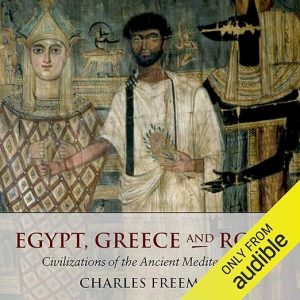
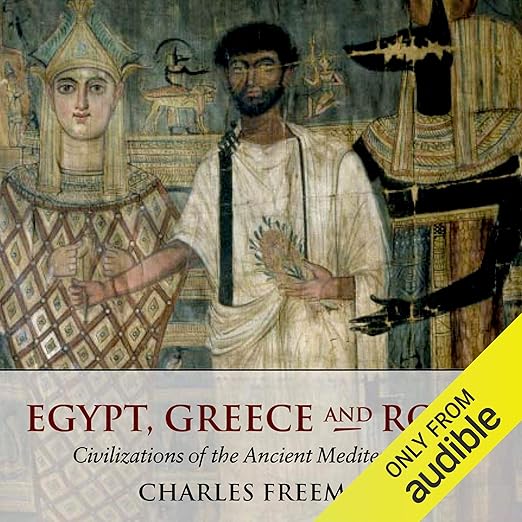
The synopsis describes this as a generously illustrated book in both color and black-and-white, and that is where audio listeners will feel the format most acutely. Freeman refers to specific artworks, architectural plans, and maps throughout the text. Meskimen reads these references cleanly, but there is no compensatory audio description for what you cannot see. If you are coming to this as an introduction to ancient Mediterranean cultures, the absence of visual material is a real gap. The audiobook works best as a supplement to a print copy, or as a refresher for listeners who already carry some mental geography of these civilizations.
Jim Meskimen’s performance is measured and clear. He does not dramatize, which suits the academic register of Freeman’s prose, and he handles the density of proper names across multiple languages without stumbling. At this length, a more theatrical narrator could become exhausting, and Meskimen’s restraint is the right call.
What the Overview Actually Delivers
There is a particular pleasure in a book that can say, in the same chapter, something meaningful about Spartan military culture, the organization of an Egyptian funeral, and the economic infrastructure of the Roman grain trade. Freeman earns that range by doing the connective work. When he writes about the legacy of these civilizations to the modern West, he is not being rhetorical. He has spent hundreds of pages demonstrating the specific vectors through which law, philosophy, religion, and art traveled across time and geography.
The reviewer who called it a good 10,000-foot view is right, and for certain listeners that is exactly what they need. If you have spent years reading narrowly about the Peloponnesian War or the late Republic, Freeman’s panoramic approach surfaces connections that focused histories tend to obscure. The section on the Byzantine transition, which most popular histories treat as an afterthought, gets genuine attention here as a world in its own right rather than merely a footnote to Roman decline.
Who Should Listen, Who Should Skip
This is the right audiobook if you want a single comprehensive framework for thinking about the ancient Mediterranean and its intellectual legacy, and you are prepared to invest the runtime. It works best for listeners with some existing familiarity with at least one of the three civilizations covered, who will have enough scaffolding to absorb Freeman’s broader arguments. Listeners who prefer deep narrative history focused on a single period or figure will find the pace too wide-angle. And anyone planning to get the most out of the illustrated content should pair the audio with a print or digital copy.
Frequently Asked Questions
Does this audiobook cover all three Punic Wars, or is it a broader survey?
Egypt, Greece, and Rome is a broad survey of three major civilizations from 3500 BC to AD 600, it is not focused on the Punic Wars. Those conflicts appear within the larger Roman narrative, but they are not the primary subject. For a dedicated Punic Wars account, Goldsworthy’s The Fall of Carthage is the better choice.
Is 32 hours manageable, and does Freeman sustain quality throughout?
Reviewers consistently describe the book as readable and stimulating cover to cover, with particular praise for the individual profiles of key figures. The pace is steady rather than urgent, treat it as a long-form course rather than a driving narrative and it holds up well.
Does the audiobook work without the illustrations the print edition includes?
You can follow Freeman’s arguments without the visuals, but the experience is reduced. He references maps, artworks, and architecture throughout, and those references land more fully in the print edition. If ancient art and architecture are central to your interest, print is the stronger format.
How does this compare to a university-level textbook on the ancient world?
Freeman writes for a general educated reader rather than specialists, and the prose reflects that. One reviewer noted it draws on the most up-to-date scholarship while remaining accessible. It functions as a serious introduction rather than a course textbook, though it covers comparable ground at a higher reading level than most popular history.