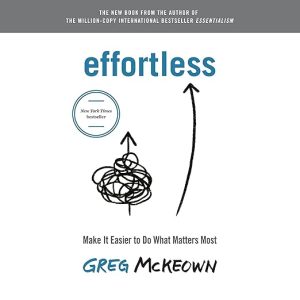
I came to Effortless at the end of a quarter where I had been operating at the kind of sustained intensity that felt productive right up until it clearly wasn't. My calendar was full of things that mattered; my ability to actually do any of them well was declining in direct proportion to how hard I pushed. McKeown's question - "What if this could be easy?" - arrived at exactly the moment when the question had something to land on.
Effortless is McKeown's follow-up to Essentialism, the 2014 book that made a disciplined case for doing fewer things with greater focus. Where Essentialism asked what matters most and how to protect it, Effortless asks a harder question: once you know what matters, why does it still feel so hard? The answer McKeown develops is that we have been conditioned to conflate effort with virtue, exhaustion with commitment, and difficulty with importance. The book argues that this conditioning is not just unhelpful - it actively degrades the quality of our most essential work.
What Greg McKeown Delivers
The book's most useful reframe is the distinction between effortful and effortless states - and McKeown's argument that the effortless state is not laziness but a mode of engagement in which resistance has been removed rather than ignored. The practical chapters are organized around specific patterns: turning tedious tasks into enjoyable rituals, solving problems before they arise, setting a sustainable pace rather than powering through. Reviewer CJ quoted a passage that gets at the core tension: "Perfectionism makes essential projects hard to start, self-doubt makes them hard to finish, and trying to do too much, too fast, makes it hard to sustain momentum." That sentence does considerable diagnostic work in a small space.
The book also includes a final chapter that reviewer CJ described as "vulnerable and heartbreaking" - a personal account of loss in McKeown's family that grounds the philosophy in something real rather than merely analytical. That chapter changes the emotional register of the book in a way that matters. This is not productivity advice from someone who has optimized their way to comfort; it is wisdom developed under actual pressure.
McKeown's narration is one of the better self-author performances in the business nonfiction space. His voice is measured without being flat, and the British accent gives the practical advice an unexpected warmth. At six hours and two minutes, this is a commute-sized audiobook - the kind that fits into a week of normal listening without requiring marathon sessions. The chapter structure is modular enough that returning to specific sections later, once the ideas have had time to settle into practice, is easy.
For listeners who have already read Essentialism, the two books work as a genuine sequence: Essentialism provides the what and why, Effortless addresses the how. Reviewer Elsa Hernandez noted she planned to make flash cards and apply the ideas daily, which speaks to the book's practical density - there is specific, actionable material here rather than abstract inspiration.
Where Greg McKeown Loses Some Ground
The central premise requires some faith from skeptical readers. The idea that important work can and should feel easier, that resistance is often manufactured rather than inherent, runs against a deep cultural bias toward difficulty as the appropriate medium for things that matter. McKeown anticipates this objection and addresses it, but the argument requires the reader to take the reframe seriously before the evidence can land. Listeners who are deeply identified with their capacity to work hard, who understand sustained effort as a core part of their identity, may find the book's premises more challenging to internalize than the writing style suggests they should be.
Should You Listen to Effortless?
The ideal listener is someone who has already reduced their commitments to what matters most - perhaps through reading Essentialism or through their own discipline - and is discovering that the remaining essential work still feels harder than it should. McKeown's framework is most useful when the problem is not distraction or scattered priorities but a fundamental relationship to effort itself. Readers who have not yet addressed what they are doing will find this book less useful than one that helps with selection. For the audience it is actually written for, Effortless is one of the more genuinely useful books in its genre, and the self-narration makes the audio format the recommended way to engage with it.
Common Questions
Do I need to read Essentialism before listening to Effortless?
No, but Essentialism provides useful context. The two books address related but distinct problems: Essentialism focuses on identifying what matters most and protecting time for it; Effortless focuses on making the execution of what matters most easier. Reading both in sequence is worthwhile, but Effortless works as a standalone.
How does McKeown's narration compare to a professional narrator for this type of content?
McKeown is a notably good self-narrator relative to the category. His delivery is calm and considered, and the personal passages benefit from his own voice in ways a third-party narrator could not replicate. Listeners who strongly prefer produced audiobook narration may notice the difference from studio-polished performances, but most find the self-narration an asset.