
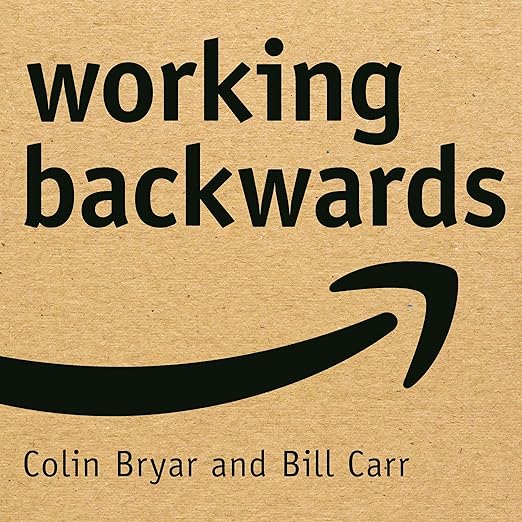
The Short Version
- Narration: Bill Carr holds the reading credit on a book the description says he co-wrote, so the emphasis choices belong to somebody who sat in the meetings.
- Themes: Amazon's leadership principles, hiring machinery, invention as a repeatable process, culture built out of procedure.
- Mood: Methodical and admiring, an operations manual with a company attached.
- Verdict: Specific enough to be genuinely useful for operators, wrapped in a listing that mislays half its authorship.
Colin Bryar's name is on the byline of this audiobook, and the second author's name is not. The description states plainly that the book comes from two long-time, top-level Amazon executives, then names them both: Bryar, who started in 1998, and Bill Carr, who joined in 1999. Carr appears on this listing exactly once, in the narration credit. Ten hours and forty minutes of Amazon's internal machinery, delivered by the man the byline forgot.
Where This One Lands
Start with that credit, because it colors everything else on the page. A byline dropping one of two authors breaks author-based searching outright: look the book up by writer and half its authorship returns nothing at all. The listing compounds the error by putting the missing name in the reader's slot, where a browser will take it for a hired professional rather than the co-writer the description describes. Nothing here is false, exactly. It is arranged so that only somebody who reads to the fourth paragraph ever finds out.
Writing in February 2021, a five-star response confirms the authorship from the other direction and discloses something else along the way. That account describes senior leadership roles at Microsoft and Apple, explains having been recruited by Bill to join Amazon when he ran the company's digital music and video businesses, and closes by thanking him and Colin for putting in the work to create the book. Warm and useful, and also written by a former colleague hired by one of the authors, which belongs in your reading of the grade.
Rating figures here line up with nothing. Five written grades are visible here while the counter reports three ratings, so the population is wrong before any arithmetic starts. Then the arithmetic: three whole-star votes cannot average 4.6, because the reachable means in that neighborhood are 4.33 and 4.67 and nothing sits between them. The five visible grades average 4.8. Whatever the badge at the top is measuring, it is neither the three votes it claims nor the responses printed underneath it.
What earns the ten hours is specificity about machinery rather than attitude. The artifacts get explained as procedures: the fourteen leadership principles, the bar raiser hiring process, and the founding characteristics the description lists as customer obsession, long-term thinking, eagerness to invent and operational excellence. Most business books describe a culture and leave you to infer the practices underneath it. This one runs the other way, which is the more useful direction for anybody who genuinely intends to copy something.
The innovations carry the argument. Kindle, Prime, Echo and Alexa, and Amazon Web Services are each traced back through the process that produced them, which turns the principles from slogans into decisions somebody actually made. Writing in May 2022, a five-star reader places Amazon in a lineage of companies everyone was once told to emulate, GM, then IBM, then GE, and calls this 'different from most books about what to copy from great companies'. That framing is the correct one.
Bill Carr reads it, and since the description names him as one of the two authors, this becomes an author-narrated business book with a twist: the reader is the half of the partnership the cover left off. The consequence is practical rather than sentimental. Emphasis is an argument in a book like this, because which clause of a principle carries the weight decides what a listener walks away with, and those choices are being made by somebody who was in the room rather than by a professional working from a script.
Weak Spots in Working Backwards
The April 2021 four-star is the most useful anybody could write here, and its complaint inverts the usual one. Most business books have a big idea and then struggle to show how to implement it, that account observes; this one shares the big idea and tells how it is done, and the trouble is the details. Too many details. The closing verdict calls it 'a solid book, mostly interesting, and worth your time' while noting it is 'not really easy to implement for a business owner'.
That points straight at the real limit. Amazon's processes were built for Amazon's scale, and a bar raiser hiring program or a fourteen-principle framework assumes an organization large enough to need both. Somebody running a ten-person company will find the reasoning transferable and the apparatus not. The description promises practices 'you can apply at your own company, no matter the size', which is the standard promise of the genre and the exact claim this book's readership is most likely to test.
Vintage matters too. The recording dates from February 2021 and the evidence stops before that, so anything that has happened to Amazon since falls outside the frame entirely. It is also an insider account by definition, written by two people who spent long careers inside the company and clearly still admire it. Criticism of Amazon is not what this book is for, and a listener wanting the other half of that story should treat this as one side of a conversation.
Recommended For
Operators are the audience. A five-star from March 2021 comes from somebody who has read widely in both directions, business successes and high-profile failures alike, valuing the book for presenting 'principles and processes that Amazon honed over many years by trial and error'. That is the right frame. This is a record of what was tried, kept and discarded, and it rewards anyone responsible for how decisions get made more than anyone interested in what got decided.
Owners of small businesses hoping for a playbook they can lift and drop should temper the hope. The mechanisms described here assume headcount, budget and time horizons most companies do not have, and translating them is work the book leaves to you. Readers wanting a critical history of Amazon are in the wrong place altogether. Anybody allergic to corporate framework vocabulary should sample first, since this book takes its own terminology seriously and uses it constantly.
Working Backwards is one of the better books of its kind precisely because it commits to specifics, and the audio edition is read by a man who helped build the things being specified. What surrounds it is careless: half an authorship missing from the byline, a rating badge matching neither its own count nor the responses beneath it, and a five-star from somebody one of the authors once hired. The book is considerably better than its listing.
A Few Questions About Working Backwards
Is the audiobook narrated by one of the authors?
Almost certainly. The reading credit names Bill Carr, and the description names Bill Carr as one of the two executives who wrote the book. Nothing on the listing states the connection outright, so a buyer has to notice that the same name appears in two different roles.
What does working backwards actually mean at Amazon?
The listing never defines its own title. What the description supplies instead are the founding characteristics the phrase sits inside: customer obsession, long-term thinking, eagerness to invent and operational excellence. Expect the definition to arrive through worked examples rather than as a stated rule up front.
Does the audiobook justify ten and a half hours?
If you want the mechanisms, yes, since the length is spent on how things were actually done rather than on repetition. If you want the headline ideas only, the same material exists in far shorter summaries elsewhere, and the detail that makes this book worth hearing will feel like weight.







