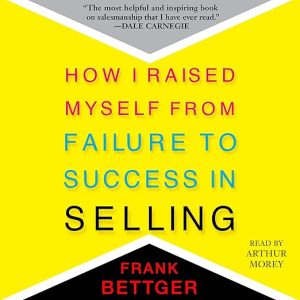
Picture a twenty-nine-year-old insurance salesman who has failed so thoroughly that his colleagues consider him a cautionary example. That is Frank Bettger's starting point in this audiobook, and it is a genuinely effective one. Not because failure is dramatic, but because his account of why he was failing is precise enough to be immediately recognizable. He was going through the motions. He was present in body and absent in spirit. He had the product knowledge and none of the animating conviction that makes product knowledge matter to a prospective buyer. That diagnosis is still accurate seventy-five years after he wrote it down.
I want to be clear about the historical context upfront because it shapes how this audiobook should be approached. Bettger wrote this in 1949. The dollar amounts are period figures, some of the social dynamics reflect mid-century American business culture, and a handful of examples will land as dated for contemporary listeners. One reviewer specifically notes that their father read and lived by this book, passing it along across generations. That is the most useful framing available. This is a book that has outlived its own era because the underlying mechanics it describes are not era-specific. The principles travel.
Where This One Lands
Arthur Morey's narration serves the material extremely well. Bettger's writing style is anecdotal and illustrative. He builds his principles through specific incidents, specific conversations, specific moments where the right or wrong approach produced a demonstrably different outcome. Morey understands that these anecdotes are the argument, not decoration, and he paces them accordingly. He does not rush to the principle; he lets the story breathe, which is precisely the right approach for a book whose central argument is about the value of patience and genuine presence in a sales relationship.
The core insight the audiobook circles back to throughout is the relationship between enthusiasm and performance. Bettger credits his turnaround to a piece of advice he received from a baseball manager: the observation that acting enthusiastic produces enthusiasm, that the feeling follows the behavior rather than preceding it. This is now familiar territory in both psychology and business literature, but Bettger articulated it through lived experience decades before the research caught up with the intuition, and the specificity of his account gives it a force that abstract summaries of the concept lack entirely.
Why Listen to How I Raised Myself From Failure to Success in Selling
Dale Carnegie's endorsement is not merely promotional context. Carnegie and Bettger occupied the same intellectual territory: the conviction that effective interpersonal communication is a learnable skill, not an innate gift, and that the specific habits involved can be identified, practiced, and measurably improved over time. The two books complement each other well, and listeners who find value in one will generally find value in the other. Bettger's book is more tightly focused on the sales relationship specifically, while Carnegie's is broader in scope, but the underlying philosophy is consistent and mutually reinforcing between the two texts.
The seven golden rules for closing a sale, the techniques for winning confidence quickly, the method for handling the skeptical prospect, these specific tools are laid out in the audiobook with enough concrete detail that they are genuinely applicable rather than merely inspirational in the vague sense. One reviewer notes that the book teaches traits useful not just in selling but in business and personal life broadly, and that is an accurate observation. The communication principles translate across contexts because Bettger is ultimately writing about how human beings respond to sincerity, preparation, and genuine interest in the other person's situation and concerns.
What Gives Us Pause
The audiobook rewards listeners who engage with it actively rather than passively. Bettger's method is built on specific behavioral changes, and hearing the principle is only useful if it prompts reflection about how the principle applies in your own working context. Listeners who treat this as background audio will take considerably less from it than those who pause and consider the implications of each anecdote as it arrives. At just over six hours, the length is appropriate for the material. Long enough to develop its ideas fully, short enough to revisit when specific sections become relevant again to your current situation.
One reviewer describes the book as not lulling them to sleep, which is a meaningful compliment for a 1949 business text. Bettger is a genuinely engaging writer, and Morey's narration preserves that quality entirely. The audiobook does not drag through the principles; it earns its pace through accumulated illustrative detail, and the forward momentum never flags across the full six-hour runtime. The specific examples carry sufficient weight that the book feels alive rather than archival even decades after its original publication.
The Right Listener for How I Raised Myself From Failure to Success in Selling
This audiobook belongs in the library of anyone whose livelihood involves persuasion in any form. Not just salespeople in the traditional sense, but entrepreneurs, consultants, anyone who regularly needs to bring another person around to a position or a decision. New entrants to professional life will find it foundational and surprisingly applicable to situations Bettger never specifically imagined. Experienced practitioners who have read it in print may find the audio format reveals something different about how Bettger structured his arguments and paced his narrative for maximum effect. Skip it only if you require contemporary case studies and current market data. Bettger's examples are period-specific, and that is not negotiable.
Before You Listen
Does the audiobook version of How I Raised Myself From Failure to Success in Selling work better than reading it in print?
Many listeners find the audio format particularly well suited to this book because Bettger's writing is conversational and anecdote-driven. Arthur Morey's pacing reinforces the rhythm of how the arguments are built. That said, some listeners prefer print for books they want to annotate or return to specific passages quickly. The audiobook excels for primary consumption, print for reference use.
Is this audiobook relevant for someone who is not in a traditional sales role?
Very much so. The principles Bettger describes, including building trust quickly, converting fear into action, and sustaining enthusiasm as a behavioral discipline rather than a mood, apply across professional contexts. Reviewers consistently note that the book's usefulness extends well beyond formal sales situations into business relationships and personal life generally.
How does the 1949 publication date affect the audiobook's usefulness today?
The dollar amounts and some period details are dated, but the underlying behavioral principles are not era-specific. Multiple reviewers across generations note that the book's core insights have remained applicable across decades. Listeners who can hear the period-specific examples as illustrations of timeless mechanics rather than prescriptions for current practice will get full value from the audiobook.
What does Arthur Morey's narration specifically bring to this audiobook?
Morey's warmth and deliberate pacing suit Bettger's storytelling approach well. He treats each anecdote as a complete unit worthy of full attention, which aligns with how the book actually builds its arguments. Dry or rushed narration would undercut the illustrative stories that are the real engine of the book's persuasive force and lasting impact.