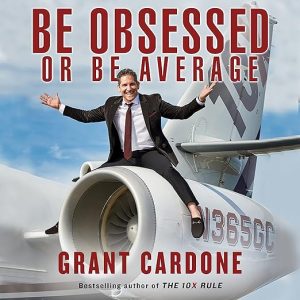
Cardone's philosophy is constructed deliberately to be uncomfortable, and this audiobook makes no concessions to that. Be Obsessed Or Be Average is Grant Cardone's argument that conventional wisdom about work-life balance is not just wrong but actively harmful to anyone who wants to build something extraordinary. He narrates the book himself, as he does most of his recordings, and his self-narration is the right call. Cardone's energy is inseparable from his argument. Reading it on the page would lose roughly half of what makes the message land.
The personal biography that opens the book is worth sitting with. Cardone was broke, unemployed, and drug-addicted before he built five companies and became one of the most recognized names in sales training. He is not the person who had a comfortable life and decided to optimize it. He is the person who had no floor and had to build one, and that context gives the obsession argument a different weight than it carries when it comes from someone for whom success was always relatively available. The distance he has traveled is the credential, and he leans on it appropriately.
His core argument is that average is not a neutral state. It is a choice, and a choice made under social pressure from people who benefit from your scaled-down ambitions. The friends, family members, and colleagues who advise moderation are not, in Cardone's telling, wrong because they are bad people. They are wrong because their frame of reference is calibrated to what they have already experienced as possible. The person who wants to exceed that frame has to stop taking direction from it.
What We Made of It
The book's construction is worth examining closely because it demonstrates something about how Cardone thinks. He does not structure arguments in the traditional sense of premise, evidence, conclusion. He structures them as cascading assertion, with momentum as the persuasive mechanism. Each chapter adds intensity rather than adding proof. That approach will feel exhilarating to listeners who are already predisposed to the worldview and will feel manipulative to listeners who are not. Both responses are fair readings of the same text.
The most practically useful section is the one Cardone calls feeding the beast, which is about the relationship between money and obsession. His argument is that people who feel guilty about wanting financial success have been conditioned to suppress an ambition that is actually productive. He argues for a specific relationship with money: not greed, but the recognition that financial resources enable the scale of impact you are reaching for. When you frame spending on growth as fuel rather than indulgence, the psychology of investment changes. That reframe has genuine practical utility regardless of whether you accept the surrounding ideology.
The haters-as-fuel concept, which runs throughout the book, is psychologically interesting but structurally fragile. Cardone argues that criticism and disapproval are evidence you are on the right track, which is both sometimes true and prone to becoming an unfalsifiable defense against legitimate feedback. The book does not fully reckon with that instability. Listeners should extract what is useful about using external doubt as motivation while maintaining their own capacity for honest self-assessment.
What Makes Be Obsessed Or Be Average Worth Hearing
The audiobook format amplifies Cardone's strengths considerably. He is a speaker and trainer by profession, and the self-narration gives the text a live-performance quality that print cannot replicate. At over eleven hours, this is a long listen, but reviewers consistently describe returning to it multiple times, which suggests the content rewards re-engagement rather than being fully absorbed in a single pass.
The book works best during periods when you are actively fighting resistance, both internal and external, to pursuing an ambitious goal. Its energy is specifically calibrated for moments when conventional encouragement feels insufficient. If someone telling you to be more realistic is what you are pushing against right now, Cardone's counter-argument will land hard.
For sales professionals and entrepreneurs specifically, the book's language maps onto professional experience in ways that more general motivation content does not. Cardone's background is in sales, and the obsession framework he describes is rooted in the specific psychology of closing deals, building pipelines, and maintaining energy through inevitable rejection.
What Might Not Land
The absolutism of the title, and of the argument, is real and intentional. Cardone is not interested in nuance about when balance is appropriate or when obsession might damage relationships and health. He has his own answers to those questions, but they are embedded in his personal biography and may not transfer cleanly to every listener's context. The book is best taken as a counterweight to excessive moderation rather than as a literal prescription for how to operate at all times.
The absence of structural skepticism about the obsession framework is the book's primary limitation. Cardone describes the upsides of obsession with precision but treats its risks as manageable rather than examining them rigorously. Listeners should bring their own thinking about sustainability, health, and relationships to the material rather than expecting the book to do that work for them.
The intensity of the self-narration over eleven hours can be fatiguing. Cardone's delivery is high-energy and does not modulate significantly across the book's length. Listening in sessions rather than in extended runs may help listeners maintain engagement and avoid the point of diminishing returns that extended high-intensity narration can create.
Who Should Pick Up Be Obsessed Or Be Average
Entrepreneurs and sales professionals who are in the early or mid-stage of building something ambitious and are encountering serious social resistance to their goals will find Cardone's argument useful as both motivation and permission. The book specifically addresses the experience of being told your ambitions are unrealistic, and for people experiencing that pressure, the counter-argument is valuable.
Listeners who have previously found conventional motivational content too soft or too focused on incremental improvement will find Cardone's intensity refreshing. This is not a book about making small changes. It is a book about committing fully to an orientation toward extraordinary achievement.
Anyone navigating a personal pivot from underachievement toward serious ambition, particularly in the context of a prior identity built around diminished expectations, will find the biographical section of the book specifically resonant. Cardone's account of his own transformation from addiction and failure is one of the more honest versions of that story in the business self-help genre.
The Short Version
- Narrator: Grant Cardone narrates his own work with the high-energy, live-performance quality of someone who has delivered these ideas in rooms full of salespeople for years.
- Subjects: Obsession as professional strategy, rejecting conventional balance, using criticism as fuel, goal setting without ceiling, and building financial ambition without guilt.
- Tone: Relentlessly high-energy, unapologetically intense, and deliberately confrontational toward conventional moderation advice.
- Bottom line: A polarizing but effective audiobook for ambitious professionals fighting resistance to extraordinary goals, best consumed in sessions rather than marathon listens.
Common Questions
What is the central argument of the Be Obsessed Or Be Average audiobook?
Cardone argues that conventional advice about balance and moderation is calibrated to average outcomes and will produce average results. He makes the case that obsession with your goals, not balance, is what separates extraordinary achievement from ordinary results, drawing on his own transformation from addiction and failure to multimillionaire entrepreneur.
Who narrates the audiobook and how does self-narration affect the listening experience?
Grant Cardone narrates himself, and the self-narration significantly amplifies the book's impact. His background as a speaker and trainer means the delivery has a live-performance quality that printed text cannot capture. The energy is high throughout the full eleven-hour runtime, so listening in sessions is advisable.