Quick Take
- Narration: Corvina Grumorne reads with warmth and clarity, keeping the guide’s practical tone accessible without becoming dry.
- Themes: Cultural immersion, budget-conscious travel, authentic local experience over tourist-trail defaults
- Mood: Encouraging and conversational, like advice from a well-traveled friend
- Verdict: A solid first-trip primer that works best as a cultural orientation rather than a comprehensive logistical planner.
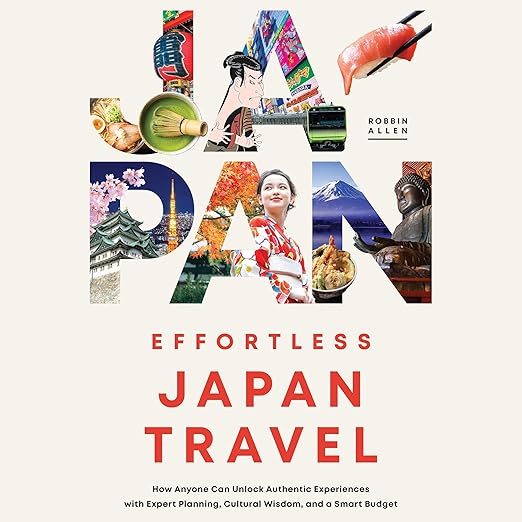
I picked this one up the week after a colleague returned from her first solo trip to Japan and spent an entire lunch hour apologizing for all the cultural missteps she had made without knowing she was making them. She had skipped the tourist traps, she said, but she had also accidentally been rude at a ryokan, struggled with the IC card system at rush hour in Shinjuku, and eaten every meal at places with English menus because she had no idea how to navigate anything else. Listening to Effortless Japan Travel afterward, I kept thinking about how differently that trip might have gone with a few hours of this in her earbuds beforehand.
Robbin Allen’s guide runs under four hours, which is worth naming upfront because it shapes expectations. This is not an exhaustive reference volume. It is a cultural and logistical orientation, built around the idea that most first-time visitors to Japan fail not from bad planning but from cultural blindness. The sections on local customs and etiquette are the strongest material here. The discussion of onsen etiquette, the guidance on navigating yatai food stalls, the breakdown of when and how to bow: this is the kind of information that transforms a trip from a pleasant exterior viewing into something that actually connects with the country.
Our Take on Effortless Japan Travel
The ten money-saving hacks and ten expert planning tips are structured to be immediately actionable, and most of them are. The advice on getting an IC card before leaving your home country, on avoiding international roaming charges, on identifying neighborhood eateries over tourist-adjacent restaurants: practical, clear, and presented without condescension. The inclusion of basic Japanese phrases in audio form is a genuine strength. Hearing the pronunciation rather than reading a romanized transliteration is the difference between approximating a phrase and actually communicating it.
Where the guide shows its limitations is in depth. One reviewer noted that she would need additional research beyond this book to fully plan her trip, and that is accurate. The guide gestures toward certain regions and experiences, including tranquil temples and centuries-old onsen resorts, without providing the specificity that a traveler would need to actually book and navigate them. It reads more as a mindset-setting guide than an operational manual, and listeners who approach it that way will get considerably more from it.
Why Listen to Effortless Japan Travel
The audio format works surprisingly well for this material. Corvina Grumorne’s narration keeps the tone conversational and warm, which suits Allen’s approach to the subject. This is not a guide that talks down to first-time travelers or overwhelms them with exhaustive option lists. It is more interested in building cultural confidence than in providing GPS coordinates. That is a specific and legitimate function, and for travelers who have already done their logistical research elsewhere, this guide fills in the human layer that most travel apps cannot.
The culinary sections are particularly enjoyable on audio. Allen writes about Japanese food with genuine enthusiasm, and hearing descriptions of themed cafes, yatai, and generational family recipes is considerably more evocative when spoken aloud than on a page. A reviewer who called it the first travel guide she had read cover to cover captures something real about the book’s readability: it flows like a personal recommendation rather than an indexed reference.
What to Watch For in Effortless Japan Travel
The guide promises comprehensive coverage in its marketing language but delivers something narrower: a curated cultural orientation for first-timers. Listeners who go in expecting a complete trip-planning resource will find gaps. The transportation section, for instance, covers the IC card and a few rail basics but does not prepare a traveler for the full complexity of regional rail passes, highway bus options, or the considerable variation between Japan Rail and private operators. This is not a criticism of the guide’s quality so much as a clarification of its scope.
The guide is also strongest for travelers to major urban and historical destinations. Those planning more rural or off-grid itineraries will find less directly applicable material, though the cultural framework it establishes applies across the country regardless of destination.
Who Should Listen to Effortless Japan Travel
First-time visitors to Japan who want to arrive culturally prepared and budget-conscious rather than just geographically oriented. It pairs well with more logistics-heavy resources: think of this as the human layer you add on top of your guidebook research. Return travelers who felt culturally disconnected from their first trip, as one reviewer explicitly described, may also find it reframes what a Japan trip can be. Those looking for a single complete resource that covers all planning needs will need to supplement it with additional research.
Frequently Asked Questions
Is this guide useful for return visitors to Japan or only first-timers?
Allen frames it as a first-trip resource, but at least one reviewer who had visited Japan before found value in the cultural depth and budget framing. If your previous visits felt logistically fine but culturally surface-level, this guide addresses exactly that gap.
Does the audio format include the Japanese phrases in a form that’s actually pronounceable?
Yes, and this is one of the genuine advantages of the audio edition over a print version. Hearing the phrases spoken by narrator Corvina Grumorne gives you the pronunciation in a way that romanized text on a page cannot replicate.
How detailed is the budget travel advice in Effortless Japan Travel?
The ten money-saving hacks are practical and actionable for most travelers: IC cards, neighborhood restaurants, strategic transport choices. But the guide does not provide specific price benchmarks or detailed accommodation comparisons. It is more principles-based than numbers-based.
Can this guide serve as a solo trip-planning resource without additional research?
For most travelers, no. Multiple reviewers, including enthusiastic ones, noted they needed supplementary research for logistics like specific rail passes, regional planning, and accommodation booking. The guide is most valuable as a cultural and mindset orientation layered on top of conventional trip planning.