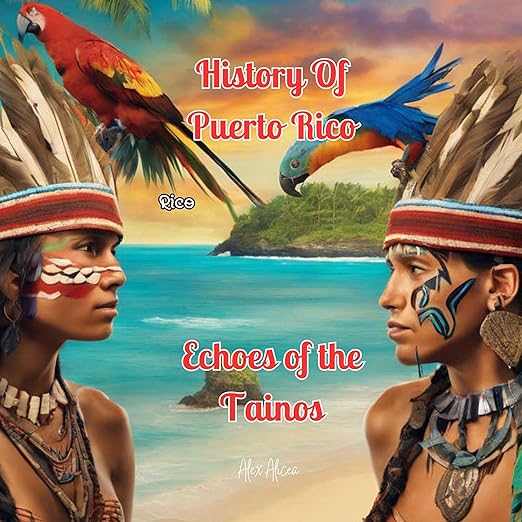
Taíno civilization has been written out of Caribbean history so systematically that many people of Puerto Rican descent grew up learning almost nothing about the island's first inhabitants. One reviewer, born in Puerto Rico in the 1950s, notes directly that the Taíno were simply not taught in school - and that this audiobook, Alicea's second in the History of Puerto Rico series, corrects that absence with what she describes as amazing facts delivered clearly. That kind of personal testimony from a listener with direct ancestry in the subject matter is worth weighing more carefully than a generic five-star endorsement, because it speaks to whether the audiobook actually delivers on its central ambition: to recover and transmit knowledge that formal education suppressed.
Alex Alicea's approach in this audiobook centers on the people of Borikén - the Taíno name for Puerto Rico - before colonization reshaped every aspect of island life. The agriculture, the spirituality, the relationship between the Taíno and the landscape of their island: all of this is rendered through what the book calls vivid storytelling, which is a framing choice worth examining. Alicea is not simply listing facts but constructing a portrait of a living civilization, one whose influence, as he argues, still pulses through Puerto Rican culture today. At 2 hours and 39 minutes, narrated by Luke Swierczek, this audiobook functions as a compact but substantive entry into a subject that most mainstream history has neglected.
The Review
The most effective sections of this audiobook are those that move beyond the standard arc of indigenous history - pre-contact flourishing, colonization, devastation - and linger instead on specifics: Taíno agricultural techniques, their cosmology, the sacred geography of the island. Reviewers consistently point to the spirituality and culture of Puerto Rico's first people as the material that stays with them, and that is telling. Alicea is at his strongest when he is specific rather than elegiac, when the Taíno are rendered as people with particular knowledge and practices rather than as a people defined by what was done to them.
Swierczek's narration serves this material without drawing attention to itself, which is the right choice for a history of this kind. The subject matter carries its own gravity, and a narrator who performs too heavily would tip the audiobook into sentimentality. Instead, Swierczek reads with the pace of someone who understands that the listener needs time to absorb what is being described. A reviewer who described the book as very well researched points specifically to the narrative structure that incorporates stories of the Taíno people as interesting and educational - that balance between scholarship and storytelling is evident in how the audio lands.
Why Echoes of the Taíno Works as an Audiobook
The audio format benefits this particular book because the storytelling mode Alicea employs - oral tradition shaped as historical account - suits being heard rather than read. The Taíno themselves sustained their history through oral culture, and listening to an account of that culture preserves something of that transmission method, even at one significant remove. For Puerto Rican listeners in particular, Swierczek's narration of Alicea's material is a kind of restoration - information about ancestors that was deliberately erased, now available in audio for the first time for many families.
This audiobook also works well for listeners who want Caribbean history but find academic monographs inaccessible. Alicea writes for a general audience without sacrificing the substance that makes the history meaningful. At under three hours, the commitment is modest enough that listeners who are new to this subject can test whether they want to pursue it further, while those already invested in Puerto Rican or indigenous Caribbean history will find Alicea's framing adds perspective to what they already know.
The Caveats
One reviewer notes that this is the third in the History of Puerto Rico series while the series listing indicates it is the second entry. That minor inconsistency in series positioning doesn't affect the content, but listeners who are building a complete picture of the series should verify the numbering. More substantively, the audiobook's short runtime means it is necessarily selective. The full range of Taíno civilization - the geographic spread across the Caribbean, the variety of sub-groups within the broader cultural identity, the complexity of their political structures - cannot be exhausted in under three hours. Alicea prioritizes depth in specific areas over comprehensive survey, which is a defensible editorial choice but one that means this is a starting point rather than a definitive reference.
Listeners who have personal or professional reasons for wanting the most rigorously cited historical scholarship should pair this audiobook with academic sources. Alicea writes with confidence and clearly from substantial research, but the audiobook's format does not offer footnotes or bibliography, and the narrative mode occasionally prioritizes fluency over granular documentation.
Who Should Listen to Echoes of the Taíno
Puerto Rican listeners of all ages who have felt the gap in their education about Taíno heritage will find this audiobook particularly resonant. History enthusiasts interested in pre-colonial Caribbean civilization, indigenous studies, and the recovery of suppressed cultural knowledge will find it a worthwhile introduction. The short runtime makes it accessible to listeners who are new to the subject and unsure how deep they want to go.
Listeners expecting an academically exhaustive treatment or a comprehensive multi-hour cultural history will need to supplement this with additional sources. Those primarily interested in the colonial and post-colonial periods of Puerto Rican history would be better served by a different volume in the series. Non-specialist listeners who want a general Caribbean history rather than one focused on the Taíno specifically should consider whether this title aligns with their actual interest before purchasing.
Before You Listen
Do I need to listen to other books in the History of Puerto Rico series before this audiobook?
No. Echoes of the Taíno focuses specifically on Taíno history and works independently. The series addresses different periods and aspects of Puerto Rican history, so this entry stands on its own for listeners interested in the pre-colonial indigenous heritage.
How does Luke Swierczek's narration handle the cultural and spiritual material in this audiobook?
Swierczek reads with a respectful, measured pace that suits the subject's gravity. He doesn't perform the material dramatically but allows the content - the Taíno cosmology, agricultural practices, and spiritual life - to carry its own weight. Listeners familiar with the subject will find the narration appropriately understated.
At under 3 hours, is this audiobook substantial enough to justify the purchase?
For listeners whose primary interest is an accessible, well-researched introduction to Taíno heritage, yes. Alicea's research is solid and the narrative density is high for the runtime. Listeners who want exhaustive coverage of every aspect of Taíno civilization will need additional sources, but as a focused introduction this audiobook delivers genuine content rather than a surface skim.