In Brief
- Narration: Eric Conger reads with narrative energy that suits the business-thriller pacing Stross brings to his material, this is VC drama delivered like a story, and Conger honors that instinct.
- Themes: Wealth creation and its psychology, venture capital decision-making, the dot-com era as a specific cultural moment
- Mood: Propulsive and insider-intimate, with the slightly breathless quality of watching enormous bets being placed in real time
- Verdict: A 2000-era classic of business narrative that holds up remarkably well as a portrait of how venture capital actually operates at the highest level.
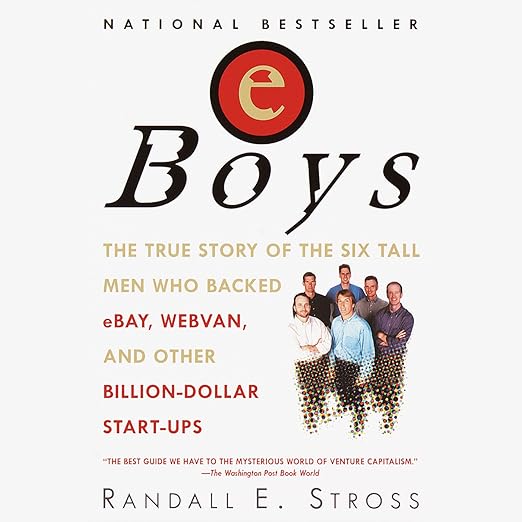
I came to eBoys through a recommendation from someone who had worked in venture capital and described it as the most accurate account of how the job actually feels that they had ever read. That is a specific kind of endorsement, and it held up. Randall Stross spent two years embedded with Benchmark Capital, an upstart firm founded by a group of thirtysomething renegades who had assembled an average height of six foot five and a collective appetite for risk that was unusual even by Sand Hill Road standards. The access he gained is the foundation of everything that makes eBoys unusual as a business book, and twenty-five years after publication it remains one of the few texts in this genre that actually shows the inside of the room.
The timing is worth accounting for. This is a book about the dot-com era written and published at the peak of the dot-com era, in 2000. Stross was reporting in real time on events that had not yet resolved, Webvan had not yet collapsed, the NASDAQ had not yet corrected, and the mood among Benchmark's partners was one of extraordinary, almost vertigo-inducing confidence. Reading it now means reading it as history, which adds a layer that Stross could not have intended but which the text supports. You know what happens to some of these companies. The partners don't. That dramatic irony is present on every page without the author having planned it.
From Twenty Million to Twenty-One Billion via eBay
Stross's central achievement is making the evaluative process of venture capital feel dramatic without misrepresenting it. The conversations he reconstructs, which partners supported which deals, which concerns were overruled, which intuitions turned out to be correct, have the quality of genuinely good narrative nonfiction. He describes himself as bringing a business historian's perspective combined with a journalist's flair for suspenseful storytelling, and both halves of that description are accurate. The eBay story, which takes a company from a $20 million valuation to more than $21 billion within two years of Benchmark's initial investment, is the headline example. But the strength of the book is in the texture around that headline: the smaller bets, the internal disagreements, the partnership dynamics between men who are all competing to have been right.
Eric Conger's Momentum Makes This Feel Like a Novel
Eric Conger's narration brings the right energy to material that could easily become a list of company names and valuation numbers. He reads with the forward momentum of someone who finds the story interesting, and the dramatic sections, the partner meetings, the evaluations of early-stage pitches, the moments when someone's conviction exceeds the consensus, benefit from that commitment. A reviewer who read this on vacation under a shade umbrella at a resort described it as feeling like a novel, which is exactly what Stross is aiming for and what Conger's narration supports. For anyone working in or adjacent to venture capital, the book functions as a period document with genuine diagnostic value. The patterns Stross describes, how partners think about founder quality, how they weight market size against team, how they manage the relationship between capital and guidance, are recognizable to practitioners even now.
Benchmark's Access Tilts the View of Rivals
Reviewers who disclosed VC backgrounds noted a clear bias toward Benchmark and against their rival firm Kleiner Perkins. Stross's access was through Benchmark, and his sympathy follows that access. This does not invalidate the book's insights, but it does mean that readers should treat its characterizations of the competitive landscape with some critical distance. One experienced VC reviewer described the stories as disjointed and the composition as somewhat loose, which is a fair observation. The book is organized around moments and anecdotes rather than a strict linear narrative, and some sections feel more like reported scenes than integrated chapters. For readers who prefer tight business narratives, the structure can feel episodic in ways that are not always purposeful.
Founders Learn How Investors Actually Talk
Anyone who follows current venture capital and wants to understand where the culture and methods came from will find eBoys essential. The contemporary VC world is populated by people who grew up professionally in the shadow of the firms and decisions this book documents, and the continuities are striking. It is also the right listen for founders who want to understand how their potential investors think about risk, not as they describe it in Medium posts, but as they actually discuss it in partner meetings with each other. Skip it if you need your business audiobooks to be prescriptive or forward-looking; eBoys is retrospective by nature and does not offer frameworks to apply. Embrace it if you want to understand how a specific, extraordinary moment in the history of wealth creation actually felt to the people inside it.
Does eBoys age poorly given that it was written at the peak of the dot-com boom? Are the companies and situations it covers now irrelevant?
It ages unusually well, partly because the dot-com collapse makes it more interesting in retrospect rather than less. Stross was reporting on events in real time, which means the book captures the confidence and reasoning of the era without the benefit of hindsight, and knowing what happened to Webvan and other Benchmark bets adds a dramatic dimension Stross could not have planned.
Is eBoys worth listening to if you have no background in venture capital or technology?
Yes, with the caveat that some company-name context will require external lookup. Stross writes for a general audience and explains the mechanics of VC investment clearly enough that the evaluative process is comprehensible without specialist knowledge. The emotional and human dynamics of the partnership are accessible to any listener.
Reviewers mention a bias toward Benchmark. How significantly does that shape the book's reliability?
The access Stross had was through Benchmark, and that shapes the perspective throughout. Kleiner Perkins and other firms are viewed largely through Benchmark's competitive lens. Readers should treat characterizations of rival firms with appropriate skepticism. The internal Benchmark material, however, is considered authoritative by industry practitioners who have commented on it.
Eric Conger narrated this in 2000. Does the production quality hold up for modern listeners?
Reasonably well. The audio is older and lacks the production values of contemporary audiobook releases, but Conger's narration is clear and his reading style suits the material. Listeners accustomed to current production standards may notice the difference in audio quality, but it does not impede comprehension or engagement.