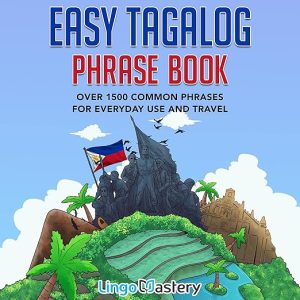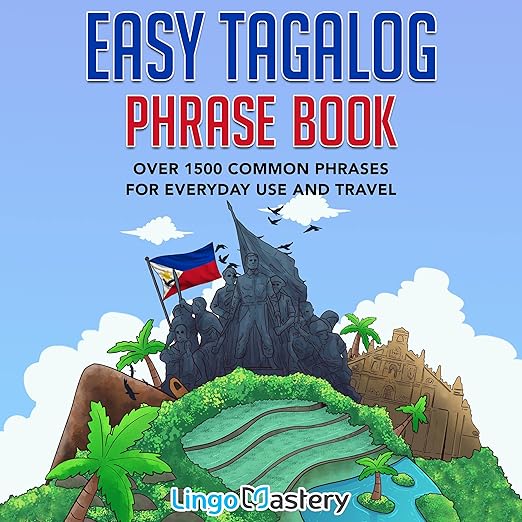
Somewhere in Lingo Mastery's approach to language learning is a clear-eyed acknowledgment of where traditional textbooks consistently fail: they teach grammar and spelling mechanics without teaching how to sound like someone who actually lives in the language. The Easy Tagalog Phrase Book audiobook, narrated by JR Alagao, is built on that premise. Over six hours and thirty-two minutes, it works through more than 1,500 common Tagalog phrases organized by situation and use, each accompanied by an English translation and a phonetic pronunciation guide delivered in audio. Lingo Mastery has applied this framework across multiple languages, and the Tagalog edition earns its 4.5 rating from a sizable pool of listeners who describe it as filling a genuine gap in available learning resources for Filipino language students.
The phonetic component is the key audiobook-specific value here. Tagalog pronunciation presents particular challenges for English-speaking learners: vowel sounds, consonant combinations, and the implications of stress placement all behave differently than English conventions would suggest. Alagao's delivery demonstrates pronunciation for each phrase before the phonetic guide is given, which means the audiobook is doing something print editions of phrase books cannot accomplish. It is showing you what correct sounds like before asking you to reproduce it, rather than asking you to decode a phonetic approximation without an audio anchor to calibrate your ear against.
Is Easy Tagalog Phrase Book Worth Your Time?
The audiobook's most consistently praised quality is its organization. Rather than building grammar scaffolding and filling it with vocabulary, Lingo Mastery organizes the 1,500 phrases around communicative situations: the contexts in which a learner needs to say something, rather than the structural categories that would make sense to a linguist. This is a pedagogical choice that reflects the stated goal of enabling natural conversation rather than grammatical proficiency, and it makes the content feel more immediately applicable than a traditional language course would at the same beginner stage.
One reviewer describes the example sentences as having a drama to them that makes them more fun to learn and easier to remember, which is a meaningful observation for audio learners specifically. Memorable sentences are retained better than arbitrary vocabulary lists, and the audiobook format means you hear each phrase multiple times in sequence: translation, then phonetics, in a pattern that creates auditory encoding rather than merely visual recognition. Whether this quality is intentional design or the natural outcome of Lingo Mastery's method, the practical effect is the same: the material sticks more reliably than a conventional phrase list format would produce.
The Best Parts of Easy Tagalog Phrase Book
The obvious use case is pre-travel preparation for the Philippines, and the audiobook serves this well. Travelers can work through situationally relevant sections: greetings, transportation, food and accommodation, emergency phrases, without the overhead of building grammatical comprehension first. A reviewer who described the book as less an on-site phrase book and more a way to prime the pump captures the most honest characterization of its utility. This is best used in advance, not as a real-time reference guide on your phone while standing at a market stall in Manila or Cebu.
The audio format creates a layer of value that the print edition cannot replicate. Hearing Alagao pronounce each phrase, and then hearing the phonetic guide immediately after, trains your ear to recognize sounds before your mouth has to produce them. Listeners who have studied Tagalog through textbooks alone and found themselves unable to parse native speech in real situations will find that this audiobook recalibrates their phonetic expectations in useful ways. The download note indicates a PDF companion is available in your library alongside the audio, which is the recommended approach for learners who plan to practice writing as well as speaking.
Before You Commit to Easy Tagalog Phrase Book
The audiobook's structural limitation is also its structural honesty. A phrase book is organized as a list, and listening to a list for six-plus hours without strategic pacing is repetitive regardless of the subject. The audiobook rewards targeted use by section more than cover-to-cover listening in a single session. Approach it as you would a reference guide: work through the sections most relevant to your immediate needs and return to others as preparation demands change. This is not a learning resource that builds toward a destination the way a narrative course does, and that expectation should be calibrated before starting.
One reviewer notes that the phrases are organized as vocabulary items rather than guiding you through complete conversational sequences, which means you learn the components of conversation without always learning how they connect in real exchanges. This is a limitation of the phrase-book format as a category rather than a failure of this particular title, but listeners expecting a dialogue-based course structure should calibrate their expectations accordingly before investing the full six hours in what is fundamentally a well-made reference resource.
Should You Listen to Easy Tagalog Phrase Book?
Travelers preparing for a trip to the Philippines who want to move beyond tourist-phrase-card basics. Heritage speakers who want to reconnect with conversational Tagalog at a practical level. Beginners who find full grammar courses overwhelming and want an accessible entry point to the language before committing to structured study. Not suited as a primary resource for learners seeking grammatical competence or academic proficiency: this is a communicative tool, not a comprehensive course. Serious students should treat the PDF companion and the audiobook as paired resources that each provide what the other cannot, particularly for the pronunciation and written form components.
Key Details
- Read by: JR Alagao delivers the 1,500+ phrases and their phonetic guides with clear pronunciation that makes the audio format genuinely functional as a learning tool, though the phrase-list structure makes extended sessions repetitive.
- At its heart: Practical Tagalog communication, cultural approachability, native-speaker cadence
- Vibe: Purposeful and instructional, with occasional charm in the example sentences
- Short version: A well-organized Tagalog phrase audiobook that fills a real gap in Filipino language learning resources, with a PDF companion that serious learners should use alongside the audio.