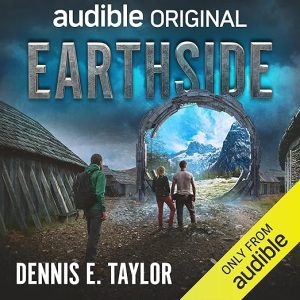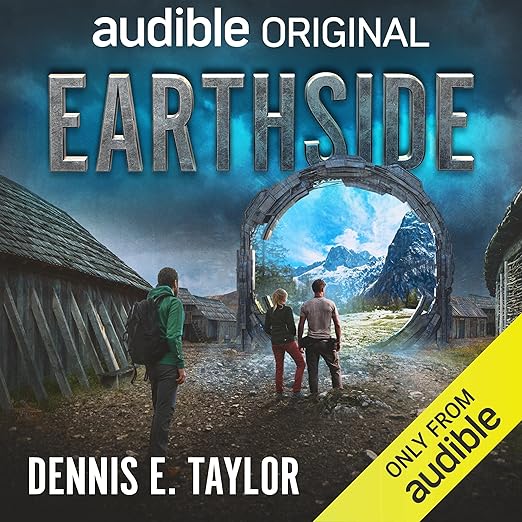
Earthside, Dennis E. Taylor's follow-up to Outland, is a post-apocalyptic audiobook that refuses to take itself too seriously, and that refusal is both its greatest strength and the thing most likely to frustrate readers who want their Yellowstone super-eruption treated with full gravity. I came to it already fond of Taylor's voice from the Bobiverse series, which trained me to expect witty dialogue, science-nerd protagonists, and plot machinery that clips along at a pace that makes long listens feel short. Earthside delivers all of that and adds a layer of community-building friction that the first book only hinted at.
What Dennis E. Taylor Delivers
The Yellowstone eruption has erased modern civilization, and what remains of organized humanity is clustering around Rivendell, the alternate-Earth colony that Bill and Kevin have been developing since Outland. Taylor is smart enough to recognize that the real drama is not the catastrophe itself, which happened offscreen, but what comes after: who gets to make decisions, what rules apply when the old institutions are gone, and what happens when a large group of refugees arrives with its own power structure and very different ideas about how things should run. Monica's police force is understaffed. Security has been pulled back Earthside to investigate a garbled distress call from Omaha. Winter is coming. And the population keeps growing faster than the infrastructure can support. As governance problems go, this is a rich setup, and Taylor develops it with more political texture than most survival fiction bothers to attempt. The book's comedy remains present throughout but the weight of the decisions being made at Rivendell gives the humor a foundation it earns rather than assumes. The garbled message from Omaha is one of the book's smarter structural moves: it removes most of the colony's security capacity at precisely the moment it is needed most, and the thinned-out team left behind is forced to improvise solutions that reveal character more efficiently than any amount of backstory would. Taylor understands that constraint is the engine of plot, and Earthside applies that understanding well.
The Best Parts of Earthside
Ray Porter is the central reason to choose the audiobook over print. His performance captures Taylor's tonal range: the jokes land because Porter commits to the comedic rhythms without overselling them, and the moments of genuine tension work because he does not play them for drama either. Porter has narrated enough of Taylor's work to understand when to step back and let the ensemble breathe, and Earthside has a proper ensemble. Bill and Kevin's world-hopping continues alongside Monica's domestic crisis, and the parallel structure benefits from a narrator who can shift register between plotlines without losing the listener. One reviewer notes 'very fluent writing, good jokes and interesting plot lines,' which is accurate, and Porter's audio work reinforces all three qualities. The ensemble casting challenge is significant here: Taylor's characters often feel like archetypes with sharp dialogue rather than fully individuated people, and Porter finds the vocal distinctions that keep them separate even when the page might blur them together.
Before You Commit to Earthside
The most consistent criticism in the reviews, that 'characters are shallow and do not evolve,' is fair and worth naming honestly. Taylor's characters are vehicles for wit and plot function more than they are interiority. If you listen to fiction primarily for psychological depth or slow-burn character transformation, this series is going to leave you wanting. What Taylor does superbly is build systems: how a colony feeds itself, how governance emerges under pressure, how science-minded people argue about practical problems, and how good intentions collide with resource constraints. The colony politics in Earthside are more developed than anything in Outland, and the logistics of winter preparation produce several of the book's most satisfying scenes. One reviewer describes the experience of rereading it: initial disappointment, then surprise on a second listen, then genuine affection for the whole series. That arc tracks. The book's pleasures are quieter than they first appear, and the stakes of what Monica and the colony leadership are managing only fully register once you let the book settle. Taylor's decision to keep the Yellowstone eruption itself offscreen is also worth noting as a structural choice. The disaster is a given rather than a spectacle, which means the book can focus entirely on the social and logistical aftermath. That decision distinguishes Earthside from most disaster fiction and aligns it more closely with the governance-drama tradition of Kim Stanley Robinson's Mars trilogy than with the survival-horror tradition.
Who Should Pick Up Earthside
Listeners who finished Outland and want more of Rivendell, more Bill and Kevin, more colony drama, more of the alternate-Earth premise pushed into more complex territory, will find Earthside an easy yes. This is Quantum Earth book two and it assumes you already know the world and the cast. Coming in cold here would be disorienting; start with Outland. Bobiverse fans will feel immediately at home with Taylor's voice, and Ray Porter's presence on the narration makes the audiobook the recommended format without question. If you are looking for post-apocalyptic fiction that takes the horror of civilizational collapse as its emotional center rather than its premise, look elsewhere. Taylor is interested in what people build after the fall, not in mourning what was lost. Readers who prefer their survival fiction to engage seriously with the political and psychological dimensions of collapse, along the lines of Emily St. John Mandel's Station Eleven or Colson Whitehead's Zone One, will find Taylor's approach too comic and too solution-oriented. The book's energy is directed toward building, not mourning, and that is genuinely a distinct creative sensibility worth seeking out if it matches your own. Dennis Taylor has built a corner of science fiction that is distinctly his own: optimistic about human ingenuity, skeptical of human politics, and consistently funnier than the genre average. Earthside expands that corner in directions that reward continued investment.
Good to Know
Is Ray Porter's narration as strong here as in the Bobiverse audiobooks?
Porter is consistently excellent in both series. His comedic timing is well-suited to Taylor's dialogue-heavy style, and he handles the ensemble cast of Earthside with clear vocal differentiation. Fans of his Bobiverse work will feel right at home with his performance here.
How does this audiobook compare to the Bobiverse series in tone and pace?
Very similar in tone: witty, science-forward, and faster-paced than most post-apocalyptic fiction. Earthside leans slightly more toward community governance drama than the Bobiverse's space-opera scope, but Taylor's narrative voice and character types are recognizably consistent across both series.