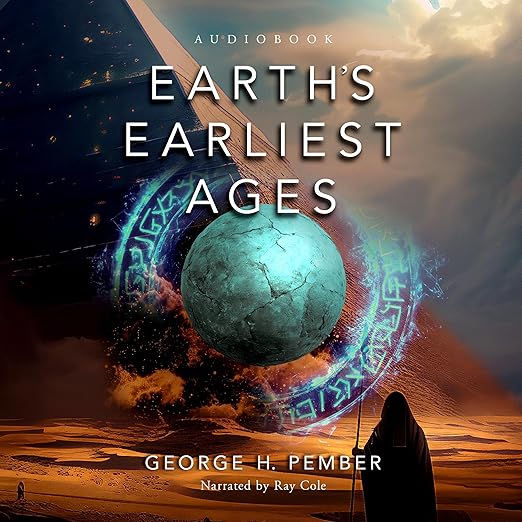
George Hawkins Pember wrote this book in 1876, and the prose still carries every ounce of that Victorian formality: long, stacked clauses, biblical citation piled on biblical citation, argument built the way a barrister builds a case rather than the way a modern nonfiction writer paces a chapter. Listening to this audiobook rather than reading it on the page changes the experience more than usual, because narrator Ray Cole has to carry that dense, nineteenth-century sentence structure entirely through pacing and emphasis, with no paragraph breaks or footnotes to lean on.
First, the Big Picture
The core argument spans an enormous amount of ground for a single thesis: comparative myths of descending gods across Rome, Greece, Egypt, Persia, Assyria, Babylonia, and Sumer, read together as scattered fragments of one original event, the mingling described in Genesis as the 'sons of God' and their offspring known as Nephilim. Pember ties this comparative-mythology reading directly to end-times prophecy, arguing that Christ's own reference to 'the days of Noah' in Matthew 24:37 points toward a literal return of these beings before the Second Coming.
What makes the book worth engaging with beyond its historical interest is how directly it anticipates a strand of Christian prophecy writing that would come much later. A reviewer notes the text 'theorizes on how angels may have built structures all over the world using amazing technology,' a claim that reads as a direct ancestor of the Nephilim-focused prophecy literature that remains active today. Treated as a primary source, this 1876 text functions as a genuine foundation stone for that entire tradition rather than a late imitation of it.
The terminology itself carries real argumentative weight in Pember's hands. He builds his case around the Hebrew phrase b'nai ha Elohim, 'sons of God,' from Genesis 6:4, and the beings the Hebrews called Watchers, treating both as consistent threads running through a scattered global mythology rather than isolated cultural coincidences. That comparative method, reading myths from unconnected ancient cultures as corroborating fragments of one real event, is the actual engine driving the book's larger prophecy argument.
Reading myths from that many unconnected ancient cultures side by side as evidence for one shared original event was itself a methodologically unusual move for 1876. Comparative mythology was only just emerging as a serious field of study in Pember's own lifetime, and applying that comparative lens to prove a specific theological claim, rather than simply catalog similarities for their own sake, sets this book apart from more purely descriptive folklore scholarship of the same era.
What G. H. Pember M. A. Gets Right
I found no prior narration credits for Ray Cole, so this is a fresh assessment built purely on what the material requires of him specifically. A reviewer describes the prose itself as 'old-school convoluted,' and dense, clause-heavy nineteenth-century argument like this needs a narrator who can hold a listener's attention through sustained clarity and measured pacing rather than dramatic flair, since no dialogue or scene work exists here to lean on for variety.
The nearly thirteen-hour runtime suits gradual, chapter-by-chapter engagement more than a single sitting, closer to a lecture series than a novel. That structure gives a patient listener room to absorb Pember's layered argument piece by piece rather than trying to hold the entire comparative-mythology case in mind at once.
A real case exists that audio suits this material more naturally than it first appears to. Pember's own era delivered dense theological argument like this primarily aloud, from a pulpit or a lecture hall, rather than through silent private reading, and hearing Earth's Earliest Ages spoken rather than skimmed on a page arguably returns the text closer to how a Victorian audience would actually have first encountered ideas this dense.
A Few Reservations
This is squarely a work of Christian prophecy interpretation, not secular history or anthropology, despite ranging across ancient civilizations for its evidence. Listeners expecting a neutral academic survey of the ancient world will be in the wrong book; Pember writes as a believer building a specific theological case, not as a disinterested historian.
The density is real and worth taking seriously before committing to nearly thirteen hours. One reviewer who rates the book highly still admits 'it takes some getting used to,' and a newcomer to this specific style of Victorian religious argument would be well served sampling an early chapter before deciding whether to continue through the full runtime.
Reviewer Jerry Davis calls the book '130 years old, yet reads as fresh as if it were written this morning,' a striking claim worth unpacking rather than taking purely as praise. What that durability really reflects is how consistently later Nephilim-focused prophecy writers have kept returning to Pember's original framework rather than replacing it, which says as much about the staying power of this specific interpretive tradition as it does about the prose itself.
Given the density of the argument, treating that runtime as a multi-week project rather than a single extended sitting is a reasonable, even recommended, way to approach this specific listen. Splitting the material into shorter daily sessions gives Pember's stacked, citation-heavy sentences room to actually land rather than blurring together under sustained, uninterrupted listening.
Genesis 6:4 remains one of the most genuinely disputed short passages in the entire Hebrew Bible, and mainstream biblical scholarship has never fully settled on a single reading of who or what the 'sons of God' actually were. Pember's confident, specific answer sits at one clear end of a debate that continues among biblical scholars generally, worth knowing before treating his interpretation as the only reading a serious listener might encounter on this exact question.
Who G. H. Pember M. A. Is Writing For
Readers already engaged with Nephilim and Watchers prophecy literature, students of nineteenth-century Christian eschatology, and anyone curious about the primary historical texts behind a specific modern prophecy subculture will find real substance here.
Listeners generally interested in the history of ideas, specifically how a fringe theological interpretation takes root and keeps getting rediscovered across more than a century, will find real value here even without sharing Pember's specific theological commitments.
It's also worth a look for readers of contemporary Christian prophecy writing who want to trace a specific argument back to something closer to its documented origin, rather than encountering it only secondhand through a modern author's summary or reinterpretation.
Skip this one if you want mainstream biblical scholarship or a secular account of ancient civilizations; neither is what this book is doing. Listeners uncomfortable with speculative prophecy interpretation presented as settled conclusion, rather than one argued possibility among several, may find Pember's confidence hard to sit with for the full runtime.
Common Questions
Is this audiobook easy to follow for someone new to nineteenth-century religious writing?
Not especially. One reviewer who rates it highly still calls the prose 'old-school convoluted,' so newcomers to this style may want to sample an early chapter before committing to the full runtime.
Does this audiobook cover secular history or Christian prophecy specifically?
It's Christian prophecy interpretation throughout, using comparative ancient mythology as evidence for a specific theological argument about the end times, not a neutral historical survey.
How does the narration handle Pember's long, layered nineteenth-century sentences?
Ray Cole leans on measured pacing and clear emphasis to carry the argument, since dense clause-stacked prose like this has no dialogue or scene variety to fall back on.
Is this audiobook connected to modern Nephilim and 'ancient astronaut' theories?
It functions as an early foundation for that later tradition. Its 1876 argument about beings who 'built structures all over the world using amazing technology' anticipates ideas that more recent prophecy writers have continued to develop.