At a Glance
- Voice: Jonathan Davis brings gravitas and precision to the Sith material, differentiating Bane's menace from Zannah's cold calculation with real skill.
- Big ideas: Succession and betrayal, the logic of the Rule of Two, legacy versus immortality
- Atmosphere: Dark and deliberate, with the inevitability of Greek tragedy
- Worth it?: A fitting conclusion to the Darth Bane trilogy that earns its final confrontation and closes the arc with the weight it deserves.
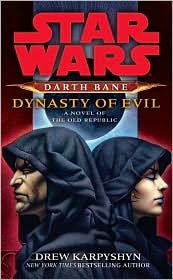
The Darth Bane trilogy occupies a specific place in Star Wars extended fiction, it is the work that gave the Rule of Two its flesh and its logic, that made the Sith doctrine something more than a plot device by tracing it back to the man who invented it out of necessity. I came to Dynasty of Evil having read the first two Drew Karpyshyn novels in print years before the audiobook era and revisited this final volume in audio form specifically to hear Jonathan Davis's narration of the conclusion. It holds up. Not just as a finale, but as a meditation on what legacy means when the only person who can carry it forward is also the person designed to destroy you.
The premise of the third book is essentially a trap with two sides. Darth Bane knows the Rule of Two demands that Zannah challenge and defeat him, that is the architecture of the Sith as he rebuilt it. But he also knows that he built it too well, and that Zannah's reluctance to move against him raises the possibility that he will have to seek immortality rather than train a worthy successor. Twenty years have passed since the order's reinvention. The clock is running on both of them. Karpyshyn makes this mutual awareness the engine of the plot rather than a background tension.
What Drew Karpyshyn Delivers
What Karpyshyn does with extraordinary efficiency is introduce multiple candidates for the role of Sith apprentice and use them to define, by contrast, what makes Zannah actually suited to succeed Bane. The Dark Jedi, the Iktotchi assassin, and Serra of Doan's hired killer all orbit the central power struggle, each one illuminating something about the criteria for Sith succession that pure exposition could not achieve as elegantly. Serra's storyline deserves particular mention: a character defined by childhood trauma and the need for vengeance against the Sith soldier who destroyed her father, she provides the book with its most human stakes in a narrative otherwise built around beings operating at the edge of human comprehension.
The quest for Darth Andeddu's holocron and its knowledge of Sith immortality drives Bane's private agenda through the book, and Karpyshyn handles the ancient-lore dimension of the Star Wars universe with the same careful attention to plausibility that distinguished his earlier work. The Sith cult sequences on the remote stronghold are among the trilogy's most interesting world-building, expanding what the dark side means as a living tradition rather than just a power system.
What Drew Karpyshyn Gets Right
Jonathan Davis is the gold standard for Star Wars audiobook narration across multiple entries, and his Darth Bane trilogy work is some of his finest. The Bane voice he established in the first book has developed over three installments into something fully inhabited, the cadence of a man who has rewritten the rules of evil and knows it, who carries certainty the way others carry doubt. His Zannah is differentiated effectively: cooler, more calculating, the intelligence working behind a different kind of stillness.
At nine hours and twenty-two minutes, the runtime is appropriately focused for a concluding volume. Karpyshyn does not pad the finale, and Davis respects that economy.
Where Drew Karpyshyn Loses Some Ground
The one review available for this audio edition calls it a fitting conclusion, which is exactly right and also somewhat summarizes the book's nature: it is structured toward an ending rather than discovery. Readers hoping for surprising revelations about the Sith cosmology or substantial world expansion may find the book more concentrated on its character confrontation than on mythology building. This is not a weakness so much as a genre choice, the trilogy was always about two people and the terrible logic of the order they inhabit.
First-time listeners to Star Wars extended fiction should be aware that Dynasty of Evil is the third book in a trilogy. Beginning here would mean missing the context that makes the Bane-Zannah confrontation emotionally significant.
Who Should Pick Up Dynasty of Evil
Fans of the Darth Bane trilogy who want the conclusion delivered with all the care Karpyshyn and Davis brought to the earlier books. Star Wars extended fiction readers who have not yet encountered this trilogy should start at Path of Destruction. Listeners drawn to the philosophical dimension of the Sith, the Rule of Two as a brutal but internally coherent doctrine, will find this the most fully developed treatment of that idea in the audiobook canon.
Is Dynasty of Evil accessible to listeners who have not read the first two Darth Bane novels?
Not really recommended as a starting point. The emotional weight of the Bane-Zannah confrontation and the logic of the Rule of Two both depend on the foundation built in Path of Destruction and Rule of Two. Start at the beginning for full impact.
How does Drew Karpyshyn handle the challenge of writing Sith characters sympathetically without sanitizing their worldview?
By taking the Sith doctrine seriously on its own terms. Karpyshyn presents the Rule of Two as internally coherent, a ruthless but logical response to the failures of the old Sith Brotherhood, which allows Bane to be understood without being excused.