The Short Version
- Read by: Kevin Pierce handles Jonah and the ensemble of the Elk Clan with a roughened, weathered register that suits the post-nuclear highway landscape without tipping into grim parody.
- At its heart: Leadership under conditions of catastrophic loss, inherited authority, survival communities under external pressure
- Vibe: Bleakly atmospheric with a propulsive narrative engine, built for sustained listening
- Short version: A five-book box set that delivers genuine narrative scope and a protagonist whose leadership arc earns the 35-plus-hour runtime.
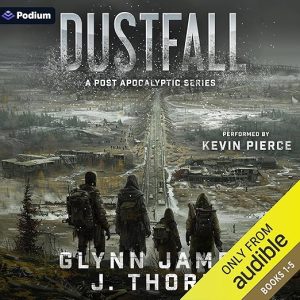
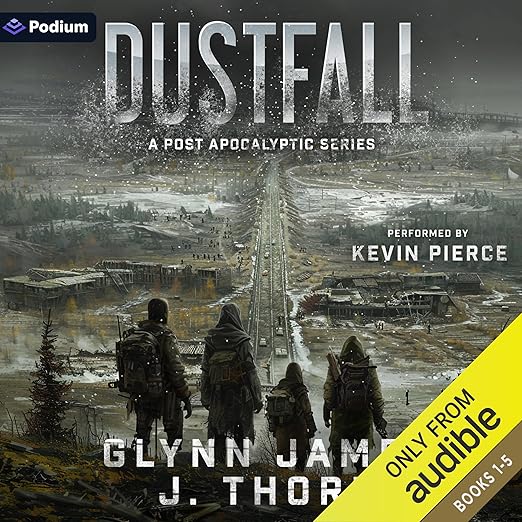
Jonah inherits the leadership of the Elk Clan from a father whose death is suspicious, whose inner circle doubts the son's ability, and whose clan is facing a winter migration of several hundred miles through ruined highway corridors controlled by feral gangs. That is where J. Thorn and Glynn James begin their five-book post-apocalyptic series, and Dustfall: A Post Apocalyptic Series, narrated by Kevin Pierce across 35 hours and 25 minutes, earns its scope precisely because the authors treat that opening premise seriously rather than as background texture. The complete series is collected in this single audiobook purchase.
The world here is years past nuclear destruction of the United States. What remains is a fragmented population organized into clans navigating ruins and surviving on whatever social structures survived the collapse. The Elk Clan's destination is the ruins of a place called Eliz, their winter shelter, and the journey toward it provides the physical infrastructure for the first book's plot. But the more interesting tension is internal. Jonah inherited authority he did not earn by accomplishment, and the members of his father's inner circle who question his fitness are not simply antagonists; they represent a legitimate structural problem that Jonah has to resolve rather than overcome. That political texture distinguishes this series from straightforward survival narratives, which tend to resolve leadership through demonstration of physical or tactical superiority. Jonah's arc is more complicated, involving the slow construction of credibility through a series of choices that cost him something.
The dark stranger who appears early in the narrative introduces a mystery thread that persists across the arc and pays off over the full five-book sequence. The clashes with feral gangs along the highway provide the action infrastructure. But the core of the series is the question of what makes a leader and what it costs to become one under conditions where every mistake is potentially fatal to the people depending on you. Reviewer Chuck described the series as immersive enough to make the reader feel present in the world, and reviewer K. Holmes noted the character development for secondary figures including Sasha, Judas, Seren, and Declan could have been deeper. Both assessments are accurate. The series prioritizes Jonah's arc over its ensemble, which is a deliberate structural choice with real trade-offs.
Highlights
Kevin Pierce is a reliable presence across long-form post-apocalyptic audio, and his weathered register suits the world Thorn and James have built. He handles the ensemble nature of the Elk Clan scenes without losing track of individual voices, which matters in a series where community politics are as important as external threats. At 35 hours and 25 minutes, this is a sustained listening commitment, but the five-book structure means the story builds genuine cumulative weight rather than cycling through variations of the same premise. The 4.6 rating across nearly a thousand listeners suggests the series' ambition translates to satisfaction for most of its audience. The epigraph, "With every light comes a shadow," announces the series' moral register accurately: this is not hopeful post-apocalyptic fiction in the redemptive mode, but it is not nihilistic either.
Things to Know Before Starting Dustfall: A Post Apocalyptic Series
The pacing criticism in the reviews is accurate for the middle books of the series, where the journey structure creates a sense of forward motion without consistent narrative acceleration. This is a common challenge in episodic post-apocalyptic fiction, and Thorn and James manage it unevenly across the five books. The first and final entries are the strongest in terms of urgency. Reviewer MBKehoe noted that the bunker subplot, involving a community with significant knowledge that could improve clan life, is not fully resolved by the end of the series. The story ends without closing that thread, which may read as an invitation to continuation or as an incomplete arc depending on your tolerance for open endings. The series does not continue beyond these five volumes.
Thorn and James wrote the Dustfall series with an understanding of how post-apocalyptic fiction earns its moral weight: not through the external dangers its protagonists face, though those are rendered with real tension, but through the quality of the choices made under pressure and the cost those choices exact. Jonah is not a natural leader who simply needs the right circumstances to prove himself. He is a man who had lived his entire adult life in the shadow of a father whose authority was taken for granted, and the discovery of what he actually believes about leadership, and what he is actually willing to sacrifice to lead well, is what the series is ultimately about. Kevin Pierce's narration supports this arc without melodrama. He gives Jonah's voice a specific texture of uncertainty in the early books that slowly changes as the character changes, which is the kind of longitudinal performance work that serialized audio fiction demands and that not every narrator provides.
Best Suited For
Recommended for post-apocalyptic genre readers who have found similar titles too focused on survival mechanics and not enough on the political and social texture of collapsed societies. Also for listeners who want a single continuous narrator across a full series arc and are willing to commit to five books rather than sampling a standalone. Skip if you want a tightly plotted, character-rich ensemble; the series' secondary characters are underwritten relative to the Jonah arc. Also skip if unresolved subplots are a dealbreaker; the bunker storyline does not receive full closure by the final book.
Before You Listen
Is Dustfall: A Post Apocalyptic Series audiobook a complete series, or does the story continue in additional books?
This box set contains all five books in the Dustfall series. However, some listeners note that a subplot involving a bunker community is not fully resolved by the end of the fifth book. The series does not continue beyond these five volumes, so that thread remains open.
How does the 35-hour audiobook hold together across five books, does the pacing stay consistent?
The pacing is strongest in the first and final books. The middle entries rely on a journey structure that can feel episodic. Kevin Pierce's consistent narration helps maintain cohesion, but listeners sensitive to pacing variability may find books two through four slower than the opener.
How does Kevin Pierce's narration serve the post-apocalyptic tone of this audiobook?
Pierce uses a weathered, grounded register that fits the world's bleakness without overplaying the grimness. He maintains character differentiation across the ensemble cast of the Elk Clan, which matters in a series where internal community politics are as important as external threats.