At a Glance
- Narrator: Edoardo Ballerini is credited, but the DUST anthology platform features ensemble casts including Corey Hawkins and Toni Collette across different seasons.
- Subjects: Speculative futures, anthology science fiction, AI and alien encounter
- Tone: Varied and atmospheric
- Bottom line: The DUST audio anthology brings original science fiction across multiple seasons and cast configurations, though prospective listeners should verify which specific season they are purchasing before committing.
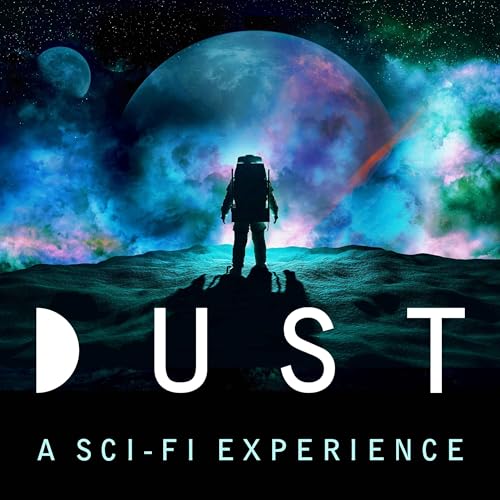
DUST, the science fiction audio anthology platform, arrives in audiobook form under a listing that also carries Hugh Howey's name and the title Dust. This creates a significant caveat worth addressing directly. The synopsis on record describes not Howey's Silo trilogy conclusion but rather DUST's streaming anthology productions across three distinct seasons: Season Three's Chrysalis, starring Corey Hawkins and Toni Collette, about an AI awakening after a genocidal alien encounter and setting off across the universe; Season Two's Flight 008, a collaborative anthology by eleven science fiction writers following a Tokyo-to-San Francisco flight that passes through a spacetime wrinkle to land in 2040; and Season One's Horizons, an anthology featuring stories from Philip K. Dick and Ray Bradbury alongside newer voices. Prospective buyers should confirm the specific product content before purchasing, as the listing appears to conflate a multi-season anthology platform with a novel of the same title. Edoardo Ballerini is credited as narrator. This review addresses the DUST anthology content as described in available records.
Philip K. Dick and Bradbury Anchor This Anthology
As a concept, the DUST anthology is built on a defensible premise about the relationship between science fiction and short form. The genre has always been at its most concentrated and inventive in short stories and novellas, where a single idea can be developed to its fullest extent without the obligation to sustain a world across hundreds of pages. Philip K. Dick's most celebrated work is primarily short fiction; Bradbury built his entire reputation in the same mode. The platform's curatorial instinct toward mixing those canonical voices with newer writers reflects the same philosophy that animated the great science fiction magazine era, that the genre belongs to no single generation and that its central concerns, consciousness, technology, time, and human adaptation, recur productively across every one.
Season Two's Flight 008 is conceptually the most ambitious of the three described, with eleven writers sharing a single premise and executing it in categorically distinct directions. That kind of constraint-based creative exercise produces uneven results by design, but the best entries in such collections often achieve things that standalone novels cannot: a concentrated intensity of imagination applied to a single problem from angles that no single author would explore alone. The AI-genocide revenge premise of Season Three's Chrysalis operates at a larger scale, more cinematic in conception and likely closer in execution to audio drama than traditional narrated audiobook given the cast of named film actors involved.
Ballerini's Range Meets Chrysalis's Full-Cast Drama
Ballerini is a narrator with considerable dramatic range, and his credit suggests at least some of the anthology's content is anchored by his performance rather than an ensemble cast reading. But the inclusion of actors like Corey Hawkins and Toni Collette in Season Three indicates the anthology operates closer to full-cast audio drama than to conventional single-narrator audiobook for at least part of its runtime. That distinction matters for listeners choosing between formats. Full-cast audio drama, when executed with the commitment that named film and television actors command, can deliver an immersive science fiction experience that single-narrator productions simply cannot match in terms of spatial and character differentiation.
The genre tonal range across three seasons is substantial, from Bradbury's humanist melancholy to an AI-driven intergalactic revenge epic, which means the anthology rewards exploratory listening rather than strictly sequential progression through the seasons. Listeners who have come from the audio drama world via podcasts or BBC Radio productions will find the DUST format a natural extension of that listening mode. Those who prefer the intimacy of a single narrator sustained across a complete story may find the anthology structure less satisfying, but that's a format preference rather than a judgment on the quality of individual entries within each season.
Season Three's Chrysalis Suits High-Intensity Listeners
The anthology format carries inherent inconsistency. Season One's Horizons, which draws on established masters alongside newer voices, will almost certainly vary in quality between entries, as every anthology does regardless of curation quality. The Philip K. Dick and Bradbury material arrives pre-validated by decades of critical attention, but the strength of the newer voices depends on selection choices that listeners cannot fully assess before beginning. Season Three's Chrysalis is the most cinematic of the three premises, with its intergalactic revenge narrative and named film actors, and listeners who prefer science fiction operating at large scale and high emotional intensity should start there. Season Two offers more room for tonal variation across its eleven writers, and listeners interested in how different creative minds handle identical constraints will find that structure the most analytically interesting of the three.
Silo Trilogy Fans Will Find a Different Book
Science fiction readers who love anthology collections and appreciate both classic voices and emerging work will find this format natural. Those who came expecting Hugh Howey's Silo trilogy conclusion should be aware that the content as described is categorically different from that novel. Listeners interested in the intersection of literary and genre science fiction, or in how different writers handle the same speculative premise, will find Season Two's Flight 008 particularly engaging. The full-cast drama element of Season Three makes that season the strongest entry point for listeners more accustomed to podcast drama or audio theater than traditional audiobooks. Anyone looking for an introduction to science fiction short fiction who wants production quality beyond raw text will find the DUST anthology a compelling access point into the genre's most concentrated and inventive storytelling tradition. At nearly eleven hours of combined material, it delivers substantial value for a format that has historically struggled to match the page-count and depth of print anthologies.
Good to Know
How does the audiobook handle the multi-season anthology structure across different formats?
Each season appears to be self-contained. Season Three follows a single AI narrative with named film actors, Season Two distributes one premise across eleven writers, and Season One is a broader anthology. The listening experience differs significantly across seasons in both format and tone.
Does the presence of actors like Corey Hawkins and Toni Collette mean this audiobook functions as audio drama?
At least for Season Three, yes. The cast credits indicate production closer to full-cast audio drama than conventional single-narrator audiobook. Listeners expecting a traditional narration format should review the production specifications for each season before purchasing.