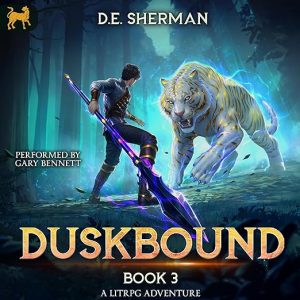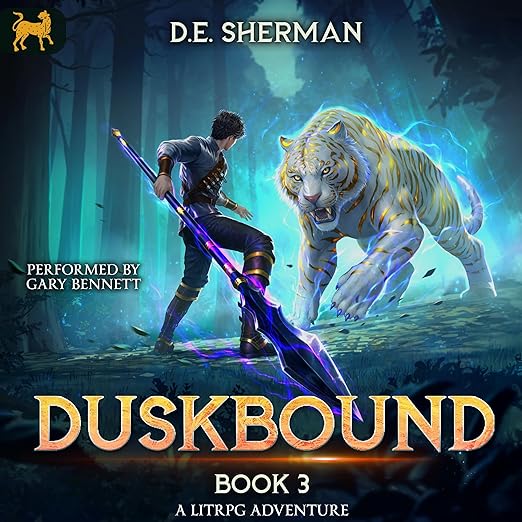
I came into Duskbound 3 having had the first two books described to me by someone who reads a lot of Royal Road progression fantasy, the kind of reader who has strong opinions about the difference between a system that respects the math and one that uses numbers as window dressing. She told me this series was worth the time. After listening to the conclusion, I understand why she said that, though I also understand the hesitations some readers bring to it.
D.E. Sherman's Duskbound began as a web serial on Royal Road, where it accumulated over two million views and seven thousand followers before professional publication. That origin matters for understanding what you are getting. Royal Road progression fantasy is a genre with specific conventions: a protagonist who grows in power through a defined system, enemies whose strength scales upward in ways that test that growth, and a world that reveals its underlying logic incrementally. Duskbound 3 is the culmination of that system, and the plot moves at the pace appropriate for a conclusion: urgently, with significant escalation, and with a willingness to answer questions that were seeded across the previous two volumes.
Where earlier entries focused on Velik navigating the dungeon system and the mysteries of the dungeon seeds, this volume expands the conflict to a cosmic scale. A divine beast stalks Velik's path, and its presence alone violates something called the Compact between the gods, which draws the divine tier of the world's power structure into direct conflict. Velik is empowered to act as their champion, which means the protagonist who was once a hunter of monsters now faces an immortal cabal that has ruled beyond the system's reach for thousands of years. These are the antagonists who have never been defeated, and the question the book poses and has to answer is whether Velik can win at that level without losing what makes him function as a character.
Reviewer Dee called it a whole new level in a very unexpected way and praised both the action and the worldbuilding, which aligns with what Sherman does best in this finale: the expansion feels earned rather than arbitrary. The author has been building toward this conflict, and the payoff is substantial. Reviewer Raef Aldrich, who binged all three books in under two weeks, describes the progression as super fun, which captures the addictive quality of a well-constructed progression fantasy series hitting its climax.
Why It Works in Audio
The four-star review from the reviewer identified as ms girl raises something worth addressing honestly: the first third of the book wanders before finding its footing. This is not an uncommon structural problem in Royal Road adaptations, where pacing was shaped by the rhythm of serial publication rather than novelistic structure. When a serial writer knows they need to fill a certain number of chapters before the next major plot development, the middle chapters can feel distended. In audio form, at seventeen hours and twenty-eight minutes, that early wandering is more noticeable than it might be in print. If you find yourself losing the thread around hours three through six, stay with it; the back half of the book is significantly stronger. The same reviewer noted that the ending felt somewhat unsatisfying for the protagonist, describing it as a raw deal even if it logically fits the world's internal rules. This reflects a legitimate debate about what a progression fantasy finale owes its readers in terms of protagonist reward versus thematic honesty, and reasonable listeners will disagree about which side of that debate Sherman lands on.
Before You Commit to Duskbound 3
Seventeen and a half hours is a significant commitment, and Gary Bennett's narration is the thing that makes it sustainable. He maintains energy across the full runtime without the kind of monotonous regularity that makes some epic fantasy audiobooks feel like endurance tests. His handling of the divine entities, who speak and move differently from the human and monster characters, is particularly effective. The escalating confrontations in the final act benefit from his ability to modulate intensity without losing clarity. For listeners who have followed Velik through the first two books, this closing volume with Bennett's performance feels like the right way to end the story.
Who Will Get the Most From It
For readers who discovered this series on Royal Road before the professional audiobook release, the question of what the editing process changed is relevant. Royal Road serials often have pacing rhythms that reflect the weekly or daily publication schedule, with chapter hooks designed to bring readers back rather than to serve the story's internal arc. The professional editing process typically smooths some of this, but the structural shape of a serial often persists into the final book. Duskbound 3 carries that heritage visibly in its first third. That is not a fatal flaw; it is a feature of the format. Reviewer Brian Komarny noted the series takes a different path than other stories in the genre, and that willingness to depart from convention is part of what makes the finale worth the investment despite its early pacing challenges.
For listeners who are new to progression fantasy as a genre and are considering this trilogy as an entry point, a word on expectations is useful. Progression fantasy, whether it originated on Royal Road, Wattpad, or in the web novel tradition, tends to prioritize systematic power growth and world-logic over character interiority and literary prose. Duskbound is a well-crafted example of the genre, but it is recognizably that genre: the pleasures are kinetic, the satisfactions are architectural, and the emotional investment comes from caring about Velik's progress through a system rather than from literary identification with a psychologically complex character. If that is what you are looking for, this trilogy delivers it with more care and consistency than most of its peers.
How does Gary Bennett handle the scope escalation in this finale, and does the narration match the stakes?
It does. Bennett adjusts his performance to the expanded stakes, and his handling of the divine-tier antagonists and the cosmic conflict differentiates this from the earlier, more ground-level confrontations in the series.
Is the pacing consistent across the full seventeen-plus hours, or are there slow stretches?
There are slow stretches, particularly in the first third, which several reviewers noted. The book finds its momentum and sustains it through the back half, but patience during the early chapters is worth the eventual payoff.