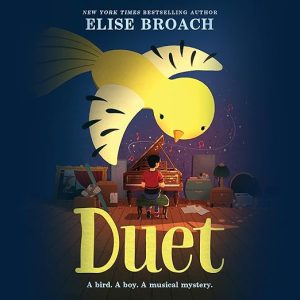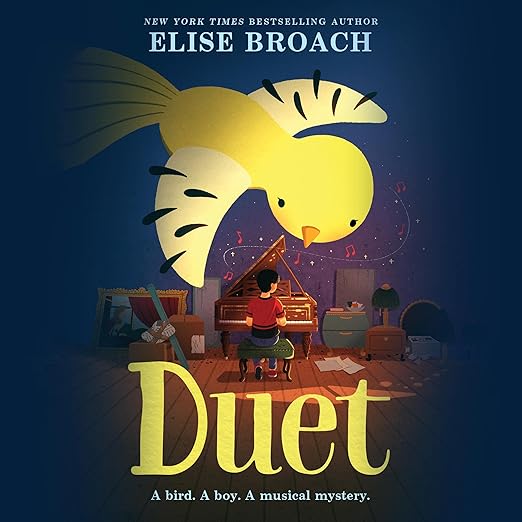
Elise Broach writes Mirabelle the goldfinch with the kind of precise interior life that children's literature at its best has always understood: this audiobook gives young listeners a bird who wants something so specific, to be heard as a musical talent rather than just a singing creature, that her frustration and her longing become immediately legible to any listener who has ever wanted recognition for something they cannot fully explain. Caroline Hewitt narrates, and her performance is one of the primary reasons this middle-grade mystery works as well in audio as it does on the page. The combination of a compelling animal protagonist, a genuine historical mystery, and a piano student with a performance block gives the novel more emotional range than its premise might initially suggest.
Two Kinds of Music-Making Find Each Other
The novel brings together three historical figures, Frederic Chopin, George Sand, and Eugene Delacroix, into a mystery centered on a lost piano that could be worth millions, and Broach handles the historical material with a light touch that informs without overwhelming. The Chopin Festival deadline gives the contemporary story its tension: Michael Jin, eleven years old and already recognized as a keyboard sensation, has not played a note in lesson after lesson at Mr. Starek's studio. His reluctance is the novel's initial mystery, and the way Mirabelle's singing breaks through it is the story's emotional hinge.
The goldfinch-and-piano-student friendship that develops is the book's real subject: two different kinds of music-making, one trained and resisting its training, one instinctive and seeking recognition, finding each other across the species divide. Broach is doing something more interesting than the premise's whimsy suggests. The novel respects the difficulty of both Michael's block and Mirabelle's ambition, and it does not resolve either easily. Emily, the human friend who joins the investigation of the lost piano, is a more conventionally drawn character but serves her function in the plot without becoming merely functional. Young reviewers have described it as impossible to put down, and the narrative momentum in the second half of the book earns that response. An eleven-year-old reviewer described Mirabelle as dreaming of stardom that 'seems as reachable as the moon,' which is exactly the emotional register Broach hits.
Caroline Hewitt Keeps Mirabelle Grounded, Never Precious
Caroline Hewitt's narration is particularly well suited to Mirabelle's voice, finding the right register for a character who is simultaneously confident in her talent and uncertain of her place. Hewitt does not make Mirabelle precious or over-cute, which is a real risk with animal-narrator fiction for younger readers. She keeps the goldfinch grounded in genuine feeling, and that grounds the listener's investment in her story. At seven hours and fourteen minutes, the audiobook is a full-length middle-grade experience that does not rush the mystery or the character relationships.
Family listening works well here: parents and children who listened together have noted the historical sections generating real conversation about Chopin, Sand, and Delacroix, which is exactly the kind of cross-generational engagement that the best children's historical fiction achieves. The mystery element, the lost piano with its connections to three nineteenth-century artistic figures, is well researched and cleanly integrated into the contemporary story without ever stopping the narrative to deliver a lecture. Hewitt maintains consistent pacing across both the contemporary scenes and the historical context sections, which is a real craft achievement in a book that moves between registers frequently.
Early Chapters Favor Mirabelle's Point of View
Listeners who are not drawn to animal-perspective fiction may find the opening chapters, which are primarily from Mirabelle's point of view, require some patience before Michael and Emily become more central. The novel earns its multiple perspectives as the story develops, but the early goldfinch-dominant narration is a specific taste that will land differently depending on the listener. The historical mystery also resolves with somewhat less complexity than adult mystery readers would expect, though this is appropriate calibration for the middle-grade audience rather than a structural weakness. The Chopin and George Sand content is accurate and interesting rather than deeply scholarly, which is the right balance for the intended readership.
Music Students Battling Performance Anxiety Will Relate
This audiobook is ideal for readers aged eight through thirteen with an interest in music, mystery, or historical fiction, and for family listening where the historical connection to Chopin, Sand, and Delacroix can spark broader conversation. Music students who are experiencing performance anxiety or resistance to practice will find Michael's story particularly resonant. Caroline Hewitt's narration makes this a strong audio experience, and the mystery's structure makes it a compelling choice for young listeners who need narrative momentum to stay engaged across longer listening sessions. Adults who enjoy high-quality middle-grade fiction will find this a satisfying listen regardless of age.
The historical connection the novel draws between Chopin, George Sand, and Eugene Delacroix is more than decorative. The three figures were, in their time, an unusual artistic triangle: Chopin and Sand in their well-documented relationship, Delacroix as a close friend who painted Sand and documented the social world they all inhabited. Broach uses this connection to show young readers that historical figures were people embedded in communities rather than isolated geniuses, which is a subtler lesson than most children's historical fiction attempts. The mystery of the lost piano becomes a way of asking what survives of a life, and what gets preserved by the people who cared about the person who created it. Mirabelle and Michael's investigation is a lesson in how the past stays present through objects and relationships, delivered at exactly the right speed for the age group.
Frequently Asked Questions
What age range is this audiobook best suited for?
The primary audience is readers aged eight to thirteen, but the historical content about Chopin, George Sand, and Delacroix and the quality of the writing make it engaging for adults listening alongside children.
Does this audiobook require any background knowledge of classical music?
No prior musical knowledge is needed. Broach introduces the Chopin connection naturally through the story, and the historical figures are explained in age-appropriate context. Music students will recognize more, but the book works without that background.
Is Duet part of a series, or is it a standalone audiobook?
Duet is a standalone novel. It does not require prior reading and the mystery resolves completely within this single book.
How does the audiobook handle the shift between Mirabelle's perspective and the human characters?
Caroline Hewitt maintains a consistent narrative register across the perspective shifts rather than dramatically differentiating voices, which keeps the story flowing without calling attention to the structural transitions.